
Title: Near-future rocket launches could slow ozone recovery
Authors: Laura E. Revell, Michele T. Bannister, Tyler F. M. Brown, Timofei Sukhodolov, Sandro Vattioni, John Dykema, David J. Frame, John Cater, Gabriel Chiodo, Eugene Rozanov
First Author’s Institution: School of Physical and Chemical Sciences–Te Kura Matū, University of Canterbury, Christchurch, New Zealand
Status: Published in npj Climate and Atmospheric Science [open access]
Astronomy relies on the status and health of Earth’s atmosphere. Each year, an increasing number of satellites are launched to the outermost layers of our atmosphere, where they continuously orbit the planet and gather data for various purposes. Ground-based observatories, such as the Vera C. Rubin Observatory, depend on a clear atmosphere for unobstructed observations. These satellites, however, can interfere with the telescope’s “vision” by reflecting sunlight toward Earth’s surface, appearing as artifacts in the data. Radio astronomy is similarly impacted by emissions from certain satellites. Altogether, the presence of satellites influences the quality of astronomical data and research.
Driven by modern technology and the need for larger spatial ranges of data, satellite design has shifted towards networks of satellites that operate in tandem–known as “constellations”. The physical size of the satellites in these networks can vary; smaller satellites, often referred to as SmallSats or CubeSats, are designed with shorter lifespans of 5-10 years. They are relatively inexpensive, making them easier to replace. Starlink satellites, which are designed and deployed by SpaceX for use as a global Internet network, can be quite large, with some current models as massive as ~1,250 kg (~2,800 lb) and some future models as massive as ~1,400 kg (~4,200 lb). (Starlink satellites also currently compose about 75% of all satellites in orbit.) At the ends of their lives, these satellites are often crashed into the lower, denser parts of Earth’s atmosphere and break into pieces. More satellites necessitate more replacements, which necessitate more rocket launches. As technology continues to advance and development costs decrease, the number of launches is expected to increase to keep up with demand. While there are certainly scientific benefits to these satellites, we need to be aware of the environmental costs.
Earth’s atmosphere has multiple layers; the layer second from the surface is the stratosphere. Within the stratosphere lies the ozone layer, which is a blanket of molecules composed of three oxygen atoms (O3) each. This layer acts like a natural sunblock for the biosphere, shielding us and all other living things from harmful UV radiation, the same radiation that causes sunburns. In the 1970s, scientists discovered that specific molecules called chlorofluorocarbons (CFCs) found in common household appliances, like refrigerators and air conditioning units, and even hairspray, were chemically interacting with the ozone layer and eroding it away at a concerning rate. In a moment of global cooperation, many countries agreed to ban most CFCs and halocarbons, reducing the harm brought about by these molecules. Since then, the ozone layer has been gradually recovering, although future progress depends on greenhouse gas emissions. For example, between 1996 to 2020, the near-global total ozone increased at a rate of ~0.3% per decade–a noticeable amount given the vast size and scale of the stratosphere.
How do these satellites and rocket launches affect Earth’s health and the ozone layer? First, as previously mentioned, satellites often become space debris at the end of their lives. Most of this debris scatters throughout the atmosphere, and the long-term impacts are still not fully understood, although they’re likely not positive. Second, the propellants used in rocket launches produce emissions. Some common propellants are kerosene (which is often used to power jet planes) and cryogenic fuels. Depending on the fuel type, emissions might include carbon dioxide and water vapor (two important greenhouse gases), black carbon and alumina (Al2O3) particulates, and other compounds.
The authors of today’s (Beyond) paper explore two scenarios–one more pessimistic and one more optimistic–about how these increasing rocket launches will affect our global efforts at combating climate change.
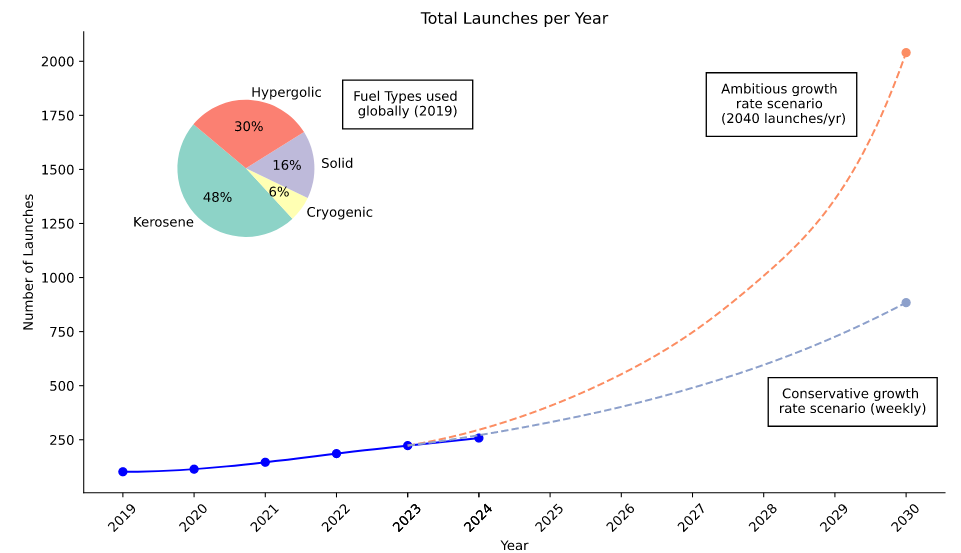
To explore the impact of these emissions, the authors focused on two scenarios they refer to as “ambitious” and “conservative” (see Fig. 1). The ambitious scenario is meant to reflect a high demand with a continuously increasing rate for rocket launches at 2,040 launches per year. This value lines up with a legal mandate in New Zealand, which caps the number of launches at one per 72 hours. The estimated total number of launches per year is then calculated by extrapolating based on the number of launch sites globally. The conservative scenario is meant to reflect a reduced demand of 884 launches per year. In five years, for example, anywhere between ~4,500 to ~10,000 satellites might be added to the atmosphere. That’s a lot considering the atmosphere currently hosts around 12,000 satellites.
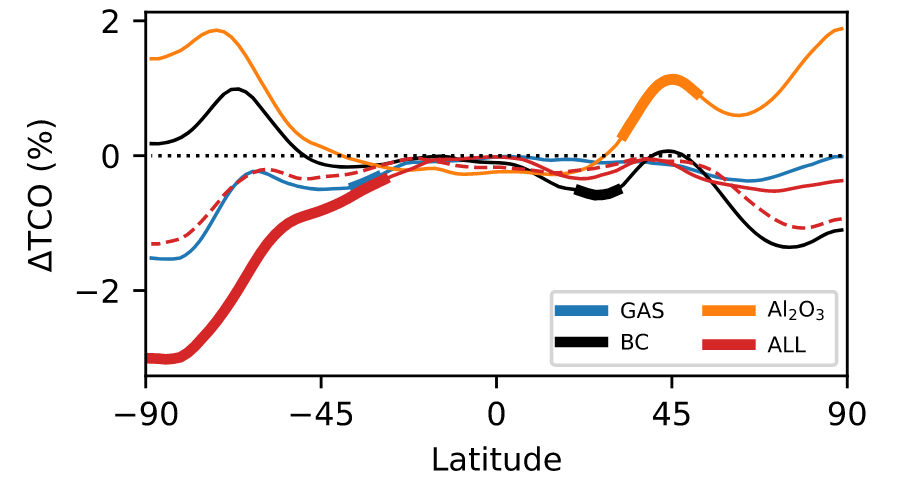
The authors then performed simulations to see where the emissions from these rocket launches concentrate and the impact of their emissions on the ozone layer (see Fig. 2). Because the vast majority of launch sites are located in the Northern Hemisphere, black carbon and alumina produced from launches at these sites are typically transported to the Southern Hemisphere by atmospheric circulations. The same can be said for chlorine produced from solid rocket motor propellant, which is used in the vehicles/boosters that launch these rockets. They find that black carbon causes ozone loss, and the simulations show that in the ambitious scenario, ozone can decrease by up to 1.5% in the upper stratosphere. Alumina, by comparison, does not have a significant effect when considering launch emissions. In terms of ozone depletion, the ambitious scenario suggests a depletion rate of -0.29% globally (with Antarctica specifically receiving a rate of -3.9%). The conservative scenario gives a global depletion rate of -0.17%. Both scenarios from this work indicate that these launches would roll back progress on restoring the ozone layer. It is additionally important to note that this work does not account for emissions caused by reentry, which some studies indicate may be a significant additional source of alumina emissions.
These results suggest that some level of international coordination will be needed to limit the global impact of these rocket launches. Such coordination could include varying the different fuel types used (to reduce the effects of the worst offenders) or limiting the rate of launches at each site. (For example, Fig. 2 suggests that some propellants might increase the ozone density.) One important note, however, is that this work assumes that we, as a global community, continue on our current pace of development. This might not be the case; major global events might prevent launches for a significant time, as they have in the past (looking at you, coronavirus). Ultimately, we cannot predict the future. Instead, what we can do in the present is prepare ourselves for what’s next by further studying the impacts of these launches and collaborating on ways to shape future technology to mitigate their harmful effects.
Author Correction: An earlier version of this Bite implied that most of the satellites in orbit were SmallSats. This is not true, as most (~75%) in orbit are large Starlink satellites.
Astrobite edited by Catherine Slaughter
Featured image credit: Mckenzie Ferrari (made in Canva)
