
Paper Title: The Noctua Suite of Simulations – The Difficulty of Growing Massive Black Holes in Low-Mass Dwarf Galaxies
Authors: Jonathan Petersson, Michaela Hirschmann, Robin G. Tress, Marion Farcy, Simon C. O Glover, Ralf S. Klessen, Thorsten Naab, Christian Partmann, David J. Whitworth
First Author’s Institution: Institute for Physics, Laboratory for Galaxy Evolution and Spectral Modeling, Ecole Polytechnique Fédérale de Lausanne, Observatorie de Sauverny, Versoix, Switzerland
Status: submitted to Astronomy & Astrophysics [open access]
Big Black Holes and Little Galaxies
Astronomers believe there is a massive black hole – a black hole that is hundreds of thousands of times more massive than the sun or more – at the center of nearly every known galaxy. This includes low-mass galaxies like some dwarf galaxies, which are often only about a billion solar masses (for reference, the Milky Way is thought to be well over 100 billion solar masses). Dwarf galaxies sometimes orbit other galaxies – the Milky Way itself has dozens of dwarf galaxies orbiting it!
One common finding is that these central black holes tend to be more massive in more massive galaxies, meaning that dwarf galaxies tend to contain smaller central black holes. Astronomers believe that studying the central black holes in dwarf galaxies could provide key insights into the growth of massive black holes, providing crucial information about how some of the largest black holes got to be so massive.
The primary ways that black holes grow are via accretion and via mergers with other objects (including other black holes). In order for a black hole to accrete, there needs to be a sufficient supply of gas near the black hole. However, feedback from hot, young stars and from supernova explosions can serve to disrupt the supply of gas to central black holes. Today’s authors investigate the effects of both of these feedback mechanisms on how massive black holes grow in environments like dwarf galaxies.
Modeling Growth and Feedback
The authors set up a numerical simulation of a massive black hole with a mass of 10 thousand solar masses inside a dwarf galaxy with a mass of 20 billion solar masses. They model the gravitational interactions of the contents of the dwarf galaxy, including dark matter, gas, stars, and the central black hole. They consider the chemistry and cooling of the gas in the dwarf galaxy, which is important for both star formation and accretion onto the central black hole. The authors also model star formation by simulating the formation of small clusters of stars since they do not have the resolution to model individual stars.
Today’s authors consider two important types of stellar feedback: feedback from supernova explosions and feedback in the form of ionizing radiation from hot, young stars. For supernova feedback, they assume that a sufficiently massive star will end its life as a supernova, which transfers energy and momentum into the surrounding gas. For ionizing radiation, they model the emission of this kind of radiation from O- and B-type stars based on their expected surface temperatures and radii. This radiation ionizes hydrogen in the surrounding gas, causing it to heat up. The authors perform one run without any feedback, one run with each type of feedback, and one run with both types of feedback.
For accretion onto the central black hole, they determine which cells of gas are gravitationally bound to and flowing towards the black hole. The black hole is expected to accrete a small portion of mass from these cells at every timestep. Since the authors do not have the resolution to model the accretion disk, they assume that the mass accreted from these cells forms a reservoir of gas around the black hole, some of which moves into the accretion disk at every timestep, and that some of the material in the accretion disk is then consumed by the black hole at every timestep. This process is shown in Figure 1.

The Role of Feedback
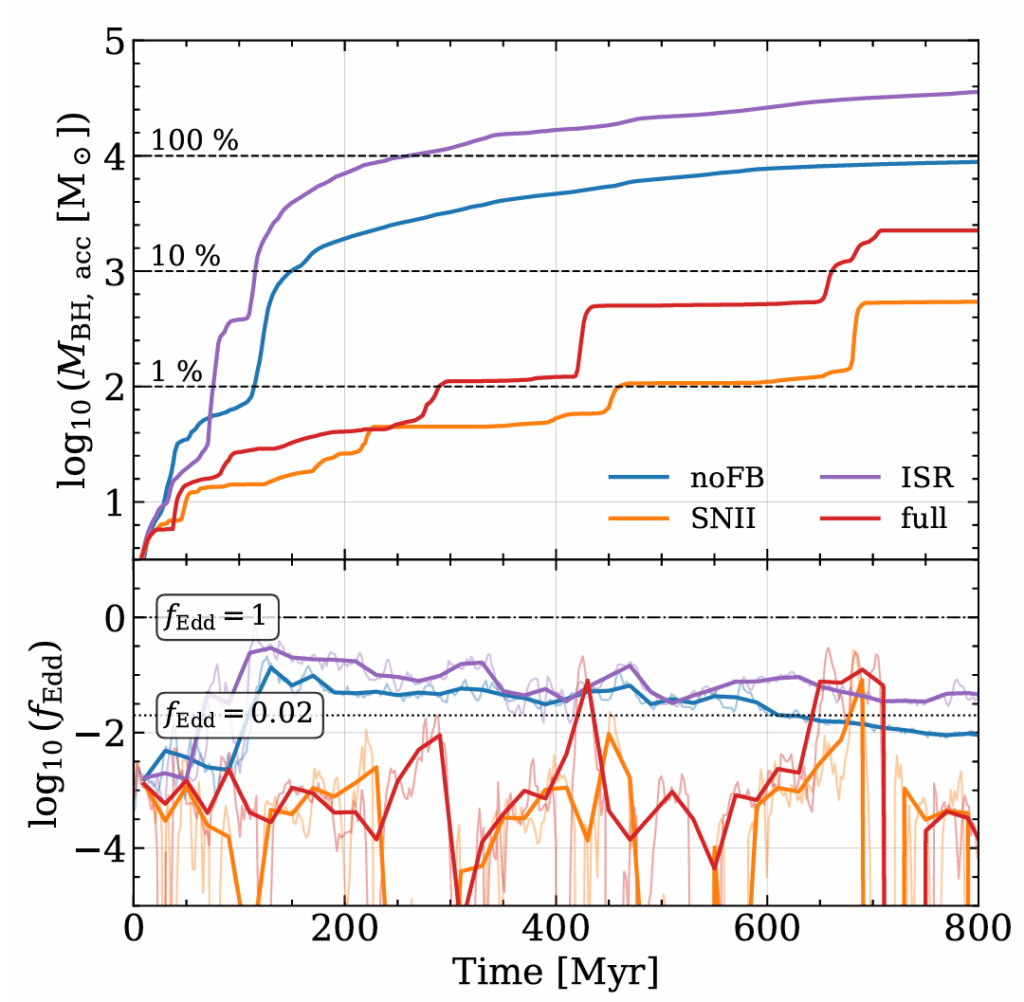
The main results from the runs investigating feedback are shown in Figure 2. Without any feedback, the black hole accreted about 100% of its initial mass, meaning that it roughly doubled in size. Interestingly, including ionizing radiation but not supernovae increased how much material the black hole accreted relative to the run without feedback (up to about 400%)! We’ll get to why in a moment. When only supernova feedback is considered, the black hole accretes significantly less material relative to the run without any feedback, increasing its mass by less than 10%. When both types of feedback are included, these competing effects lead to less growth overall, with the black hole accreting about 25% of its initial mass.
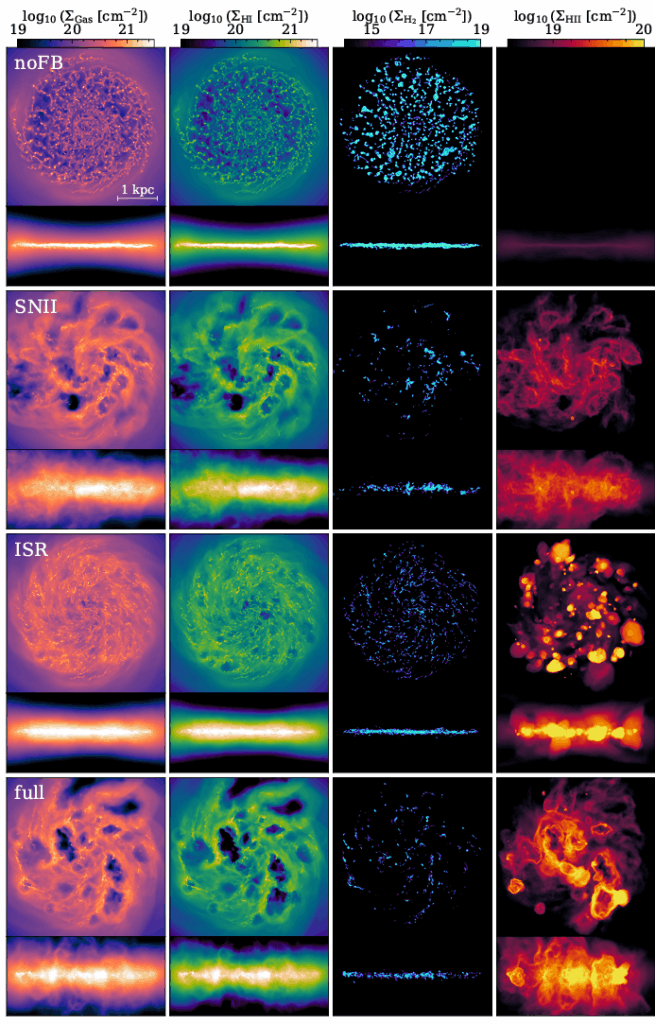
To truly understand the results in Figure 2, we turn to the visualizations of the gas in the dwarf galaxy for different runs shown in Figure 3. In these plots, we see that the models with supernova feedback have larger cavities of gas and significantly less molecular hydrogen, which is important for gas to lose energy and move towards the black hole; both of these effects disrupt the supply of gas to the black hole, which is why we get less accretion. Conversely, when just ionizing radiation is considered, the gas tends to be less clumpy than when no feedback is considered. Because of this, a larger fraction of all the gas in the galaxy resides in the interstellar medium (ISM), which means that there is more material available for the black hole to accrete.
Clearly, the effects of feedback within a galaxy can have a significant impact on the growth of massive black holes, even in a galaxy as small as a dwarf galaxy. Other feedback mechanisms also exist, such as feedback from other types of supernovae, from stellar mass black holes that accrete material in the galaxy, and even the central black hole itself! While studying the impacts of all of these mechanisms at once is extremely difficult since they occur on such different scales, continuing to study their effects on black hole growth will provide more insights on the growth of massive black holes in both the local universe and the early universe.
Astrobite edited by Katherine Lee
Featured image credit: Figure 1 from today’s paper
