
Title: Building up JWST-SUSPENSE: inside-out quenching at cosmic noon from age, Fe-, and Mg-abundance gradients
Authors: Chloe M. Cheng, Martje Slob, Mariska Kriek, Aliza G. Beverage, Guillermo Barro, Rachel Bezanson, Anna de Graaff, Natascha M. Förster Schreiber, Brian Lorenz, Danilo Marchesini, Ignacio Martín-Navarro, Adam Muzzin, Andrew B. Newman, Sedona H. Price, Katherine A. Suess, Arjen van der Wel, Jesse van de Sande, Pieter G. van Dokkum, Daniel R. Weisz
First Author’s Institution: Leiden Observatory, Leiden University, P.O. Box 9513, 2300 RA Leiden, The Netherlands
Status: Submitted to Astronomy & Astrophysics [open access]
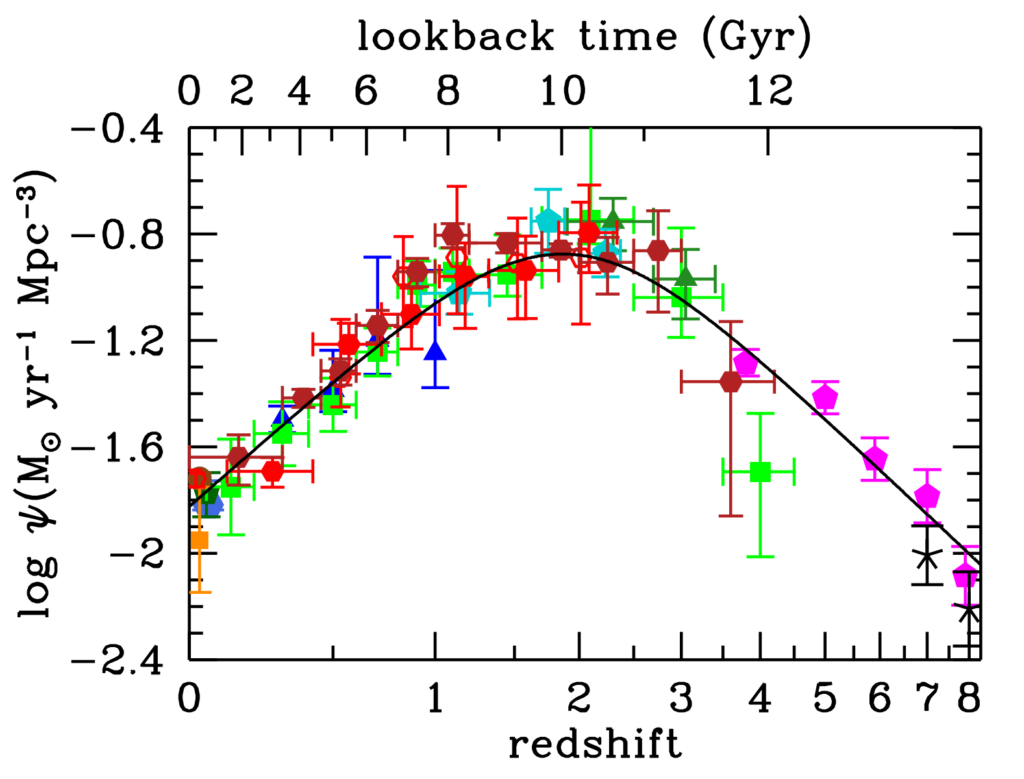
Ten billion years ago, star formation in the Universe reached its peak, a time we now call “Cosmic Noon” (see Figure 1). The Universe around us is now filled with massive elliptical galaxies which are no longer forming stars. Some process had to occur between Cosmic Noon and today to “quench,” or shut off, star formation in these massive galaxies. The exact cause—or causes—of quenching is still one of the great questions of galaxy evolution.
How do galaxies quench?
The authors of today’s paper use the James Webb Space Telescope to distinguish between two quenching pathways in massive galaxies. The first is “inside-out” quenching. Under this model, galaxies begin by forming a tight core of stars, and then they form more stars in their outskirts. Eventually, the fuel for star formation runs out in the core, leading to quenching; this process spreads outward to the outskirts of the galaxy, leading to an older stellar population in the center than in the outskirts.
In the second pathway, galaxies quench from the outside-in. This process starts when two galaxies merge, driving gas into the galaxy core. The gas in the core forms stars very quickly in a process called a “central starburst,” while the outskirts are depleted of gas and stop forming stars. Eventually, the gas in the core runs out, and the galaxy quenches. Under this scenario, massive ellipticals should have a young core and older outskirts.
So which of these scenarios occurs more often? To find out, today’s authors study differences in stellar age in the cores and outskirts of galaxies that quenched just after Cosmic Noon.
Finding old stars in massive galaxies
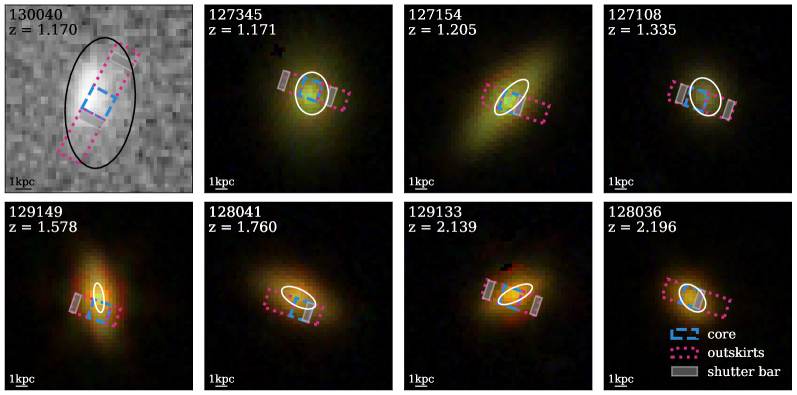
The authors begin with a sample of eight massive galaxies just after Cosmic Noon which are no longer forming stars (shown in Figure 2). They use two properties to test different quenching pathways in these galaxies: stellar population age and metallicity. Stellar population age is fairly straightforward—when did most of the stars in a particular region of the galaxy form? Since we’re interested in how these galaxies quenched, it’s useful to know whether the stars in the core are older (as we’d expect for inside-out quenching) or younger (outside-in quenching) than those in the outskirts.
So why do they care about metallicity? Metallicity refers to the amount of “metals” (in astronomy, any element heavier than helium) in a galaxy, usually represented in reference to the amount of hydrogen (for example, [Fe/H] is a measurement of the ratio of iron to hydrogen). Metallicity is an indirect measurement of how long star formation has been happening in a galaxy, since stars convert hydrogen into heavier elements and then recycle those heavier elements into a galaxy’s gas reservoir when they die (for example, via supernova explosions). Metallicity can also impact age measurements via something called the “age-metallicity degeneracy,” since both older stellar populations and high-metallicity stellar populations will appear redder in galaxy imaging. For the purposes of this study, the authors need metallicity measurements both to break this degeneracy and to understand the long-term star formation in these quiescent galaxies.
Throughout the paper, the authors use three elemental abundance ratios to keep track of metallicity. [Fe/H] is a common measurement of metallicity. The presence of magnesium indicates that stars have had time to deposit heavier elements into the gas in a galaxy, so the authors use [Mg/H] to make inferences about the relative time it took for stars to form and for gas to deplete from different parts of the galaxy. [Mg/Fe] can also be used to infer the star formation history of a galaxy, where higher [Mg/Fe] indicates a longer period of active star formation. They compare these three measurements of [Fe/H], [Mg/H], and [Mg/Fe], as well as the stellar population age, between the core and outskirts of massive galaxies to determine whether they quenched from the inside-out or from the outside-in.
Results
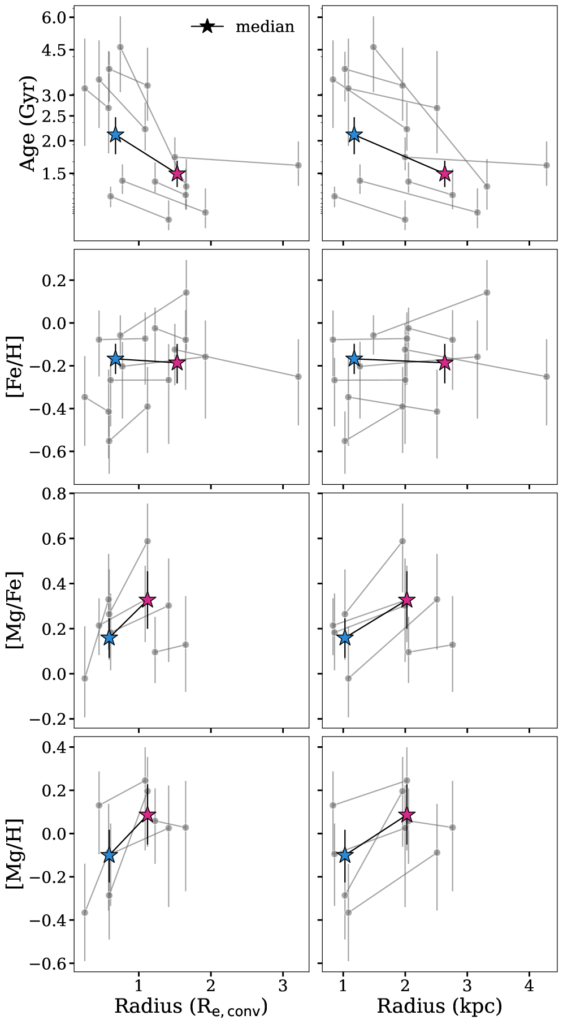
The authors find that these massive quiescent galaxies have older stars in their core than in their outskirts. They also have a similar [Fe/H] between the core and the outskirts, indicating that there’s no significant difference in metallicity between the core and outskirts of massive galaxies at Cosmic Noon. Interestingly, they find on average lower magnesium in the galaxy cores than in their outskirts, which may tell us something about the origins of the stellar populations in each. Figure 3 shows each of these measurements for the core versus the outskirts.
They compare these results to previous results around Cosmic Noon, which show a variety of stellar age and metallicity gradients. They point out that this may be due to the small sample sizes in these works, including their own—very few massive quiescent galaxies at Cosmic Noon are bright enough to perform this kind of study. In the more local Universe, many quiescent galaxies have flat age gradients and negative metallicity gradients (higher metallicity in the core than outskirts), in contrast to their results. They suggest that this occurs because quiescent galaxies in the local Universe have had time to merge with smaller galaxies, depositing older stars with lower metallicities onto the outskirts of massive galaxies. Small quiescent galaxies in the local Universe which may not have experienced these minor galaxy mergers have more similar stellar age and metallicity properties to the galaxies in this study.
So how did they quench?
The authors suggest that they are seeing evidence for inside-out galaxy growth or inside-out quenching. They suggest that the low [Mg/Fe] in the galaxy core might have occurred due to gas being expelled from the center of the galaxy very quickly during the quenching process, preventing heavier elements from being recycled into new stars. Outflows from active galactic nuclei could potentially explain rapid quenching in and the removal of gas from galaxy cores. However, this theory is in conflict with the flat [Fe/H] gradients they observe, since under this model, iron should also be depleted in the galaxy core.
Importantly, these results disfavor outside-in quenching. This is the opposite of what has been found with other galaxies which quenched more recently, possibly indicating that different mechanisms are important for quenching star formation at different points in cosmic history. Future studies with larger samples of quenched galaxies will be key to understanding when inside-out and outside-in quenching were dominant, and a new generation of sensitive, high-resolution telescopes will be necessary to perform those studies.
Astrobite edited by Hillary Diane Andales
Featured image credit: NASA, ESA, and The Hubble Heritage Team (STScI/AURA); J. Blakeslee (Washington State University)
