
Title: Galactic forcing increases origination of marine microplankton
Authors: Péter Ozsvárt, Emma Kun, Imre Bartos, Zsolt Gy. Márka, Szabolcs Márka
First Author’s Institution: HUN-REN-MTM-ELTE, Research Group for Paleontology, PO BOX 137, 1431 Budapest, Hungary
Status: Accepted for publication in Paleoceanography and Paleoclimatology [preprint open access on arXiv]
Our oceans are right now teeming with life of all shapes and sizes. Our modern Earth has, for example, the largest animal to have ever lived (the Blue whale) while simultaneously a plethora of tiny critters that have been here with us through thick and thin: marine microplankton. Microplankton are simple organisms that have existed for hundreds of millions of years, driving the marine food chain, yet they lack the strength to swim against the oceanic current. Today’s authors posit that microplankton that favour the warm and sunny upper layers of the ocean are prime target practice for the high-energy cosmic rays bombarding our Earth.
All known instances of microplankton are here on the planet Earth, which orbits happily around the Sun every year. In contrast, the Sun, and indeed the rest of the Solar System, moves through the gravitational potential of the Milky Way with a period of roughly 230 million years. Figure 1 shows, though, that the path of the Sun through the Galactic disk is anything but regular; the Sun’s motion oscillates above and below the Galactic plane several times per Galactic orbit, with a period of approximately 63.5 million years. To soar above the Galactic plane is to leave behind much of the drama associated with living among the stars, but it brings with it different terrors altogether: cosmic rays.
Cosmic rays are some of the highest energy particles in the Universe, with some even having the kinetic energy of a pitched baseball, all the while taking up roughly the same amount of space as a proton. These electrically charged, high-energy particles are produced through a variety of mechanisms, both from processes within our own Galaxy and those extragalactic. When the Sun, and by association the Earth, are embedded well within the Galactic plane, there is a lot of ‘stuff’ – dust, magnetic fields, and gas – that can block or divert the path of cosmic rays that may have otherwise had a collision course with our friendly atmosphere. But since we’ve established that the Sun peeks out of the Galactic plane twice every 63 million years, Earth is periodically subjected to an increased flux of cosmic rays. What does that mean for our ocean’s sitting duck– er, microplankton?
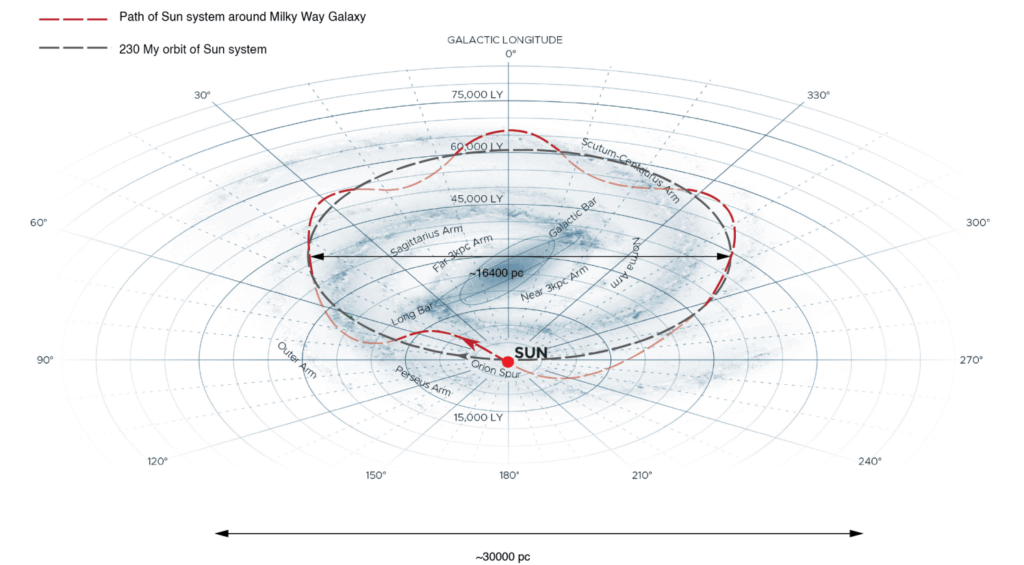
Figure 1: The Sun (red point) traces a warped ring as it moves through the Galactic potential of the Milky Way. For every Galactic orbit, the Sun moves above and below the Galactic plane roughly 4 times, due to the spatial distribution of mass in the Milky Way. Source: Figure 1 in today’s paper (right).
When a high-energy cosmic ray impacts the molecules in our atmosphere, it creates a cascade of lower energy particles that race down to the Earth’s surface below. Figure 2 shows this, where charged muons can make their way to the surface while retaining a considerable fraction of their progenitor cosmic ray’s energy. Once there, these muons (and their electron decay products) can interact with and damage the DNA of organisms like microplankton. Once a strand in DNA (for example) is broken, there are biological processes that attempt to repair said strand. As this occurs, there is a chance that the chemical makeup of that strand may be incorrectly replicated, resulting in a genetic mutation. Once enough of these mutations occur, entirely new species of organisms arise.
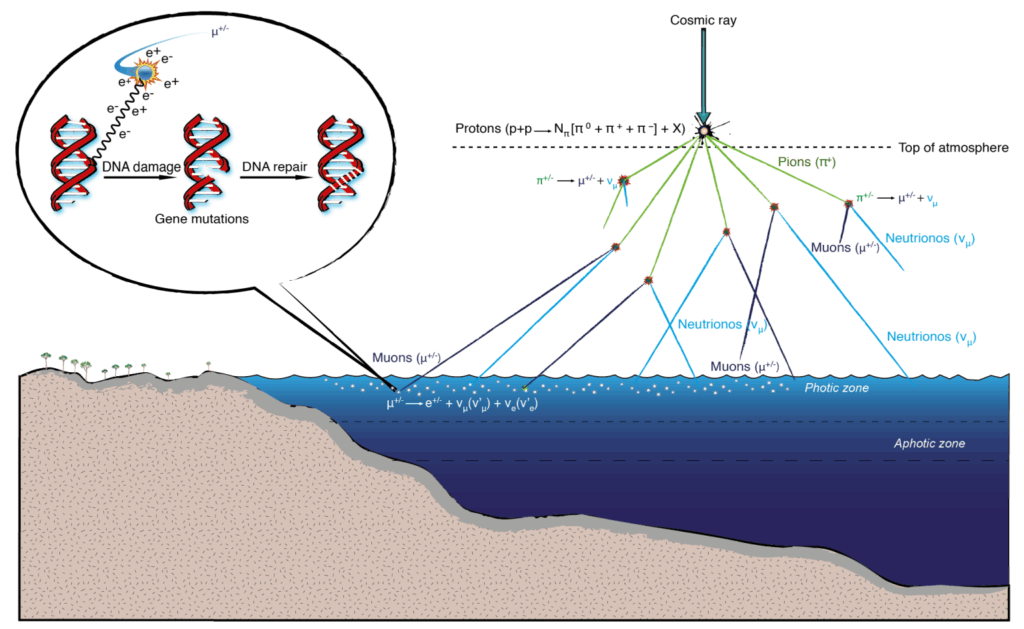
Figure 2: High-energy cosmic rays impacting the top of the atmosphere create a cascade of slightly lower energy, possibly charged particles that make their way down to the Earth’s surface. Once reaching the surface, these particles can interact with the DNA of organisms at the surface or even under a thin layer of water, leading to DNA damage, subsequent repair, and mutation. Source: Figure 6 in today’s paper.
If cosmic rays are to be linked to genetic mutations, and mutations to speciation, then we should expect to see explosions in the number of new microplankton species when the Earth is subjected to a higher radiation environment. Today’s authors find exactly this, using statistical tests to compare the number of species in the fossil record of four groups of microplankton against the backtraced motion of the Sun through the Galaxy (Figure 3). They find, to 3.72 sigma, that the vertical position of the Sun with respect to the Milky Way’s disk correlates strongly with the emergence of new microplankton species – almost every time the Sun changes course back into the disc, new species of microplankton flourish to watch the show.
While oscillations in the cosmic ray flux may be the primary cause of this repeating speciation, the authors note that it probably isn’t the only factor. In particular, they cite an explosion in radiolaria species during the Middle Triassic – a period in which the strength of Earth’s magnetic field was especially low (and hence the barrier against electrically charged cosmic radiation, from the Sun or elsewhere, was weakened).

Figure 3: The oscillation of the Sun above and below the Galactic plane seems to, at least visually, coincide with peaks in the number of emerging microplankton species. The top panel shows the vertical position of the Sun with respect to the Milky Way disk, where vertical dashed lines corresponding to peak vertical extent extend over both plots. The bottom panel shows the emergence of four different types of microplankton over the last 500 million years, with an apparent relationship with the vertical extent of the Sun. Source: Figure 2 in today’s paper.
The goings on in the broader Universe have always and will continue to impact life here on Earth. Whether it’s comets bringing water to fill Earth’s oceans, asteroids bringing extinction to a certain family of avian ancestors, or now cosmic rays fueling the proliferation of marine microplankton, our place on Earth is constantly changed by physics happening on a larger scale. Hence to understand the fossil record and what it says about the prehistoric diversity of life, we must look to the stars (or at least our Sun’s journey through them).
Astrobite edited by Will Golay
Featured image credit: Ryan White

The figures shown do not correspond to the figures in the paper.
Thanks for pointing this out Bernard! I have fixed this now.