
Paper Title: ALMA Reveals an Eccentricity Gradient in the Fomalhaut Debris Disk
Authors: J. B. Lovell, E. M. Lynch, J. Chittidi, A. A. Sefilian, S. M. Andrews, G. M. Kennedy, M. MacGregor, D. J. Wilner, M. C. Wyatt
First-author institution: Center for Astrophysics, Harvard & Smithsonian, 60 Garden Street, Cambridge, MA 02138-1516, USA
Status: The Astrophysical Journal, Volume 990, Issue 2, id.145, 18 pp. (Open Access)
Step 1: Understanding how to carve your debris disc
Let’s start with our solar system – the Kuiper belt, a large ring of icy asteroids, is believed to have been sculpted by Neptune into shape. Neptune may have previously scattered objects in the Kuiper Belt through gravitational interactions, but some of them (like Pluto) remain in an orbital resonance with Neptune. In the same way that Neptune shapes the Kuiper Belt, today’s authors believe a planet could be shaping an exo-Kuiper Belt around the star Fomalhaut.What on Neptune is an orbital resonance, though? A planet orbiting a star has an orbital period, and the gravitational forces between (astronomically speaking) nearby objects can push these objects into a state where their orbital periods are multiples of each other. For example, Pluto and Neptune have a 2:3 orbital resonance, meaning Pluto completes 2 orbits for every 3 that Neptune does. The same can happen for the asteroids and planetesimals in the Kuiper Belt, so the same should happen in other star systems!
Step 2: Make your observations
If we understand how debris discs carved by exoplanets look – and we think we do – then we should be able to infer the existence of exoplanets! Today’s authors have used observations from the Atacama Large Millimetre Array of the debris disk around Fomalhaut and made some very clever calculations. We’ve known about this disk for a while, which is why today’s authors have studied with a new analysis technique they developed.
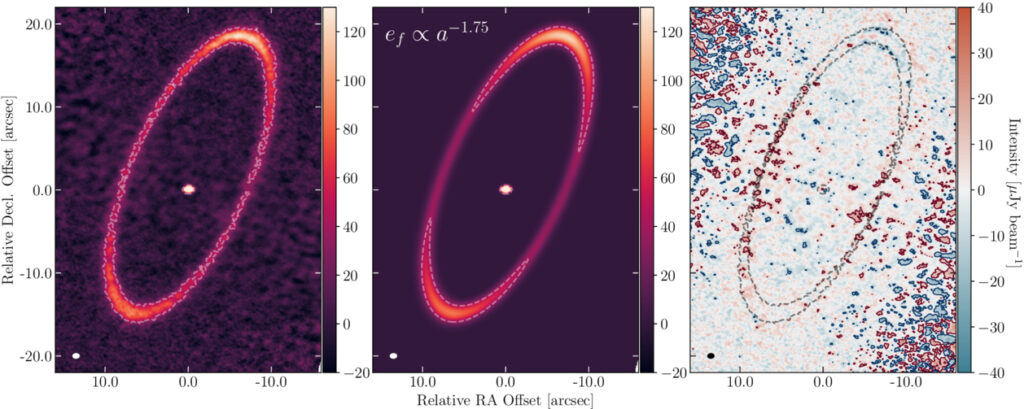
Planeteismals – basically big rocks from a few to hundreds of kilometers across – that orbit in this disc have an eccentricity, and typically things in the same orbit would have the same eccentricity. But today’s authors were clever – they checked if there was an eccentricity gradient, meaning the planetesimals’ eccentricities depend on their semi-major axis (i.e. the mean orbit radius); we would typically not expect any eccentricity gradient for bodies orbiting a star unperturbed. The authors discovered that the gradient is negative, which implies the presence of a planet when you look at the maths behind gravitational interactions between planets and planetesimals.
A negative eccentricity gradient means the planetesimals gather up at the point on the orbit furthest from the star (the apocenter), and since there are more planetesimals, they appear brighter in the ALMA data (see Fig. 1 left); the ring also appears slightly wider. If the eccentricity gradient is positive, the same thing happens at the point on the orbit closest to the star (the pericenter). The authors term this phenomenon the “eccentric velocity divergence”.
When the authors ran their eccentric velocity divergence calculations for the Fomalhaut disk model, they compared it to observations using a Markov-Chain Monte Carlo algorithm. You can see their best-fitting model in the middle of Figure 1, which fits remarkably well, based on the residual (i.e. the difference between model and data) you can see on the right – including the slightly wider ring at the apocenter!
The authors tested other scenarios with different gradients and allowed for the planetesimals to oscillate their eccentricity around their orbit, but didn’t find a better-fitting scenario.
Step 3: Find a carving planet
Okay, so those were the details. The authors investigated a few scenarios to see what could be causing the observed debris disc and its negative eccentricity gradient, and an intermediate ring that recently was seen with the James Webb Space Telescope, which sits between the main disk and the star. The authors tested two scenarios: one where a planet sits between the rings and evacuates the nearby region, and another where a planet is interior to the inner ring and clears the gap through orbital resonances (kind of like Neptune!). An illustration can be seen in Figure 2.
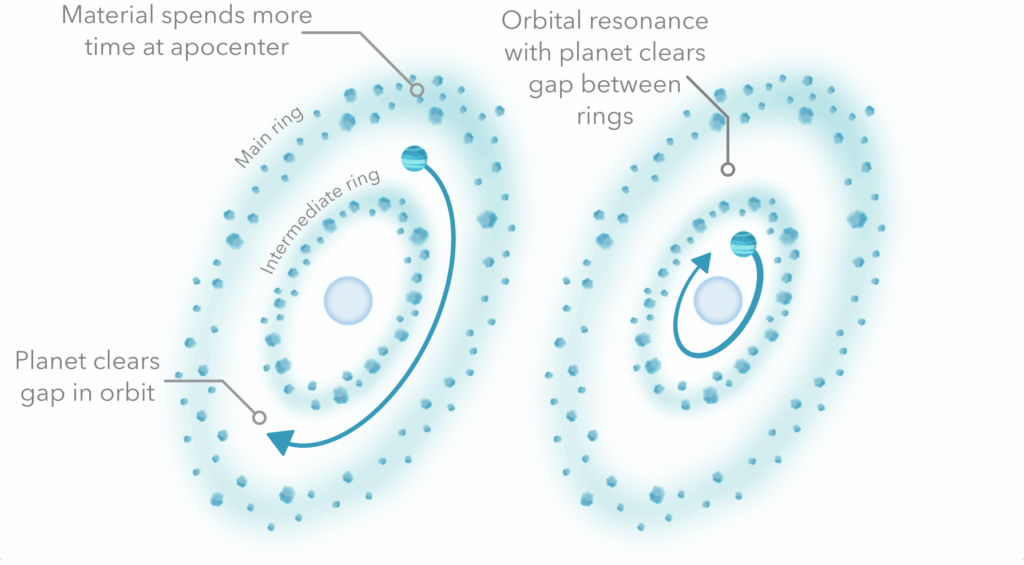
A planet was previously thought to exist around Fomalhaut, but it is now accepted there is not one we can currently observe. The authors point out that the possible planet sculpting this debris disk could be the same planet we thought existed previously, but at a lower mass (1-16 Earth masses; almost a Neptune mass). We can’t observe a planet with these parameters yet, but maybe with future observing facilities!
Finally, the authors stress, however, that it might not be a planet causing the observed structure – it could instead be the gravity of the planetesimals in the disc. Unfortunately, existing models are not equipped to explore this scenario, which is why the authors are planning to develop tools to investigate this next.
Astrobite edited by Sandy Chiu.
Featured image credit: WWE
