
Title: Optically thick winds of very massive stars suppress intermediate-mass black hole formation
Authors: Stefano Torniamenti, Michela Mapelli, Lumen Boco, Filippo Simonato, Giuliano Iorio, Erika Korb
First Author’s Institution: Max-Planck-Institut für Astronomie, Königstuhl 17, 69117, Heidelberg, Germany
Status: Available on arXiv
Astrophysicists have long speculated how black holes with masses between 100 and 100,000 times the mass of the Sun, known as intermediate-mass black holes (IMBHs), can form. Although searches for them in the Milky Way have been mostly inconclusive, the gravitational waves GW190521 and GW231123 likely came from mergers of binary black hole systems with the component or remnant masses in this elusive range. These observations provide convincing evidence that IMBHs exist, and it is up to astrophysicists to explain their origins.
One of the proposed channels for forming IMBHs is through the direct collapse of very massive stars (VMSs) with masses greater than 100 solar masses. Whether these stars eventually collapse to form an IMBH, however, depends on the amount of mass they lose throughout their lives.
Metallicity, the fraction of an astronomical object made up of heavy elements (heavier than hydrogen or helium), dramatically affects how much mass a star loses throughout its life. High-metallicity stars have stronger stellar winds and lose more mass, producing smaller cores. Meanwhile, low-metallicity stars retain more mass, allowing larger cores that are more likely to collapse into IMBHs. Current models predict that VMSs can form IMBHs if their metallicity is less than around 0.014, or 1.4%.
However, there’s a catch. If the cores are too massive, reactions inside the core can cause the star to explode so violently that it leaves no black hole remnant behind. In other cases, it can lose much of its mass in bursts before finally collapsing. These powerful explosions, known as pair-instability supernovae and pulsational pair-instability supernovae, prevent the formation of black holes with masses in a range known as the pair-instability mass gap.
A new model for stellar winds in VMSs, which the authors label S23, describes stellar winds that transition from optically thin, where light escapes easily, to optically thick, where light scatters and drives much stronger mass loss. This model, consistent with observations of VMSs in our Galaxy and the Large Magellanic Cloud and with the observed pair-instability supernova rates, predicts that strong winds strip away enough mass to lower core masses, suppressing both pair-instability supernovae and the formation of IMBHs.
The authors of this paper investigate how metallicities and mass-loss rates affect the formation of IMBHs under this new thick-wind model.
Methods
The authors model the evolution of VMSs by incorporating the thick wind model S23 into a stellar evolution code. For comparison, they also test a model labeled C15, which describes optically thin winds.
They evolve the VMS until the last stages of its life before it collapses or until it undergoes a (pulsational) pair-instability supernova. Using state-of-the-art mass models for each case, they determine the masses of the remnant black holes that the VMSs collapse to form.
The authors then simulate the evolution of a population of massive stars that may collide or even form binary black hole systems, and they study the resulting black-hole mass distribution. They consider stars with masses from 50 to 500 solar masses at the time they join the main sequence, called the zero-age main sequence (ZAMS) mass. They consider metallicities between 0.0001 and 0.02.
Impact of thick winds on stellar core and black hole masses
At low metallicities, both the S23 and C15 models predict that the stellar core mass increases as the star’s ZAMS mass increases. This is because the stars in the S23 model have not developed the optically thick winds that cause substantial mass loss.
Once the metallicity exceeds about 0.001, the stars in the S23 model develop optically thick winds that can shed mass from the star. As a result, the core mass instead levels off or decreases as the ZAMS mass increases. The C15 model, which does not include this transition to thick winds, continues to predict that core mass increases with ZAMS mass.
These differences carry over to black hole remnants. In the S23 model, IMBH formation occurs for metallicities below 0.001, while in the C15 model, IMBHs can form at metallicities up to 0.012. Furthermore, even at low metallicities, stars can still undergo (pulsational) pair-instability supernovae, producing a mass gap between 65 and 135 solar masses in the S23 model.
Impact of thick winds on the distribution of black hole masses in a population
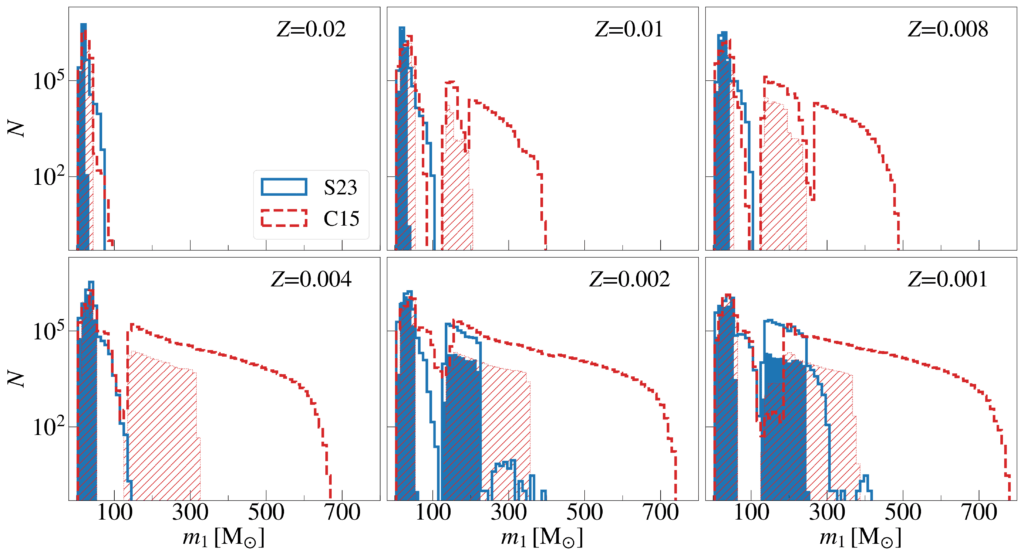
After simulating a population of VMSs, the authors study the mass distribution of the resulting black holes, which are shown in Figure 1 for different metallicities. The blue distributions correspond to the S23 wind model, while the red distributions correspond to the C15 models. They look at black holes in binary systems as well as black holes that were in binaries but became single due to dynamical interactions, including star-star collisions.
Consistent with their previous findings, the S23 model is suppressed at higher masses compared to the C15 model in all cases. At low metallicities, the mass distributions for black holes in binaries have a pair-instability gap for both models, shown by the two separate filled/hatched distributions in the bottom center and bottom right panels. However, single black holes from star-star collisions can fill in these gaps.
Finally, the authors compare their results to the observed component and remnant black hole masses of GW231123 and GW190521. They find that, under the S23 model, the progenitors of GW231123 would need to have metallicities below 0.002 to form the observed black hole masses. In contrast, the larger black hole of GW190521 falls within the pair-instability mass gap in both models, suggesting its origin might need an alternative description.
In short, thick winds change everything. Using the S23 model, the authors show that these outflows strip VMSs so efficiently that forming IMBHs becomes much more difficult than previously thought.
Astrobite edited by Bình Nguyễn.
Featured image credit: NASA
