
Disclaimer: “Beyond astro-ph” articles are not necessarily intended to be representative of the views of the entire Astrobites collaboration, nor do they represent the views of the AAS or all astronomers. While AAS supports Astrobites, Astrobites is editorially independent and content that appears on Astrobites is not reviewed or approved by the AAS.
Title: Canadian natural science graduate stipends lie below the poverty line
Authors: Andrew J. Fraass, Thomas J. Bailey, Kayona Karunakumar, Andrea E. Wishart
First Author’s Institution: University of Ottawa / University of Victoria
Status: [Open Access] Published 2025 May 22, Public Library of Science ONE (PLOS ONE)
Being a graduate student can already be an overwhelming experience, from managing coursework to learning research skills to teaching lab sections full of undergraduate students for the first time. Alongside these challenges, there is also the financial side of post-graduate life. With the cost of living rising each year, especially in the wake of the COVID-19 pandemic, graduate students are finding it difficult to afford rent, groceries, medical payments, and other essential needs. Struggling to make ends meet is an unfortunate reality for many students.
In Canada, especially, graduate student pay has not risen to meet the increased cost of living brought on by inflation, as today’s paper’s results make abundantly clear. The authors reveal that almost no university programs in the country provide a minimum graduate stipend above the poverty line. Graduate students in Canada typically receive a fixed annual stipend, a lump-sum payment intended to cover the cost of living and separate from research costs, such as lab equipment. Universities also normally charge students tuition and fees, which are effectively deducted from the stipend. This reduction in stipend means the net stipend, or “take-home” amount, may be significantly lower. Oftentimes, working as a teaching assistant counts toward part of the stipend package; however, it is also sometimes treated as an additional, optional income source on top of the base stipend.
Working as a teaching assistant, while incredibly valuable work which can provide rewarding, crucial teaching experience, also reduces a student’s capacity for research. Additionally, graduate students are sometimes expected to perform “service work”, additional tasks necessary for a lab or instrument to run, but not necessarily directly related to one’s own specific research. This service work also takes time away from completing one’s degree, and often disproportionately falls onto early-research scientists. Together, these can prolong the time it takes to complete a degree, increasing the total cost of graduate school.
In Canada, federal funding for the natural sciences comes from the National Sciences and Engineering Research Council (NSERC). Supervisors or principal investigators (PI) of a research group apply for grants through NSERC. Discovery grants, for example, are 5-year grants that support new or ongoing research. Grant proposals are judged on three factors: the past research conducted by the applicant, the production of highly qualified personnel, and the proposed project. As the authors of today’s paper point out, though proposals are not supposed to be based on the number of highly qualified personnel in an applicant’s research group, there is still an implicit incentive to have more students because this will likely lead to more publications and citations. In effect, a PI may choose to pay the minimum wages required by their university to the students in their group in order to increase the total number of students producing research.
From February to August 2024, a total of 140 programs across all 38 universities in Canada with a Physics and/or Ecological Sciences/Biology program were examined. The authors found that information was not prominently displayed and that different units of time were used to divide funding amounts across universities. For example, at one university, the amounts might be provided per term, while another might provide an annual sum. This makes simple comparison difficult for prospective graduate students looking to make informed financial choices. Some fees, such as health insurance, were also not consistently listed, which can be significant costs for grad students–sometimes even more for international students.
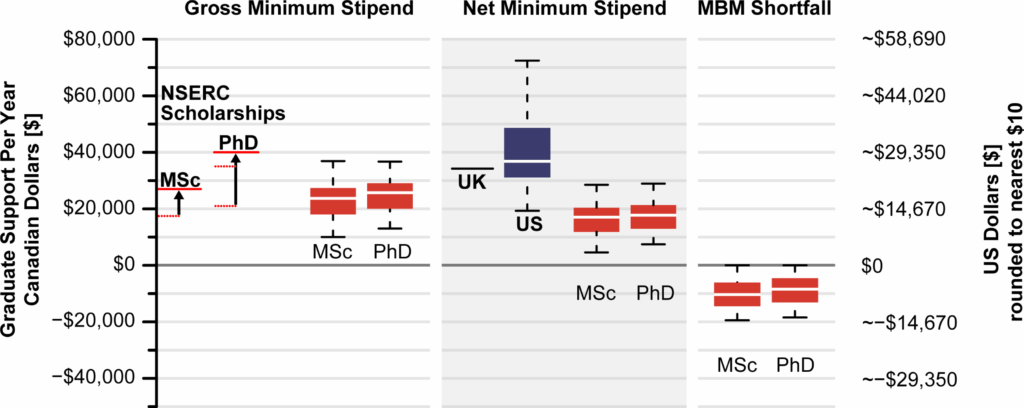
Of the 140 programs analyzed, 91 programs guaranteed a minimum stipend. The mean gross minimum stipend was CAD 23,933. After subtracting tuition and fees, the mean net minimum stipend was CAD 16,528. Comparing this to the Canadian government’s own poverty threshold for a single individual with no dependents–the Market Basket Measure (MBM)–the authors find that only two programs out of 140,—the Physics PhD and MSc at the University of Toronto,–meet the poverty line minimum. Based on these results, the average department would need to add CAD 9,584 and CAD 16,953 to the minimum stipends for domestic and international students, respectively, to meet the MBM.
The authors also compare these results to those of two countries, the USA and the UK. Unlike the USA and Canada, the UK has a single national minimum stipend level, which increases each year to keep pace with inflation. While it is difficult to compare poverty metrics across countries, the authors generally find that Canadian stipends would need to double to match the USA or the UK. The USA, while having a mean stipend similar to the UK, has much more variation, reflected in the central graph of Figure 2.
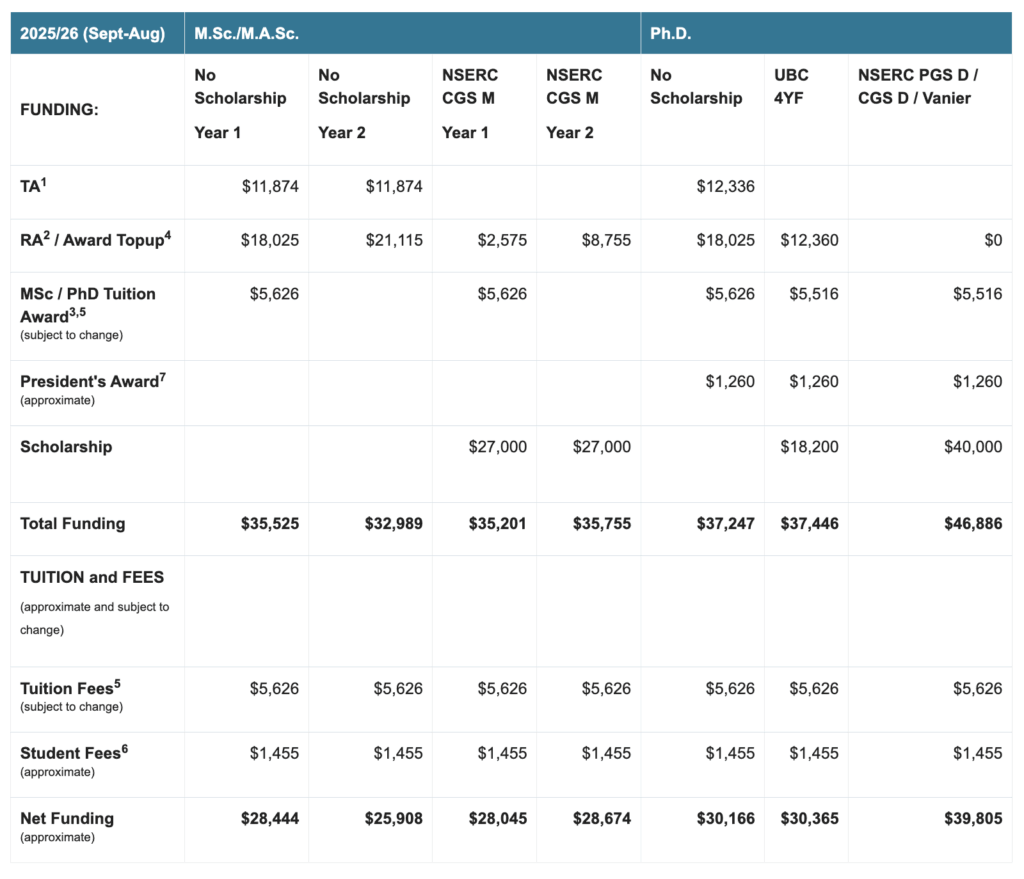
There are a few caveats to keep in mind. First, of course, many students do receive more than the minimum stipend amount for their program. Additional income sources can come from multiple teaching assistantships, external scholarships, departmental scholarships, and top-ups from PI grants (though, as explained above, PIs are often faced with pressure to pay their students the minimum amounts). There have also been significant improvements recently in terms of federal scholarships from NSERC, with the MSc, PhD, and post-doc scholarships increasing to CAD 27,000, CAD 40,000, and CAD 70,000, respectively, in 2024. These federal scholarships would be in addition to the minimum stipend a graduate student receives. The total number of federal scholarships available also increased by 1720. These amounts would boost PhD recipients above the MBM threshold.
However, the authors note that in 2021-2022, only 15% of domestic PhD students had received one of these federal awards, and international students are ineligible for many of them, leaving the majority of graduate students without access to these additional funds. With the increased number of available scholarships, that 15% should increase over time, but it will still not be the majority. Shockingly, some of these federal scholarship amounts had not been updated since 2003, meaning their real value had drastically fallen with the rise in the cost of living, making the updated amounts less of a net gain and more of a desperately needed act of catching up.
Still, these changes are a step in the right direction. Three of the authors of the paper are members of Support Our Science, a “not for profit grassroots advocacy group for graduate student and postdoctoral funding”, which helped in the campaign to push for these recent scholarship increases. Support Our Science has laid out some further improvements that would help alleviate the financial strain of being a graduate student:
- Index the value of the scholarships to the cost of living, helping prevent the scholarships from once again being devalued with inflation
- Have research councils set a minimum stipend value for students funded by federal research grants, including providing enough in the grants to meet the minimum, and take into account tuition and fees
- Make student pay a criterion for evaluating grant applications
- University departments should raise their minimum stipend levels using the research funding increase from 2024
While it is important to point out the societal and economic benefits Canada receives from the hard work of its graduate students and researchers, and appealing to this cost-benefit viewpoint is powerful, it is perhaps simpler to end by noting that graduate students are workers, and like all workers, deserve dignity in their work and a fair living.
Astrobite edited by Mckenzie Ferrari
Featured image credit: Astrobites
