
Paper title: Episodic Feedback in Triple AGN Candidate SDSS J0849+1114 Revealed by Extended ionized gas
Authors: Xiaoyu Xu, Meicun Hou, Zhiyuan Li, Sijia Peng, Zhao Su, Zongnan Li, Fuyan Bian, Junfeng Wang
First Author’s Institution: School of Astronomy and Space Science, Nanjing University, Nanjing 210023, China
Status: Accepted in The Astrophysical Journal [open access]
When Galaxies Collide
Galaxies are social creatures; they interact and merge (more astrobites talking about this are here and here)! When galaxies collide, the gravitational chaos acts like a funnel, driving massive amounts of cold gas toward the center. This gas rush has two major consequences: it triggers intense bursts of star formation (known as starbursts) and it feeds the central Super-Massive Black Holes (SMBHs), activating them as Active Galactic Nuclei (AGNs).
But the story doesn’t end there. These powerful AGNs don’t just sit and feast on the gas. They launch high-velocity winds or jets that push back against the incoming gas, a process known as AGN feedback (read more about it in Astrobites here and here). This feedback is thought to be the key mechanism by which SMBHs regulate their host galaxies, either by heating and expelling the gas (negative feedback, which starves star formation) or, in some cases, by compressing it (positive feedback, which promotes star formation).
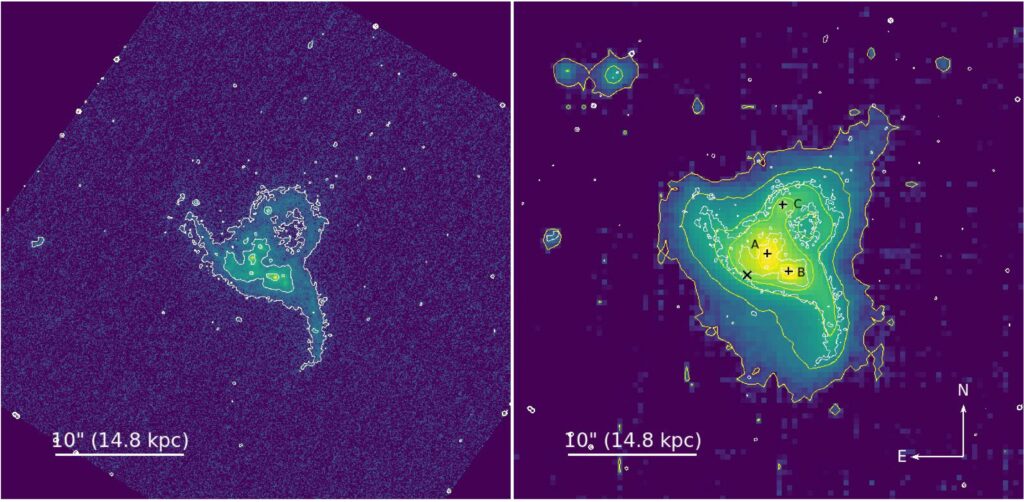
While binary AGNs (two AGNs in one merging system) are rare, finding systems with three AGNs in one system is fascinatingly rare. The galaxy SDSS J0849+1114 (J0849+1114) is one such system, featuring three Seyfert 2 AGNs, a type of active galaxy with a bright, compact nucleus whose spectrum shows only narrow emission lines, within a tight region of about five kpc. Studying this system gives us a front-row seat to how multiple black holes interact and regulate their host environment during a complex merger. VLA observations reveal that nucleus A (see Figure 1) contains two jets, inner and outer. In contrast, nucleus C has one jet, providing further evidence for the presence of an active galactic nucleus (AGN).
Peering into the Triple Core with VLT/MUSE
To understand the gas dynamics in J0849+1114, the authors used the Very Large Telescope (VLT) and its Multi-Unit Spectroscopic Explorer (MUSE) instrument. MUSE is an integral-field spectrograph, meaning it provides spectra for every single spatial pixel (or “spaxel” ) across the field of view. This allows astronomers to map not just where the light is coming from, but how the gas is moving and what is causing it to glow, all resolved spatially across the galaxy.
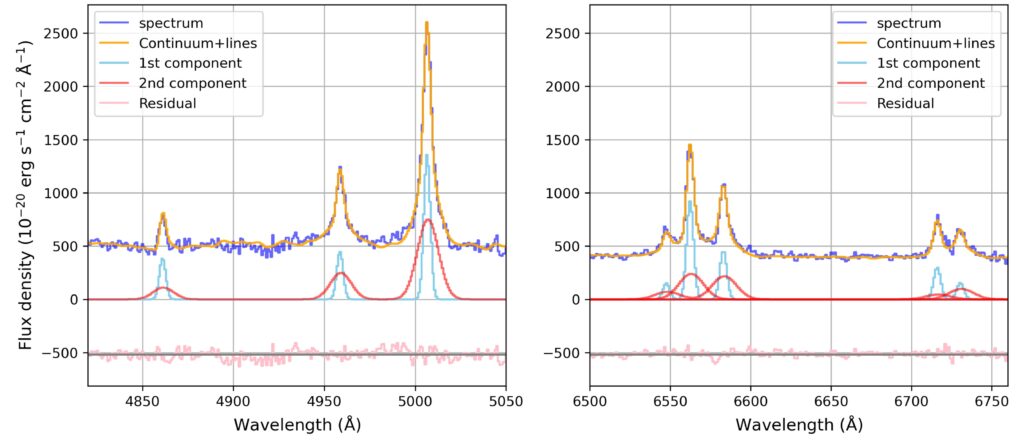
The main technique employed was two-component Gaussian fitting of key emission lines, such as Hydrogen-alpha (\(\text{H}\alpha\)) and ionized oxygen (\([\text{O III}]\lambda\lambda 4959, 5007\)). The width of a Gaussian line (or its velocity dispersion) in a spectrum tells us how fast the gas is moving. A narrow line means the gas is relatively calm, with most of it moving at similar speeds. A broader line, on the other hand, means the gas velocities are more spread out—some parts are racing toward us, others away—indicating turbulence or outflows. By comparing the widths of different components, astronomers can separate quiet, rotating gas from the high-speed winds launched by the active black holes.
What They Found: Gas Tails and Outflows
The VLT/MUSE observations successfully characterized both the undisturbed (First Component) and turbulent (Second Component) gas across the system.
1. Galactic-Scale Tidal Tails
The slow-moving gas (First Component) revealed extended structures of ionised gas stretching over 10 kpc, and in some directions, even more than 15 kpc away from nucleus A. These large, low-velocity gas clouds align well with features known as tidal tails: the stretched-out arms of gas and stars pulled away by the violent gravitational forces of the merger.
2. Two Distinct Outflows Driven by Radio Jets
The fast-moving gas (Second Component) clearly showed two distinct sites: outflows originating from nucleus A and nucleus C.
- Outflow A: This outflow extends over five kpc around nucleus A. The gas kinematics and geometry strongly suggest that this outflow is being driven by nucleus A’s radio jet. This finding is key, as the measured kinetic power of the outflow is about 10 times stronger than what star formation alone could supply, and the current luminosity of the AGN is also insufficient to power it.
- Outflow C: A smaller but detectable outflow extends about 5.9 kpc around nucleus C, with a lower kinetic power compared to Outflow A. But, like Outflow A, the energetics and velocity gradients suggest this outflow is also linked to nucleus C’s radio jet.
A Black Hole That’s Recently Gone Quiet
The most striking implication of this study relates to the timing of nucleus A’s activity. The presence of extended ionized gas far from the nucleus (in the tidal tails, > 10 kpc away) provides a fascinating glimpse into the AGN’s recent past.
The physical conditions of this distant gas were determined using emission line ratios ([O III]/H\(\alpha\) and [N II]/H\(\alpha\)) on the BPT diagram. A BPT diagram uses emission line ratios to diagnose the energy source that ionizes the gas: star formation, AGN, or shocks. The BPT diagram of J0849+1114 indicates that an AGN currently photoionizes the gas.
By running sophisticated photoionization models, the scientists calculated how luminous nucleus A must have been to ionize the gas currently found 10–15 kpc away. They discovered that nucleus A required a luminosity of nucleus A that is 20–100 times stronger than the current luminosity! Since light takes time to travel, and the ionized gas quickly recombines (on timescales of < 100 years for this gas), this luminous phase must have ended very recently, approximately 30,000 to 50,000 years ago. This is a long time for us, but just a blink on cosmic timescales.
The Episode of Self-Regulation
By integrating the findings across different wavelengths and timescales, the current faint luminosity state, the past luminous state inferred from the distant gas, and the presence of radio jets of different ages, the authors propose a model of episodic AGN feedback in nucleus A:
- Past Activity (150,000 years ago): An active phase likely launched an outer radio jet, which subsequently drove the large-scale ionized gas outflow observe today.
- Peak Ionization (30,000 – 50,000 years ago): A subsequent burst of high accretion reached its peak, ionizing the distant tidal tails.
- Fading and Quenching (Today): The energy released by the jet and/or outflow during the active phase likely expelled or heated the surrounding gas (negative feedback), causing the central accretion disk to run out of fuel. The AGN has since faded rapidly to its current low-accretion state, marked by the appearance of a young inner radio jet.
A Quiet Ending After a Loud Beginning
J0849+1114 is not just a statistical anomaly as a triple AGN candidate; it serves as a crucial case study demonstrating the powerful and rapid effects of AGN feedback. High-resolution observations confirm that violent galaxy mergers trigger both powerful outflows and episodic bursts of extreme luminosity. Crucially, these outflows clear the gas and cause the central SMBH to quickly fade from a luminous quasar phase to a quiet, low-accretion state within tens of thousands of years. This system provides strong, spatially resolved evidence that AGN feedback rapidly suppresses SMBH accretion and shapes the host galaxy on kiloparsec scales during the chaotic drama of galactic mergers.
Astrobite edited by Lindsey Gordon
Feature Image credit: HST Wide Field Camera 3 (WFC3) UVIS/F336W (U band) image (X. Liu et al. 2019; S. Peng et al. 2022)
