
Title: Protostars at Subsolar Metallicity: First Detection of Large Solid-State Complex Organic Molecules in the Large Magellanic Cloud
Authors: Marta Sewiło, Will R. M. Rocha, Martjin van Gelder, Maria Gabriela Navarro, Steven B. Charnley, et al.
First Author’s Institution: Exoplanets and Stellar Astrophysics Laboratory, NASA Goddard Space Flight Center
Access: Published in ApJ (Open Access)
Stars and planets form when clouds of molecules collapse in on themselves due to the overwhelming force of gravity (which, relatable). This process is quite mysterious, as these clouds will only live for a couple million years before collapsing, and the newly-forming protostars only live for about half a million years before becoming a main-sequence star.
But we are able to find some protostars in the Milky Way and in the Small and Large Magellanic Clouds near us, and observing the molecules around them can help us understand how the star may have formed.
To look for molecules around protostars, astronomers take spectra of them in the infrared, which is the wavelength region where molecules emit the most light. As better instruments are being built, astronomers are more often able to look for what are called complex organic molecules (COMs), which are carbon-bearing molecules with at least 6 atoms.
These COMs can be detected in different states: most detections have been of gaseous molecules in and around forming stars or disks forming planets, but they can also found in a solid state on the surfaces of dust grains in the interstellar medium in a galaxy, called COM “ices”. These “ices” were rarely found pre-JWST, but since its launch detections have been more numerous, mainly in the Milky Way. Observing these complex molecules on the surface of dust grains tells us more about the dust chemistry around protostars, which is an important but still-mysterious aspect of star formation.
In this study, researchers look outside of our own galaxy to explore the complex organic molecules in the Large Magellanic Cloud. The LMC is an interesting place to look for these molecules in because it has lower metal content (i.e. elements heavier than hydrogen and helium) than the Milky Way, as well as a harder radiation field. This means photons flying around in the LMC are generally higher-energy than photons flying around in the Milky Way, and there are less heavier elements like Carbon, Oxygen, and Nitrogen. This is important because these conditions are more similar to what typical galaxies were like in the early universe. Thus the LMC is a better test-bed to look at protostars in than the Milky Way if we want to understand how stars formed in the early universe.
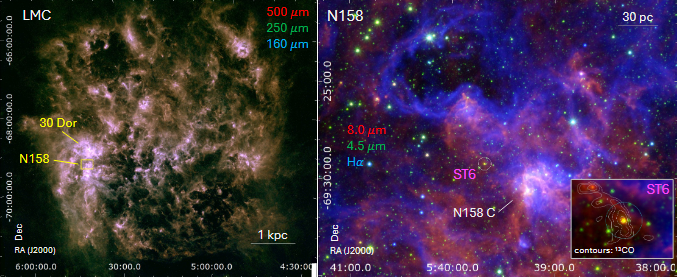
The authors of this study have found signatures of complex organic molecules in protostars forming in the Large Magellanic Cloud. They focus on the protostar ST6 in the Large Magellanic Cloud, shown in the right image in Figure 1. They used JWST’s MIRI (mid-infrared imager) instrument to get spectroscopy of the region around ST6.
Spectroscopic signatures of molecules on dust grains
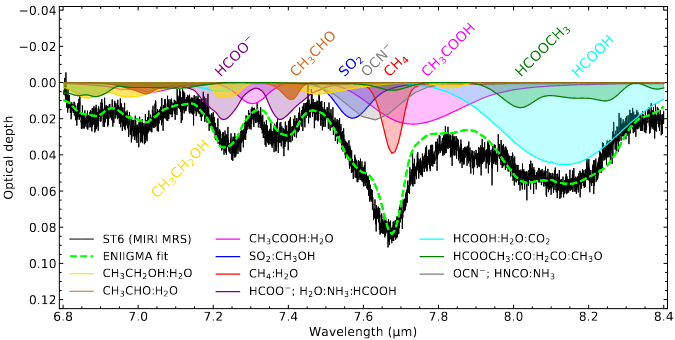
The researchers use the python tool ENIGMA to fit the spectroscopy. This code compares the spectroscopy to laboratory data of these complex organic molecules at the temperatures we see in the LMC. They fit for COMs they might expect to see, and they detect methanol (CH3OH), acetaldehyde (CH3CHO), ethanol (CH3CH2OH), methyl formate (HCOOCH3); of these, acetalydehyde, ethanol, and methyl formate have never before been detected outside of the Milky Way. Interestingly, they also detect acetic acid (CH3COOH) for the first time in any astrophysical environment. The spectral contribution from each COM is shown in Figure 2; all the individual contributions added together make up the observed spectrum.
These detections provide evidence that these complex organic molecules can be produced on the surfaces of dust grains; further, their detection in the LMC provides evidence that these molecules can be produced in “harsh” environments like the LMC, with lower metal content and harder radiation fields.
When they compare the abundances of these ices to other protostars in the Milky Way galaxy, they find that their abundances are slightly lower. This may happen because the dust temperatures are generally higher in the LMC due to the higher-energy photons, which affects the chemistry happening on the dust. Some species they find, however, do have similar abundances to the Milky Way protostars, indicating that the harder radiation field of the LMC does not affect how these species form. Finding more COMs in the LMC and the Small Magellanic Cloud will help us understand further how these compounds form on dust grains and how the galactic environment may affect their formation.
Astrobite edited by Shalini Kurinchi-Vendhan
Feature Image Credit: NASA, ESA, CSA, and STScI
