
Paper Title: Little Red Dots as Direct-collapse Black Hole Nurseries
Authors: Elia Cenci, Melanie Habouzit
First Author’s Institution: Department of Astronomy, University of Geneva, Versoix, Switzerland
Status: published in Monthly Notices of the Royal Astronomical Society [open access]
Massive Black Hole Seeds
With the rise of the James Webb Space Telescope (JWST), astronomers are peering back into the early universe, looking at some of the earliest galaxies in the history of the universe. Among these is a class of peculiar objects called Little Red Dots (LRDs). LRDs have two unique observational features:
- they appear very red, emitting much more at red wavelengths than blue wavelengths; and
- they appear very compact, with radii less than 1,000 light years (for reference, the radius of the Milky Way is about 45,000 light years).
These intriguing features suggest that LRDs are a unique kind of system. Leading theories on the structure of LRDs propose that they consist of a massive black hole, a very dense stellar cluster, or both.
Today’s authors focus on the black hole interpretation, examining whether LRDs could host a particular kind of black hole called a direct collapse black hole (DCBH). DCBHs are thought to form when a significant amount of material is funneled onto a single massive star, which forms a black hole in the core that eats the rest of the star from the inside out. After this all-you-can-eat buffet is finished, what remains is a massive black hole. This intense feeding of the black hole could lead to a short-lived period of activity as an active galactic nucleus (AGN), which could explain the observational features of LRDs.
Modeling DCBH Formation
Today’s authors run cosmological hydrodynamic simulations that model a variety of physics phenomena:
- Gravity from both dark matter and baryonic matter. This also accounts for dark energy and the expansion of the universe over time.
- Gas cooling and heating, which is important for energy transfer and allows for the formation of stars.
- Star formation and stellar feedback, including radiation and supernovae.
- DCBH formation, growth, and feedback.
The process of DCBH formation is quite complex, but today’s authors implement a model that imposes several criteria thought to be important for funneling significant mass into a single location, which should lead to the formation of a DCBH. These factors include a lack of star formation in the vicinity, high density, low metallicity, high mass inflow, and high flux of Lyman-Werner radiation. This Lyman-Werner radiation is a particular kind of UV light that is thought to help suppress star formation and support funneling of has into a single location. The authors run three simulations to test the effects of different metallicity, Lyman-Werner flux, and mass inflow constraints in the seeding criteria. Once a region meets the simulation’s seeding criteria, a DCBH is then seeded in that location with a mass based on the mass inflow rate, which is based on a fit to previous work.
Once the black hole has been seeded, it can grow by accreting nearby gas and by merging with other black holes. As it grows, the black hole can emit feedback that impacts its surroundings. When accreting at very low rates, it exists in a “radio mode” where it emits energy in bipolar jets (that is, two jets that extend outward from opposite poles of the black hole). When accreting at very high rates, it exists in a “quasar mode”, emitting energy in all directions.
DCBHs Growing Inside LRDs
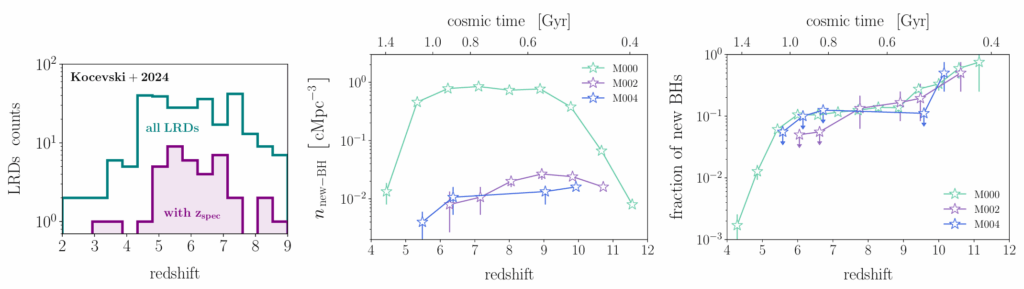
Today’s authors first compare the redshift distributions of observed LRDs and the DCBHs in their simulations, shown in Figure 1. LRDs appear to be most common between redshifts z = 5-8, which is reproduced by their simulations. They also note that the formation of DCBHs declines drastically near z = 6, which agrees with the previous result. The M000 simulation produces the highest number of DCBHs since it has the least strict seeding criteria.
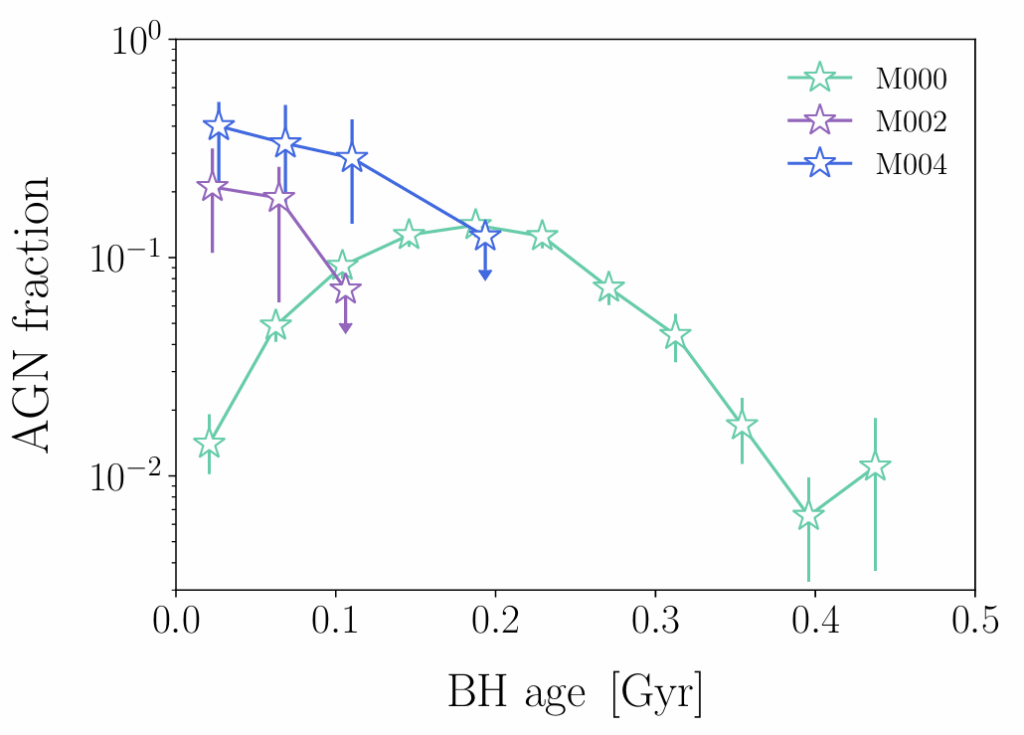
Next, they look at the population of DCBHs that are emitting enough feedback to be considered AGNs, shown in Figure 2. The newborn DCBHs are most likely to be AGNs within the first 200 million years after forming, though this depends on the model. The M000 model finds that DCBHs are unlikely to be AGNs immediately after birth, but this probability increases with age up to 200 million years.
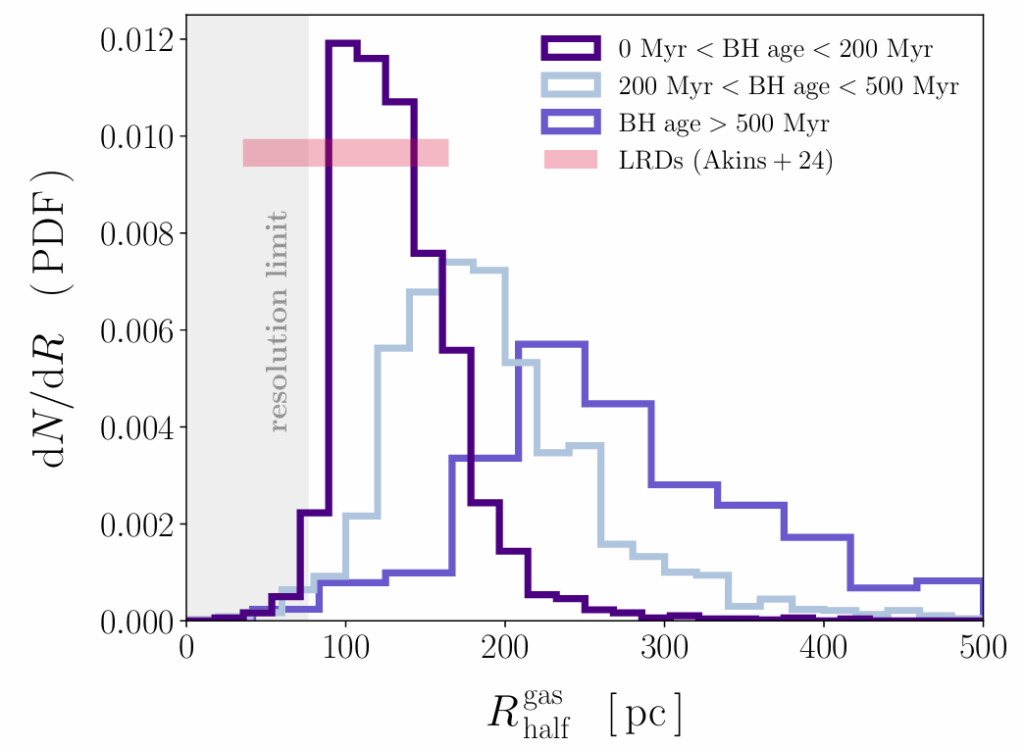
The last major investigation considered the sizes of the dark matter halos hosting DCBHs. The quantity they use for this is the half-mass radius, defined as the radius containing half the mass of the halo. They find that when DCBHs are less than 200 million years old, the half-mass radii of their halos are in good agreement with the sizes observed for LRDs, and these radii increase as the DCBHs age. These small sizes come from the halo shrinking as gas collapses towards the center, contributing to high mass inflow rates that seed a DCBH.
In summary, these simulations provide strong evidence for LRDs being the sites of newborn DCBHs. However, it is not certain that all LRDs are DCBH cradles, and not all newborn DCBHs will be bright enough and compact enough to appear as LRDs. Further simulations and observations will be necessary to provide more insight on the DCBH and LRD populations and the connections between them.
Astrobite edited by Diana Solano-Oropeza
Featured image credit: Figure 1 from today’s paper
