
Title: GW241011 and GW241110: Exploring Binary Formation and Fundamental Physics with Asymmetric, High-spin Black Hole Coalescences
Authors: The LIGO Scientific Collaboration, the Virgo Collaboration, and the KAGRA Collaboration
Status: Published open access in The Astrophysical Journal Letters
In the months of October and November in 2024, the LIGO-Virgo-KAGRA (LVK) network of gravitational wave (GW) detectors observed a pair of peculiar events, each coming from the merger of a binary black hole (BBH). Now, the observatories have come a long way since their first detection more than a decade ago, and detecting merging BBHs is considered fairly routine. In fact, the LVK collaboration recently published its fourth GW transient catalog, which consists of more than 150 compact binary coalescences.
So, what makes this pair of GW events, conveniently named GW241011 and GW241110, particularly unique and interesting? For that, we first need to understand what information can be extracted from a GW event. By comparing the GW strain data, which shows tiny ripples in spacetime, to models of what the signal should look like for a given set of parameters, we can infer the properties of the merging binaries. Notably, these include the masses of the individual compact objects, as well as their respective spins.
When such an analysis was performed on GW241011, it revealed that the larger (or “primary”) BH had a mass of almost 20 solar masses, while the smaller BH was just about 6 solar masses. Additionally, the primary BH was also measured to be rapidly spinning, and now holds the title for the most precise BH spin measured through GWs to date (see Fig. 1). Not just that, its spin vector was tilted at an angle of 30 degrees from the direction of the orbital angular momentum. On the other hand, GW241110 consisted of a merger between a 17 solar mass BH and an 8 solar mass BH. Although in this case the primary BH spin was not as well measured as GW241011, its spin vector likely pointed in a direction opposite to that of the orbital angular momentum (see Fig. 1). What makes the spin vectors of BHs so important? Read on to find out!

Why care about masses and spins?
The masses and spins of merging binaries can provide crucial insights into understanding where and how the compact binary formed in the first place. It helps us better understand the physics of binary evolution, leading to the formation of a compact binary, various formation mechanisms, and the environments in which they occur.
There are two leading formation scenarios (see Fig. 2) for creating a compact binary. The first is the isolated binary channel, where, as the name suggests, a pair of massive stars is simply born together in a binary, and may subsequently form (with or without any interaction between the two stars) a compact binary when both stars die. The other formation pathway is the dynamical channel, where interactions between stars and/or compact objects in dense environments, such as star clusters, can pair objects up and lead to the formation of a compact binary that may subsequently merge and emit GWs.
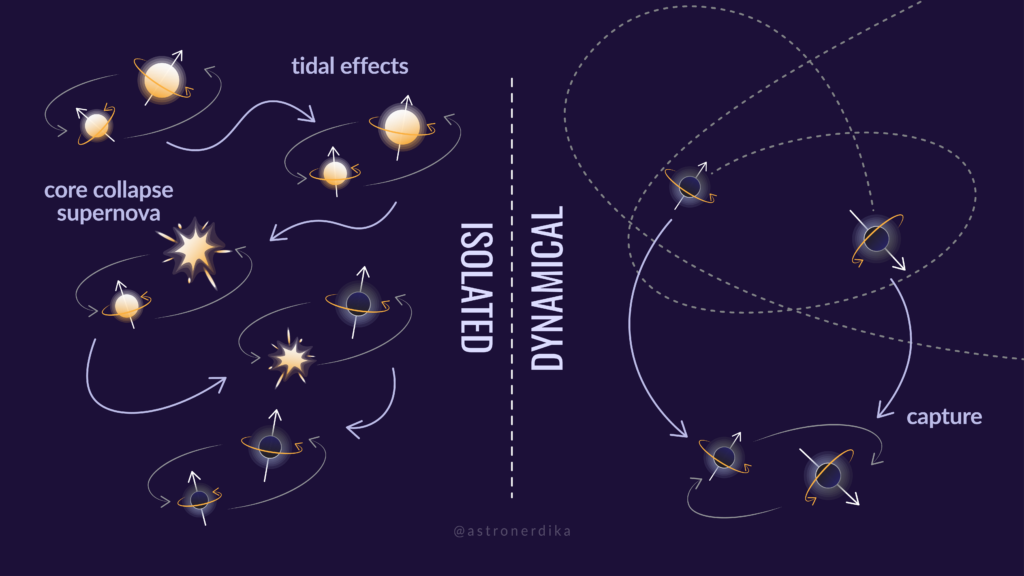
For any individual GW event, it is often difficult to confidently answer what formation channel created the merging compact binary. However, there are some key differences between the two formation channels that can be utilized to our advantage.
In the isolated formation channel scenario, it is expected that both compact objects have spins that are aligned in the direction of the orbital angular momentum of the binary. However, since compact objects are randomly paired up in the dynamical channel, they are equally likely to have compact object spins pointing in any possible direction, and not necessarily aligned with the orbit. Not just that, in the dynamical channel, one can also have a family tree of black holes, similar to the different generations in our own families. When a binary black hole merger occurs, it forms a larger remnant BH, which is called a “2nd generation (2G) BH”. These remnant BHs often receive a recoil kick due to asymmetrical GW emission, which may eject them out of the cluster. However, if this BH manages to remain bound to the cluster, it can subsequently undergo additional interactions and participate in the formation of a new merging compact binary. This could be a binary containing a 2nd generation BH with a first generation BH (2G+1G), or even a 2G+2G compact binary, and so on. A unique characteristic about higher generation BHs (2G and beyond) is that they are predicted to be highly spinning, and their spin direction need not be aligned with the orbit of the binary.
Hints of a black hole family tree?
The above properties of higher-generation black holes are what make the two events, GW241011 and GW241110, particularly interesting and worthy of their own paper. The larger BHs in both events are massive enough that they may be the remnants of a previous 1G+1G merger, and the detected events may, in fact, be 2G+1G mergers. The precisely measured high spin of the primary BH, and its tilt with respect to the orbit, are both properties expected from 2G+1G black hole mergers. On the other hand, the anti-alignment of the primary BH spin with respect to the orbit is difficult to explain for most formation scenarios, except for the dynamical channel.
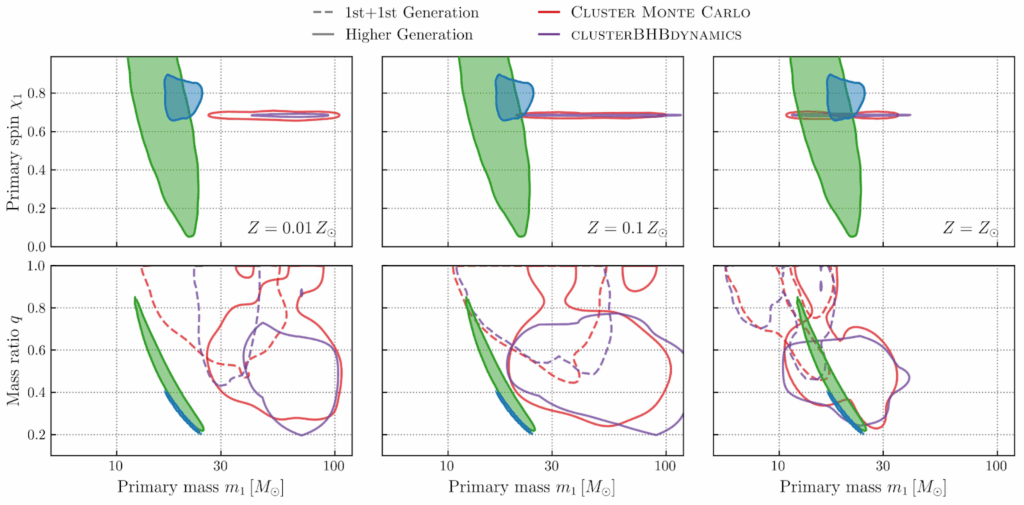
In Fig. 3, the authors compare the measured primary mass, spin, and mass ratio for the two events with predictions from two numerical simulations that track the properties of merging binaries in dense environments where dynamical interactions may dominate. They find that the measured properties agree well with the numerical predictions of higher generation mergers in their simulations at solar metallicity (Z⊙).
The louder, the better
What allowed for the exquisite mass and spin measurements of the BHs in GW241011 was also the fact that it was the third “loudest” GW signal ever detected, in terms of its signal to noise ratio (SNR). The precisely measured signal also enabled one of the strongest tests of the Kerr nature of spinning black holes, as well as the extraction of the presence of higher-order multipole moments in the GW signal. This Kerr metric helps astronomers figure out if black holes align with the theory of general relativity.
As the LVK detectors improve and observe for longer, the catalog of compact binary coalescences will keep increasing, enabling detailed studies of populations of GW sources. However, this study revealed a treasure trove of information that can still be extracted from individual GW events, from hints of the existence of a family tree of binary black holes, to one of the most stringent tests of the theory of general relativity.
Astrobite edited by Mckenzie Ferrari
Featured image credit: ESA/Hubble, N. Bartmann (edited by Neev Shah)
