
Title: The Launching of Galactic Winds from a Multiphase ISM
Authors: Fernando Hidalgo-Pineda, Max Gronke, and Philipp Grete
First Author’s Institution: Max Planck Institute for Astrophysics, Garching D-85748, Germany
Status: Submitted to MNRAS
Galaxies aren’t isolated islands in the cosmos; they are constantly breathing. Enormous winds, powered by the collective force of countless supernova explosions, blow outward from galaxies, carrying vital matter and heavy elements far into the vast, empty space between them. This cosmic breath is crucial, as it shapes both the galaxy itself and its surrounding environment. However, a closer look at these galactic winds reveals a puzzling picture that defies simple explanation.
A Lone Cloud in the Storm
X-ray and radio observation reveal that galactic winds are far from uniform. Instead, they contain intricate structures: cold, dense clouds embedded within a fast, hot outflow. Yet, basic physics tells us that such clouds should be shredded by hydrodynamic instabilities almost instantly, long before they could hitch a ride on the wind and become visible to us. How, then, do these clouds survive?
This simple picture was missing a key ingredient: cooling. Just like a hot cup of coffee cools down by radiating heat into the air, these gas clouds can radiate away their energy. This cooling process makes them denser and more resilient. Scientists refined their models and discovered that if a cloud could cool itself down faster than the wind could destroy it, it had a fighting chance. This led to a straightforward rule of thumb: survival depended on size. If a cloud was larger than a certain “critical radius,” it would live; if smaller, it was doomed.
This “single-cloud” model became the standard way of thinking, but it overlooked a simple, yet crucial, reality: clouds in space are rarely alone. The interstellar medium is a messy, crowded place. The authors of this study argue that this cosmic neighborhood changes everything. Just as trees in a dense forest can shield each other from a harsh wind, nearby gas clouds can protect one another from the destructive force of the galactic outflow. This paper sets out to discover a new, more realistic rule for survival, one that accounts for the entire community of clouds working together.
Putting the Cosmic Neighborhood to the Test
To see if a community of clouds could really make a difference, the scientists created a series of cosmic experiments inside a supercomputer. They built virtual “wind tunnels” and filled them with collections of cold gas clouds. They then blasted these collections with a hot, fast wind, mimicking a galactic outflow.
In these simulations, they played with three key variables:
- The size of each cloud: Were the clouds big or small?
- How crowded the clouds were: Were they packed together tightly or spread far apart?
- The depth of the cloud region: Did the wind have to punch through a shallow fog or a deep, dense bank of clouds?
The results, visualized in a series of snapshots (see Figure 1), were striking. The old rule that only big clouds survive was immediately proven incomplete. Even when the clouds were individually far too small to survive on their own, they often endured the storm when they were part of a group.
Survival, it turned out, depended on teamwork. In one set of tests, clouds only survived if they were crowded together, suggesting they were able to shield one another. In another test, survival depended on the depth of the cloud region; a deeper, more substantial collection of clouds was far more resilient.
Clearly, the old “single-cloud” model was missing the bigger picture. The size of an individual cloud isn’t the only thing that matters. The properties of the entire group, how crowded it is and how deep it runs, are just as important for weathering the storm.
These results naturally raise a deeper question: exactly what makes a cloud survive? If group behavior matters as much as individual size, then we need a way to quantify when a collection of clouds can endure the wind.
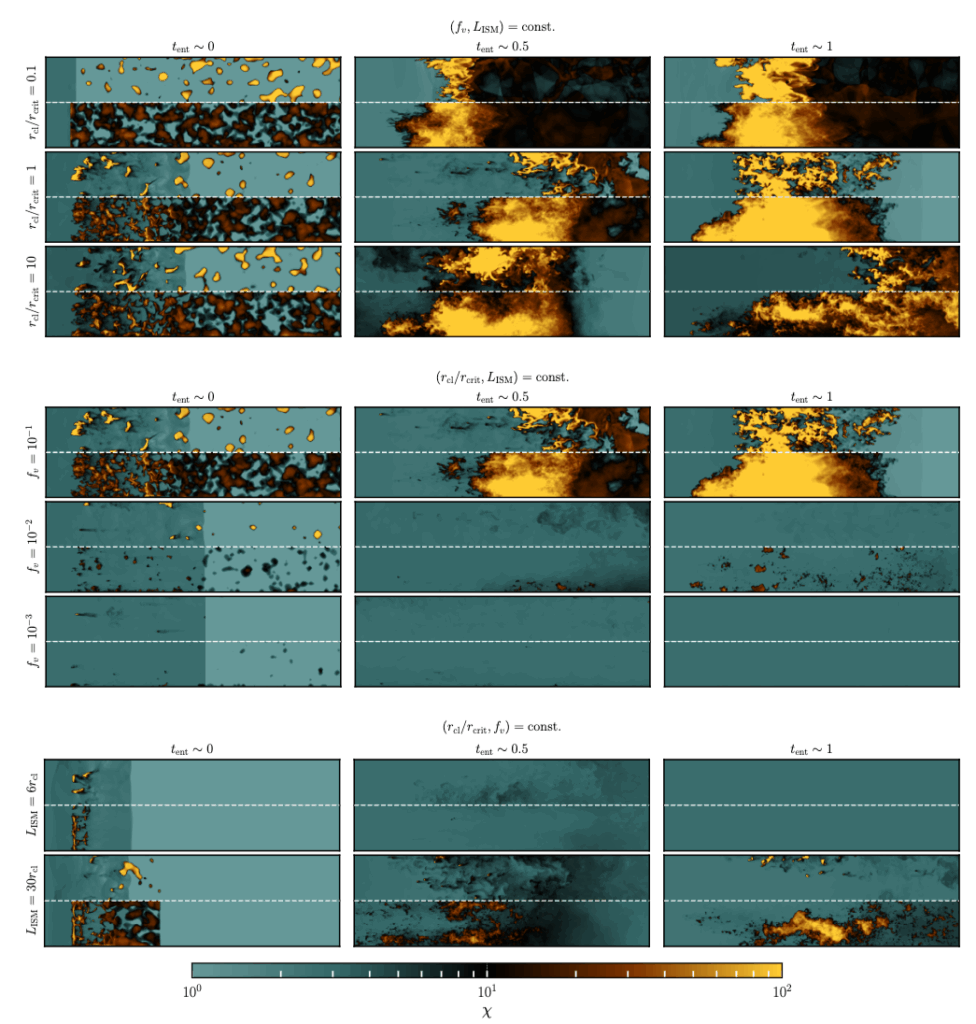
Figure 1. A gallery of cosmic wind tunnel experiments. Each row tests a different property of the cloud neighborhood, while the three columns show how the gas evolves over time as a hot wind blows from the left. Dense, cold gas is shown in yellow, while the hot, thin wind is green and black. These snapshots reveal that the survival of the cold gas (yellow) depends not just on the size of individual clouds, but on the properties of the entire group. [Fig. 3 from paper]
What kind of cloud can survive?
To quantify the survival criteria, the author proposed that the cloud can survive when the effective radius of the whole cloud population, defined by the volume-filling factor (the volume fraction of cold gas, fV) times the depth of the whole region of interest (LISM, where ISM stands for the interstellar medium), is larger than two times of the critical radius of the cloud (rcrit), then the cold cloud can survive. They summarize their simulation with different fV, LISM, and rcrit in Fig. 2. Circle means cold gas survives while cross means cold gas is completely destroyed. When the cloud radius is larger than rcrit , the cloud can always survive. However, the cloud can still survive even when the cloud size rcl is smaller than rcrit as long as the effective radius is larger than two times of the critical radius. They ran the test with two different wind conditions and found that the simulation is consistent with this hypothesis.
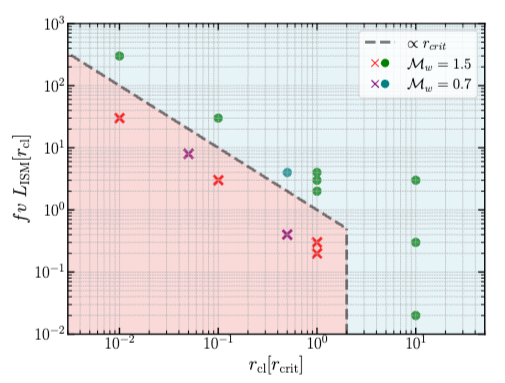
Figure 2. Generalized survival criteria. Each dot represents a simulation with a circle showing the cold gas survives, while cross represents simulations where the cold gas is destroyed. The gray dashed line shows the threshold for survival with the effective radius of the whole population equals two times the critical radius. [Fig. 6 from paper]
These simulations only consider clouds with a fixed characteristic radius. However, the realistic ISM is much more complicated. To test if the survival criteria works in a realistic ISM, the author consider a scale-free initial cloud condition, meaning that there are no characteristic scale in the cloud population, and found that as long as the multiplication of the volume-filling factor and the total depth of ISM is larger than the critical radius, cold gas can survive at the end of the simulation.
The fate of survived cold cloud
What is the final fate of these surviving cold gas? The author found that the mass distribution of the cold gas quickly reaches equilibrium and saturates to a fixed function after the wind-ISM interaction, and its shape remains constant with time throughout the simulation. This means that we cannot infer the initial condition of the ISM from the final structure of the simulation. Moreover, the author also found that, although the cold gas occupies only a tiny fraction of the total volume, it still spreads out in many small pieces that collectively block much of the wind, creating a misty structure that matches observations, something single-cloud simulations often fail to reproduceThese findings provide an overview of how this kind of ISM structure with scale-free cloud population will evolve and how they can infer the cloud formation history.
In conclusion, this research changes our understanding of how cold gas survives the violent journey out of a galaxy. By moving beyond the simplistic model of a single, isolated cloud, the authors demonstrate that survival is a team sport. The old rule, which dictated that only clouds larger than a critical size could endure, is replaced by a more nuanced and realistic criterion that accounts for the entire community of clouds. Through detailed simulations, the study concludes that as long as the effective depth of the entire cold gas region is substantial enough, the community of clouds can shield itself and survive, even if each individual cloud is technically too small to make it on its own. This new framework not only explains how cold gas survives its violent expulsion but also reveals that it will inevitably form a misty, fragmented structure consistent with astronomical observations, fundamentally advancing our understanding of how galaxies shape the cosmos.
Astrobite edited by Hillary Diane Andales
Featured image credit: Hidalgo-Pineda et al. (2025)
