

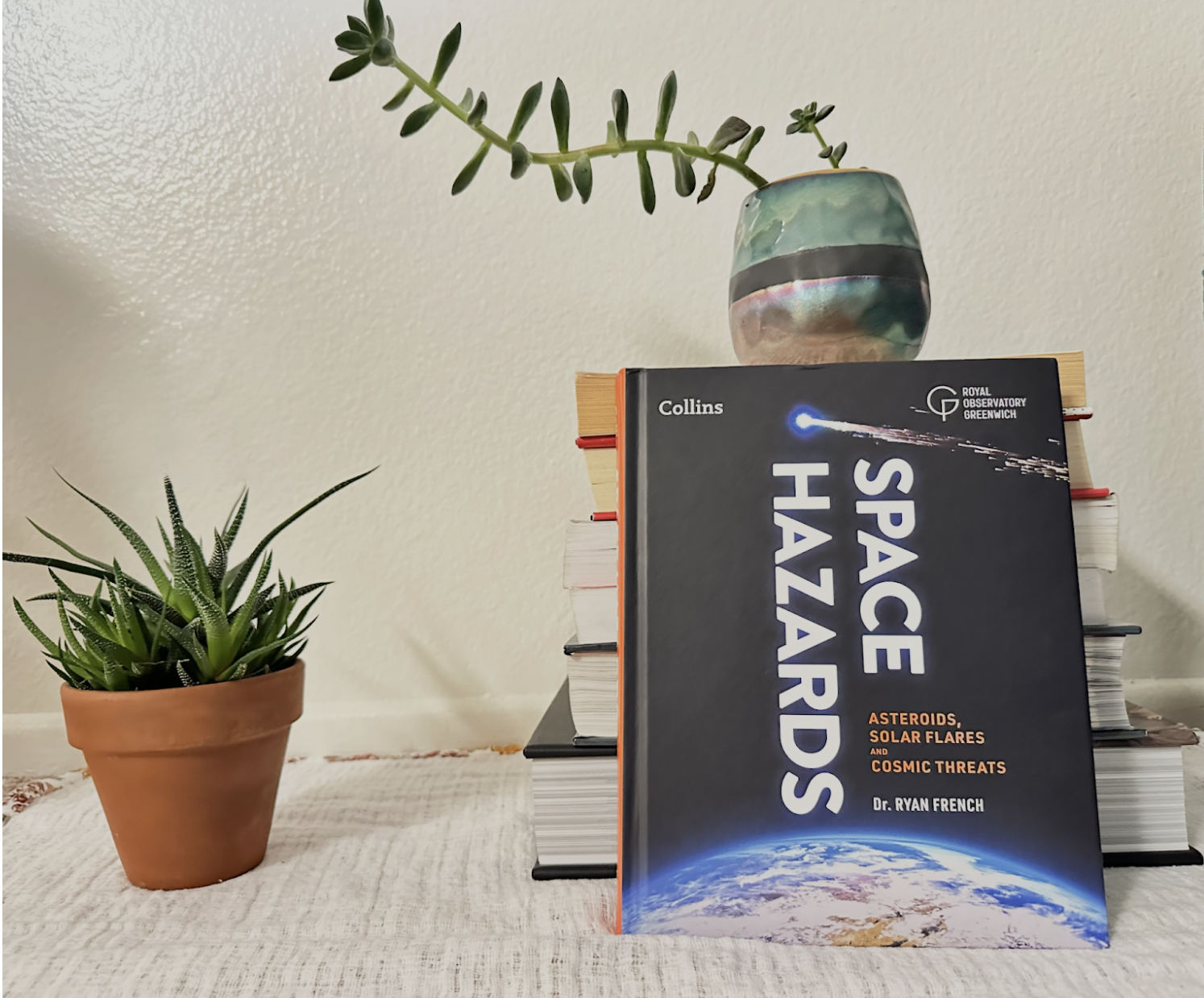
Space has plenty of ways to trouble us, yet most of them are more polite than apocalyptic. That is the starting point of Space Hazards: Asteroids, Solar Flares and Cosmic Threats, the new popular science book by solar astrophysicist Ryan French. French, whose earlier book introduced readers to the physics of our nearest star, turns his attention here to the many processes above Earth’s atmosphere that could affect our planet. The result is not a doomsday warning. Right from the first page, he reminds us that Earth is, on cosmic scales, a rather safe place, and that many dramatic scenarios either have tiny odds or would happen over spans of time far longer than human history. His goal in this book is to separate real risks from imagined ones and explain the underlying science with clarity.
Instead of focusing on nebulae, exoplanets, or faraway galaxies, this book turns to a more down-to-earth question: which cosmic events actually matter for life on Earth? French begins with the most familiar source of trouble, the Sun. He talks about why the Sun produces energy, why Earth happens to sit in such a comfortable orbit, and how magnetic fields in the solar atmosphere can store energy and then suddenly release it. Solar flares, coronal mass ejections, and bursts of energetic particles appear throughout these sections, all described with clear analogies instead of heavy equations. When solar activity reaches Earth, it can shake up the ionosphere, disrupt radio signals, and even cause satellites to drop slightly in orbit. French gives these effects some weight by retelling real incidents, from the Carrington Event in 1859 to the intense storms of Halloween 2003, then considers what a storm of that size would mean for our satellite-dependent world. Airlines changing routes, transformers pushed to their limits, and confused GPS receivers all appear as examples. Intense solar storms are rare, but the way we rely on technology makes us feel their effects more than earlier generations did.
Moving outward from the Sun, the book then focuses on the crowded region around Earth. French describes how low Earth orbit is filled with satellite constellations, derelict spacecraft, and countless fragments from past collisions. French raises the concern that a single collision in orbit could trigger another, an idea often called Kessler syndrome. He explains how space agencies manage the problem through tracking networks, automated alerts, and small avoidance maneuvers. This section blends basic orbital mechanics with the practical work of aerospace engineers and makes clear that debris is a real concern, yet not a guaranteed cascade of destruction.
Asteroids and comets appear next. French explains how astronomers survey the sky, how different sizes of near-Earth objects behave, and the hazards they pose. Most small pieces burn up in the atmosphere. Mid-sized ones, like the one that caused the 2013 Chelyabinsk explosion, can send out shockwaves that break windows and hurt people. Only the very largest bodies, the ones tens of kilometers wide, are truly devastating, and almost all of those have already been mapped. Major impacts are extremely rare on human timescales, and new facilities such as NEO Surveyor will improve our inventory even further. French also highlights recent planetary defense tests, including NASA’s kinetic impact test, which show that redirecting a dangerous object is possible.
After these dramatic possibilities, the narrative slows down and turns to gradual changes. Earth’s orbit shifts over time, its axis slowly wobbles, and long-term cycles known as Milankovitch cycles influence climate. The planet’s magnetic field weakens, moves, and occasionally reverses. These processes are often framed as looming catastrophes in popular media, yet French places them back into a geological context. Magnetic reversals do not cause mass extinctions nor trigger sudden collapse. They may influence radiation levels at high altitudes and affect navigation, but they unfold over thousands of years.
The last part of the book pulls back to a larger scale and examines hazards arising from the galaxy itself. French discusses supernovae, gamma-ray bursts, wandering stars, spikes in cosmic rays, and the way moving stellar groups can interact. For each case, he first explains the basic physics, then looks at the specific conditions required for any of these events to affect Earth. A nearby supernova could influence our atmosphere, but the chance of one happening close enough within the next few million years is tiny. Gamma-ray bursts need an even more exact alignment. When he turns to events in the far future, such as the Sun swelling into a red giant or the slow expansion that leads to the heat death of the Universe, they are presented as distant astronomical realities rather than personal threats.
The structure of the book is simple and effective. It begins at the Sun, moves outward to Earth’s orbit, continues through the Solar System, and eventually reaches the galaxy. The change in scale feels natural, and the chapters connect smoothly. French writes with a friendly, steady style, avoiding hype without slipping into technical jargon.
The book works especially well for readers who enjoy space science but worry about technical complexity. It suits anyone who wants to make sense of astronomy headlines without getting lost in acronyms. It is not a textbook. It will not teach orbital mechanics or magnetohydrodynamics. Instead, it offers a well-grounded map of the cosmic processes that shape conditions on Earth and a clear explanation of why most of them are less frightening than they first sound.
Real hazards exist, and scientists monitor them closely, yet many frightening ideas in popular culture do not match what physics allows. For anyone looking for an engaging and trustworthy guide to our place in a constantly shifting cosmos, Space Hazards is a rewarding read, a clear and reassuring guide to the real cosmic risks that matter and the ones that do not.
Astrobite edited by: Mckenzie Ferrari
Featured image credit: Collins Astronomy
Thanks to Dr. Ryan French for providing a copy of the book for this review!

Thanks for the review! I’m glad you enjoyed the book.
Hi Ryan,
Thank you! It was a really enjoyable read.
Thanks for sharing the book and your review. It really sounds interesting. I hope to get it soon and read it. I’ve always been in love with the beauty of the cosmos.
Hi Armin,
Thank you for the kind words! I’m really glad the review inspired you. I hope you enjoy the book when you get to read it.