
Paper Title: Neutrino emission and corona heating induced by high-energy proton interactions in Seyfert galaxies
Authors: A. Neronov, O. Kalashev, D. V. Semikoz, D. Savchenko, M. Poleshchuk
First Author’s Institution: Université Paris Cité, CNRS, Astroparticule et Cosmology, Paris, France
Status: accepted to Physical Review D [closed access]
Producing X-Rays and Neutrinos
Black holes power some of the most extreme environments in the universe due to their incredibly strong gravity. The largest of these – called supermassive black holes (SMBHs) – sit at the centers of most galaxies. When these SMBHs are actively “sucking up” large amounts of surrounding material in a process called accretion, they shine very brightly across the electromagnetic spectrum and are called active galactic nuclei (AGNs). An AGN is usually modeled as a massive black hole with an accretion disk and a surrounding region called the corona. The corona consists of hot, ionized gas that often shines very brightly in the X-ray regime of the electromagnetic spectrum.
In these kinds of dense, extreme environments, particle interactions can become incredibly important to understand the physics of these systems. One critical particle is the neutrino – a ghostly, nearly massless particle that often pass straight through matter without interacting (see summaries here and here). However, in such high-density and high-energy environments, neutrino production and interactions become relevant. Today’s authors investigate the production of neutrinos via protons interacting with other protons or with photons to understand how these processes impact the accretion disk and the corona.
Modeling Interactions
The authors first estimate the typical densities of protons and photons in the accretion disk. They then consider the length scales over which different processes occur since this ultimately impacts how frequently proton interactions create neutrinos and high-energy photons. These processes include:
- Pion production, which occurs primarily when protons interact with each other. The pions produced from this reaction decay into neutrinos or gamma-rays. It is also possible for pions to be produced in proton-photon interactions and in electron-positron interactions, but these processes are less important than the proton-proton interaction.
- Pair production, where a high-energy photon decays into an electron-positron pair.
- Compton scattering, where low-energy electrons interact with high-energy photons and absorb some of the energy, resulting in low-energy photons.
- Inverse Compton scattering, where high-energy electrons interact with low-energy photons and give up their energy, resulting in high-energy photons (usually X-rays).
- Synchrotron emission, where charged particles (i.e., protons and electrons) spiral around magnetic field lines and lose energy. This lost energy is released in the form of photons; however, these photons are usually low-energy photons, not high-energy photons like X-rays and gamma-rays.
- Bremsstrahlung, or “braking radiation”, which occurs when a charged particle decelerates in an electric field and converts some of its kinetic energy into photons.
- Coulomb losses, where electrons collide with other charged particles and lose energy.
The authors conclude that all of these processes occur as the particles travel distances much smaller than the size of the AGN system, meaning that the resulting emission cannot easily escape and almost all of this energy eventually becomes heat energy in the surface of the accretion disk.
However, once this energy is deposited in the accretion disk, some fraction of this energy εc will be transferred to the corona where it can be emitted primarily as X-rays, and some fraction εν will end up in the emitted neutrinos. These parameters have an enormous impact on the spectrum of electromagnetic radiation and neutrinos from the AGN, so determining or estimating them is critical. Models for this can vary widely, but the authors consider εν = εc and εν = 0.1εc reasonable upper and lower bounds, respectively.
Seyferts As Simultaneous Sources
The author’s findings are summarized in Figure 1, showing how their simulated electromagnetic and neutrino spectra from Seyfert galaxies – galaxies hosting AGNs that tend to be less luminous and with particularly low levels of radio emission – compare to observational constraints. Their spectral range agrees with the X-ray spectrum observed by the Advanced Satellite for Cosmology and Astrophysics (ASCA) at the low-energy end and with the neutrino spectrum observed by IceCube at the high-energy end. However, they find a significant deviation between their models and the gamma-ray spectrum observed by Fermi-LAT.
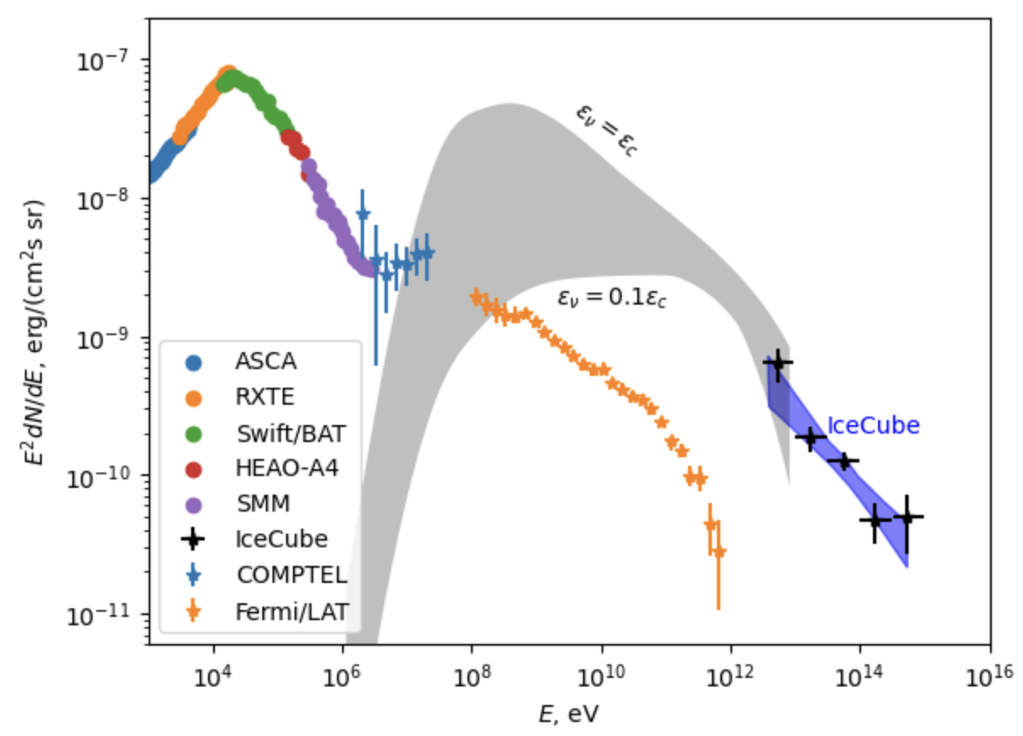
These results highlight that there is an innate connection between X-ray emission and neutrino emission in the central regions of AGNs due to the processes involved in their production. Additionally, this shows that Seyfert galaxies can be a significant source of neutrinos, which agrees with IceCube’s neutrino source candidate NGC 1068.
Astrobite edited by Chloe Klare
Featured image credit: Wikimedia Commons

