
Authors: Anna de Graaff, Hans-Walter Rix, Rohan P. Naidu, Ivo Labbe, Bingjie Wang, Joel Leja, Jorryt Matthee, Harley Katz, Jenny E. Greene, Raphael E. Hviding, Josephine Baggen, Rachel Bezanson, Leindert A. Boogaard, Gabriel Brammer, Pratika Dayal, Pieter van Dokkum, Andy D. Goulding, Michaela Hirschmann, Michael V. Maseda, Ian McConachie, Tim B. Miller, Erica Nelson, Pascal A. Oesch, David J. Setton, Irene Shivaei, Andrea Weibel, Katherine E. Whitaker, Christina C. Williams
First Author’s Institution: Max-Planck-Institut für Astronomie, Königstuhl 17, D-69117 Heidelberg, Germany
Status: Published in Astronomy & Astrophysics [open access]
As the year comes to an end, here’s one more box to check off your 2025 bingo card: “black hole suns”, predicted by Soundgarden in 1994, may be an astrophysical reality. The authors of today’s paper propose the existence of these objects, more generally named “black hole stars”, could alleviate some confusion surrounding the elusive little red dots.
The Little Red Dot Mystery
Soon after JWST observations went live, astronomers began noticing an unexpected abundance of bright, red, extremely compact objects in the early universe, which became known as little red dots (LRDs). Their other distinguishing features are highlighted in Figure 1: broad Hydrogen-alpha emission lines and a “V-shaped” spectral energy distribution (SED), which act as clues to what LRDs could be. Two major theories arose to explain their size, color, and spectral properties:
- Dusty Active Galactic Nuclei: Active galactic nuclei (AGN) are supermassive accreting black holes which emit extremely luminous jets. Broad Hydrogen-alpha emission lines like those seen in the spectra of LRDs are a typical signature of AGN, and the steep red region of the SED could be explained by the presence of dust scattering the blue light. However, AGN also produce X-ray emission which has not been observed from LRDs, and we’re not sure how black holes could grow so large so early in the universe.
- Massive, Dense Galaxies: The redness could also arise from some sort of stellar population in a very massive, but compact galaxy – either evolved stars that are intrinsically red, or bursty star formation with lots of reddening dust. Both fit the V-shaped SED, but in some cases the emission lines don’t match. Though such massive galaxies in the early universe would be surprising, this theory requires less modifications to theories of galaxy and black hole growth.
Neither scenario is a perfect match, so the nature of LRDs remains a major debate in astrophysics.
The Cliff
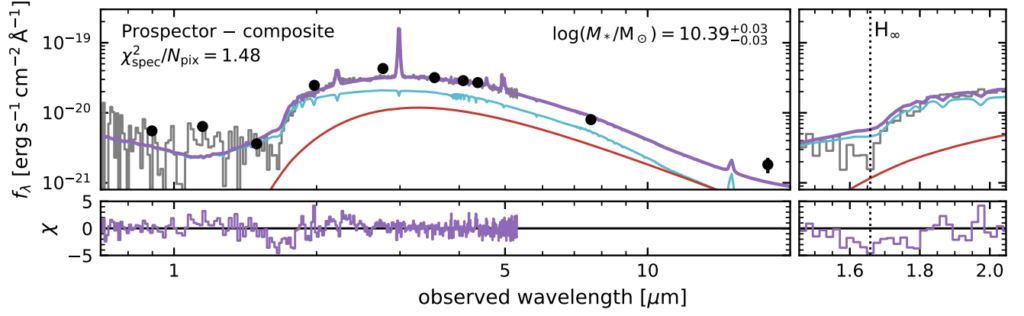
Today’s paper begins with the discovery of a peculiar LRD by the JWST RUBIES survey. Shown in Figure 1, this LRD is named The Cliff due to its exceptionally strong Balmer break in the near-infrared, which is over two times greater than those of any previously discovered LRD! Balmer breaks indicate the presence of hydrogen atoms with electrons that have been ionized to the second energy level or higher by high-energy photons, which usually originates from galaxy stellar emission. However, recent arguments in the LRD debate have shown that they can also appear when extremely dense absorbing gas clouds are near an AGN accretion disk. To determine what this bizarre object could be, the authors first compared The Cliff’s spectrum and SED to a variety of existing LRD models.

They examined a galaxy (stars only) model, a galaxy + AGN model, and galaxy + AGN models with different amounts of dust. An example model is shown in Figure 2. Even when tuning their models to include unrealistic amounts of dust attenuation, none could reproduce the steepness of the Balmer break or amount of red light. Additionally, The Cliff is very bright but also very compact, so the best models included a lot of massive stars but packing so many stars together would result in near-monthly collisions! These stellar collisions would also produce X-rays, which aren’t observed. Therefore, none of the standard LRD models are sufficient to describe The Cliff, so what next?
Here Comes the Black Hole Star
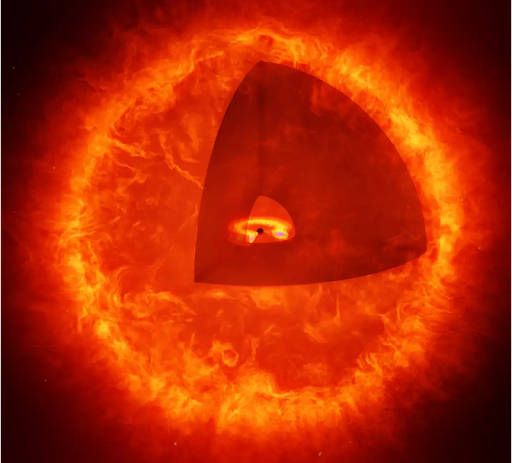
Oddly, The Cliff’s Balmer break isn’t just massive, it also looks suspiciously similar to that of an individual star. Specifically, the hot, dense gas of a star’s atmosphere. This combined with AGN signatures hinted that The Cliff could be a black hole star. Black hole stars were first hypothesized in 2006, but none have been discovered yet. The general idea is that if an AGN were at the center of a sphere of very dense gas, the accretion disk would heat and ionize the gas just like nuclear fusion in the core of a star heats and ionizes its outer layers. The resulting shape of the black hole star’s spectrum from the gas would be nearly identical to that of a star, only much brighter.
The black hole star model also resolves inconsistencies with the theory that LRDs are AGN. First, it removes the unrealistic dust modeling problem because both the Balmer break and red color could result from dense absorbing gas instead. Second, scattering via the dense gas could simply explain the lack of X-rays. Finally, an AGN accreting such dense gas would have more fuel to grow quickly, explaining how it could become so large so early on!
Much more work needs to be done to hash out the details, but for now a black hole star seems to be the best explanation for The Cliff’s puzzling properties. At the very least, The Cliff acts as the strongest evidence to date that some LRD’s emission originates from AGN rather than stars. And we’ll all have the same song stuck in our heads while we wonder about it.
Astrobite edited by Skylar Grayson
Featured image credit: Dasaptaerwin, Creative Commons Zero, Public Domain Dedication
