
In this series of posts, we sit down with a few keynote speakers of the 247th AAS meeting to learn more about them and their research. You can see a full schedule of their talks here and read our other interviews here!
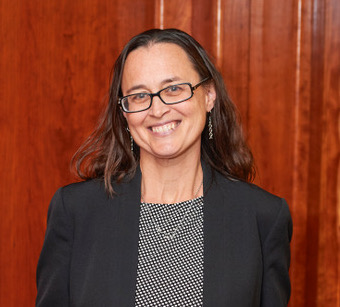
“We are using stars the size of a city that are spinning faster than your kitchen blender to detect black holes billions of times the mass of the sun billions of light years away…I’m frankly amazed that it actually has worked.” This was how Dr. Maura McLaughlin described her work to me when we sat down to chat ahead of her AAS keynote speech. Dr. McLaughlin, along with her collaborator Dr. Xavier Siemens, are the recipients of this year’s Bruno Rossi prize for their work with the NANOGrav collaboration. NANOGrav is an international project that explores how we can use pulsars to detect gravitational waves. Pulsars are rapidly spinning neutron stars that “pulse” as beams of radiation emitted from their poles swing towards earth, with the fluctuations of these pulses acting like a very sensitive clock. As gravitational waves pass through the universe, they will slightly change the timings of these pulsar signals, and by observing a large number of pulsars at once, these gravitational waves can be detected. Dr. McLaughlin and Dr. Siemens will be delivering a talk entitled “The Dawn of Low-Frequency Gravitational Wave Astronomy” exploring their first results.
Dr. McLaughlin has always had an interest in astronomy, sparked from reading science fiction and popular science books from the likes of Carl Sagan and Stephen Hawking. As an undergraduate at Penn State, she did research at the Arecibo Observatory, where, as she shared, “I fell in love with radio astronomy and pulsars. I decided then that this was what I was going to do.” She continued her research in pulsars as a graduate student in Cornell, and eventually made her way to West Virginia University where she has been for almost 20 years.
Today, her research focuses on the NANOGrav project, which “uses pulsars as cosmic clocks” to measure gravitational waves. She works primarily on the front end of the project, looking at the pulsars themselves and modelling their arrival times-hunting for a coherent signal that could be gravitational waves. Beyond the gravitational wave hunt, there is a lot of other science that can be done with this data set like testing general relativity, measuring pulsar masses, probing the interstellar medium, and exploring the dynamics of binary star systems. As she explained, “the goal is gravitational wave detection, but there’s also all these other really cool scientific things that come out of it.”
Dr. McLaughlin is very excited about the future of multimessenger astronomy, referring to the idea of using probes other than light – like gravitational waves – to study the universe. While experiments such as LIGO can detect gravitational waves from high energy events, like two black holes colliding, the NANOGrav experiment has found signs of a low frequency gravitational wave background, coming from many unresolved sources. But there’s still a lot of open questions about this signal, as she shared “we can’t say too much about the sources of this background. But the next five or ten years are going to be really really exciting. I think it’ll be a great field for undergrads to get involved in!” Current students can connect to the research through the Pulsar Science Collaboratory, which offers an online class that undergraduates from anywhere can participate in and help analyze pulsar data.
On the subject of undergraduate involvement, she highlights how beneficial an astronomy degree is for a wide range of careers. “You learn so many valuable techniques in data science, software engineering, machine learning…there are so many things you can learn doing astronomy that are applicable not just for astronomy, but for tons of other things.” She also mentioned her own experiences doubting if she was smart enough to be in the field when she was a student. To that, she would like to point out that there are so many different ways you can contribute to astrophysics. “You don’t need to do everything. I think if anyone is interested in astronomy, there’s a way to find a path where your skills can allow you to participate and be successful.”
To learn more about the NANOGrav results, be sure to attend the talk by Dr. McLaughlin and Dr. Xavier Siemens at 11:40 am MST on Thursday January 8th at #AAS245!
Edited by: Lindsey Gordon
Featured Image Credit: AAS
