
Paper Title: Wind-fed Supermassive Black Hole Accretion in the Ultracompact Dwarf Galaxy M60-UCD1
Authors: Zhao Su, Zhiyuan Li, Meicun Hao
First Author‘s Institution: School of Astronomy and Space Sciences, Nanjing University, Nanjing, China
Status: accepted in the Astrophysical Journal [open access]
Black Holes and Dwarf Galaxies
Astronomers believe that there is a massive black hole – an object that nothing, not even light, can escape its gravitational pull once inside – in the center of almost every observed galaxy. This includes many dwarf galaxies, which are smaller galaxies that often orbit larger ones. The Milky Way has dozens of such satellite dwarf galaxies. Central black holes are believed to be more common in a type of dwarf galaxy called an ultracompact dwarf galaxy (UCD). The origins of UCDs are still under study, but one theory suggests that they are the leftover cores of dwarf galaxies that had their outer regions stripped away during tidal interactions. These interactions have a huge impact on the evolution (and even formation) of dwarf galaxies. If this theory is true, then since many dwarf galaxies host massive black holes, it would naturally explain why UCDs are expected to host massive black holes.
Black holes of all sizes have two main mechanisms for growth – merging with other black holes and accreting (or “sucking up”) surrounding material. However, particularly in dwarf galaxies, there may not be large supplies of gas available for the central black hole to accrete. Alternatively, it may be possible to accrete the material in stellar winds – particles and other materials expelled from the surfaces of stars. Our Sun also has these winds, which generate aurorae on Earth and other planets in our solar system. Today’s authors explore the possibility that a central black hole in a UCD could accrete substantially from the stellar winds of massive stars, which have stronger winds than those like the Sun.
Modeling a UCD
To study this phenomenon, the authors run hydrodynamical simulations of a UCD, specifically modeling M60-UCD1. They first model the gravitational potential within the UCD, accounting for both the central black hole and the stars. They then use this to run hydrodynamical simulations, which account for the following:
- Gravity, using the gravitational potential above that accounts for the central black hole and the stars.
- Gas in the dwarf galaxy, which is modeled as a fluid (the “hydro” in “hydrodynamics”).
- Stars, which are modeled with a particular metallicity and set of ages.
- Stellar winds from massive stars, which inject mass, energy, and momentum into the surrounding gas.
- Gas inflows from the parent galaxy M60 and from the larger Virgo supercluster.
The authors run three simulations: a “Fiducial” simulation that ignores gas inflows, an “ISM” simulation that accounts for the interstellar medium in M60, and an “ICM” simulation that accounts for the intracluster medium in the Virgo supercluster.
Scavenging for Scraps
Their first results are highlighted in Figure 1, which shows visualizations of the gas density and temperature from the Fiducial simulation. These images display a clear development of a cold, dense accretion disk around the black hole (shown in blue in the second row), with very hot gas in the center surrounding the black hole (appearing as the small red dot in the very center of the disk). This disk is created from material released by stellar winds, indicating that stellar winds can produce sufficient material for the black hole to accrete in a UCD.

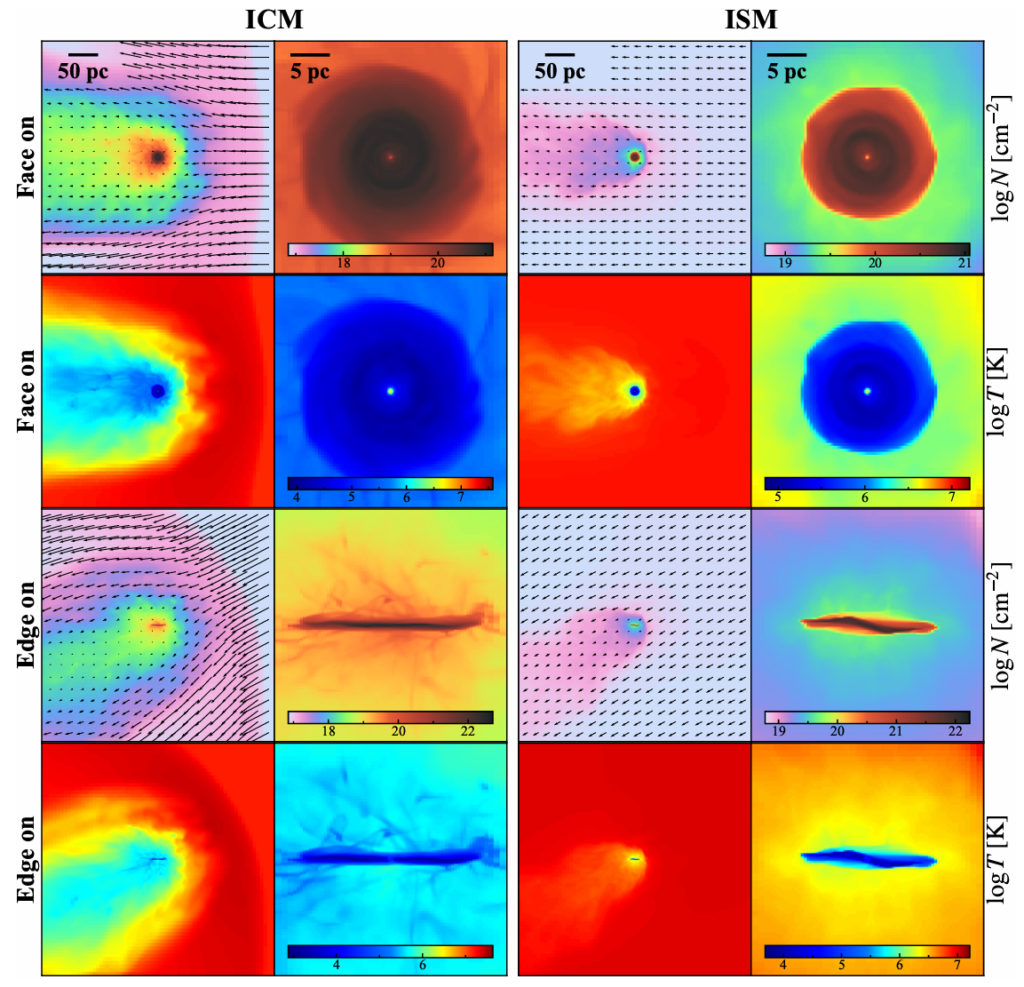
For comparison, Figure 2 shows similar plots for the end states of the ICM and ISM simulations. The ICM simulation shows much more asymmetry in the accretion disk and the surrounding region at large scales due to sizeable gas inflows from the ICM. In contrast, inflows from the ISM produce more asymmetry and warping of the accretion disk at small scales because these inflows are stronger than those from the ICM. These inflows also reduce the amount of material in the accretion disk: compared to the accretion disk in the Fiducial simulation, the accretion disks in the ICM and ISM simulations have only about 50% and 25% of the mass, respectively.
Finally, Figure 3 shows the accretion rates and X-ray luminosities near the ends of the simulations. The accretion rates and luminosities of the ICM and ISM simulations are consistently lower than those of the Fiducial simulation. This is consistent with the accretion disks being less massive: the gas inflows from the ICM or ISM disrupt the gas supply to the accretion disk, meaning that there is less material to accrete and therefore lowering the accretion rates. Importantly, the X-ray luminosity from the Fiducial simulation is in good agreement with observations of M60-UCD1, suggesting that this could be the source of the observed X-ray emission from this UCD. The authors find that most of the X-ray emission originates from the very center of the accretion disk, where the gas is the hottest (see Figure 1, second row).

In summary, today’s authors have highlighted that black holes can grow even in small environments like dwarf galaxies and even with meager supplies of gas from stellar winds. However, gas inflows from the ISM and ICM can actually inhibit growth by disrupting the accretion disk instead of providing more material to accrete. The results also suggest that the simulated black holes’ X-ray luminosities are potentially consistent with the observed X-ray emission from M60-UCD1. This could hint at an interesting new set of X-ray sources in the local universe.
Astrobite edited by Sowkhya Shanbhog
Featured image credit: Wikimedia Commons

