
Title: Misinterpreting Spin Precession as Orbital Eccentricity in Gravitational-Wave Signals
Authors: Snehal Tibrewal, Aaron Zimmerman, Jacob Lange, Deirdre Shoemaker
First Author’s Institution: Weinberg Institute, University of Texas at Austin, Austin, TX 78712, USA
Status: Available on arXiv
When two black holes merge, they produce gravitational waves, ripples in spacetime that we can observe using detectors like LIGO and Virgo. Each observation opens up a set of questions: How massive were the black holes that merged? Did they form together or did they find each other by chance? Features encoded in the gravitational-wave signal, like eccentricity and precession, tell the story of how these black holes came to merge, so it is important we properly identify them.
What are eccentricity and precession?
Let’s start by understanding a non-eccentric, non-precessing system: two black holes that orbit their shared center of gravity on a flat plane in a nearly-circular inward spiral. If the black holes are spinning, then they spin around an axis perpendicular to the plane they’re orbiting on. In this idealized case, the gravitational wave signal steadily increases in strength and frequency until the two black holes merge.
The picture changes with eccentricity or precession. Instead of a slowly-shrinking circular spiral, eccentric binaries have deformed, elliptical inward spirals like the one shown in the bottom left of Figure 1. The spin axes are still perpendicular to the plane of the orbit, but the orbits aren’t circular. Eccentricity can take on values between 0 and 1, with perfectly circular orbits having an eccentricity of 0.
On the other hand, precession causes the orbital plane to wobble around, as shown in the top right of Figure 1. This occurs when either of the black holes’ spin axes is no longer perpendicular to the orbital plane, illustrated by the randomly pointing arrows attached to the black holes in the figure. The amount of precession depends on the rate and direction of the black holes’ spin.
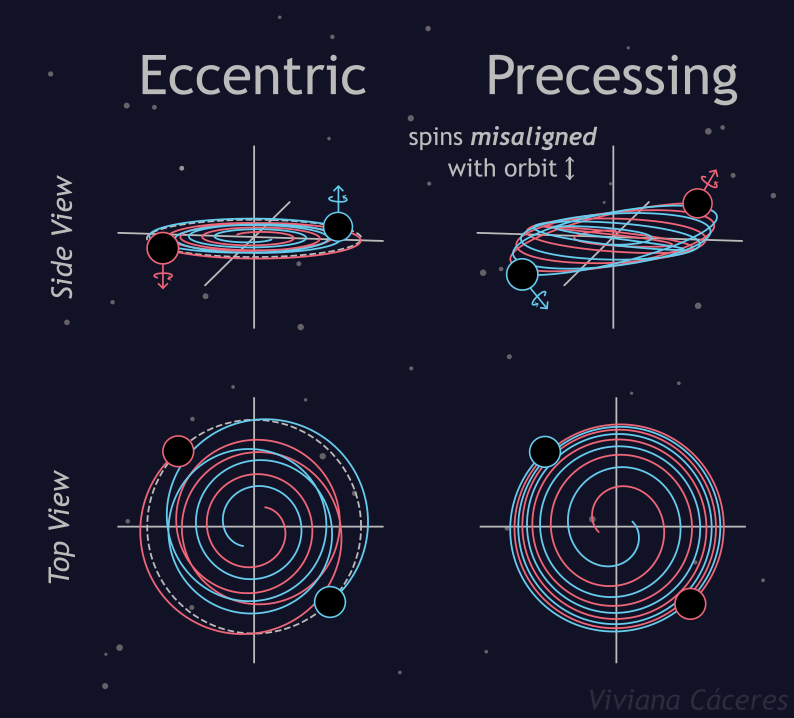
Binaries can have both precession and eccentricity, but we’ll focus on those with just one or the other. Keep in mind that black holes in eccentric-only systems can still spin, as long as their spins are perpendicular to their orbital motion.
Eccentricity and precession modulate the strength and frequency of the observed gravitational wave in similar ways. This begs the question: if we observe a gravitational wave from a precessing binary and another from an eccentric binary, can we tell them apart? Today’s paper identifies cases where eccentricity and precession are not clearly distinguishable.
Searching for look-alikes
To quantify the resemblance between two signals, the authors computed the mismatch, a statistical value between 0 and 1. The closer the mismatch is to 0, the more the signals look like one another.
To compute the gravitational-wave signal for different binary systems, the authors used two models: one for eccentric-only systems and another for precessing-only systems. They varied the eccentricities and the black holes’ spin rates to find configurations where the mismatches are low.
After calculating the mismatches between many precessing and eccentric signals, the authors found that eccentric systems with black holes that are not spinning are unlikely to be confused with precessing systems. However, a system with a combination of spins and eccentricity could mimic precession.
The authors then investigated one of the precessing signals that had a particularly low mismatch with an eccentric signal. They inserted the precessing signal into simulated background data noise and estimated its parameters using the eccentric model to check whether the analysis could confuse precession with eccentricity.
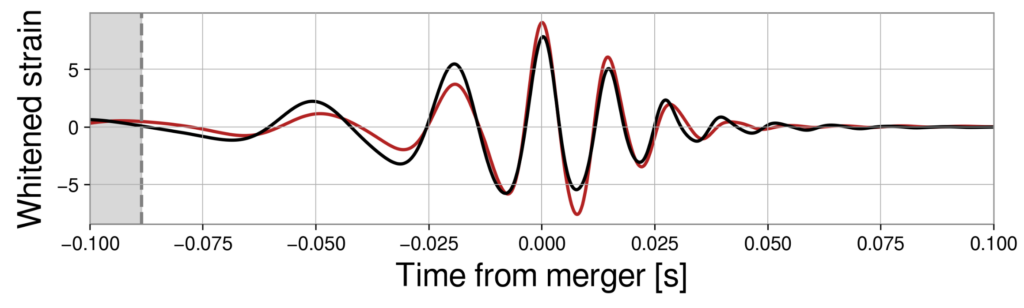
Although the injected signal was not eccentric and the spins were completely misaligned with the orbital motion, the analysis determined that the system was eccentric and that the black holes had spins aligned with the orbital motion. Figure 2 compares the true, precessing signal to the eccentric signal that best fits the data. The two are remarkable look-alikes, showing how precession could be misinterpreted as eccentricity.
To check if this misidentification happens for other black hole binaries with similar parameters, the authors slightly changed the spins and orientation of the system, as well as the length of the observed gravitational wave signal. Then, they repeated their analysis. They found that this resemblance only occurs for very specific systems. It is very sensitive to how misaligned the spins are and how the binary is oriented relative to us on Earth. Additionally, they found that if the observed signal is shorter, the estimated eccentricity gets further away from its true value of 0.
Keeping an eye out
Short gravitational-wave signals from very massive black holes, like GW190521 and GW231123, lie in the sweet spot for this deceptive similarity. This work highlights the need to stay on the lookout, ready to investigate further and ensure the validity of any scientific results, especially if precession or eccentricity are neglected. Properly identifying these effects will help astrophysicists paint an accurate picture of the black hole binaries out there in the universe.
Astrobite edited by Lindsey Gordon
Featured image credit: Viviana Cáceres
