
Authors: Vicente Estrada-Carpenter , Marcin Sawicki , Roberto Abraham , Yoshihisa Asada et al.
First Author’s Institute: School of Earth and Space Exploration, Arizona State University,Tempe, AZ, USA
Status: Published in The Astrophysical Journal (ApJ), Vol. 991, Issue 2, article 188. Oct 2025
If you want to reconstruct a galaxy’s life story, one of the best “fossil records” is its metallicity. In astronomy this refers to the abundance of elements heavier than helium, which are made in stars and returned to a galaxy’s gas through winds and supernovae. Over time, more star formation usually means more metals mixed into the gas.
Now zoom to Cosmic Noon (roughly when the Universe was most actively forming stars). Many galaxies at these epochs look “clumpy”, their star formation is concentrated in several bright knots scattered across the disk. The big question is where those clumps come from. Do they form from the galaxy’s own gas via internal disk instabilities, or do they light up when fresh, metal-poor gas flows in and both fuels star formation and dilutes the local metallicity?
The authors try to answer that question with the James Webb Space Telescope (JWST), by measuring the metallicity of each clump relative to its immediate surroundings, rather than comparing clumps to a single galaxy-wide number (which can be misleading if the galaxy has a metallicity gradient).
They use JWST/NIRISS slitless grism spectroscopy from the CANUCS survey to study 20 lensed galaxies at redshift 0.6 < z < 1.35 (lensing effectively acts like a zoom lens, helping resolve smaller structures). They focus on emission lines that trace star-forming gas, especially Hα (a star formation tracer) plus sulfur lines [SII] and [SIII] (needed for their metallicity method).
Slitless spectra come with a headache: because there is no slit, different parts of a galaxy can overlap in the dispersed image. To make reliable emission-line maps from slitless data, they use a forward-modeling code called Sleuth, which allows the continuum to vary across the galaxy.
The authors identify clumps using the Hα map together with rest-UV imaging, because these tracers are sensitive to star formation on different timescales: Hα highlights gas ionized by the youngest massive stars, while UV traces young stellar light over longer periods. As a result a clump can be bright in one and not the other, especially if dust is involved.
To estimate gas-phase metallicity, they use the “strong-line” method, which infers metallicity from ratios of bright emission lines calibrated using models and empirical samples. Their main diagnostic is S23 = ([SIII] + [SII]) / Hα. Because some line ratios also depend on the ionizationstate (how strongly the gas is being ionized by young stars), they also use the sulfur ratio S32 = [SIII]/[SII] as a check and iterate to a self-consistent solution.
So, are clumps really chemically different from their surroundings?
For each clump, the authors measure metallicity inside the clump and compare it to an annulus just outside the clump (masking neighboring clumps to avoid mixing). When they plot “clump metallicity” versus “local disk metallicity,” most points fall below the 1-to-1 line, meaning the clumps are more metal-poor than their surroundings (Figure 1). The mean offset is about 0.1 dex, which corresponds to roughly 20% dilution in the clump gas.

An extra wrinkle is that the galaxy medians hint at two populations, some galaxies have clumps with small offsets (near the 1-to-1 line), others show larger offsets. The authors suggest this could mean two formation pathways, one dominated by internal gas reservoirs (smaller offsets), and another where inflow of metal-poor gas plays a bigger role (larger offsets). They are careful, though, as the sample is still small.
If inflow is really the driver, you should expect a link: the more strongly a clump is forming stars relative to its surroundings, the more diluted its metallicity should be. That is exactly what they find. The clumps that are most boosted in star formation are also the most metal-diluted.
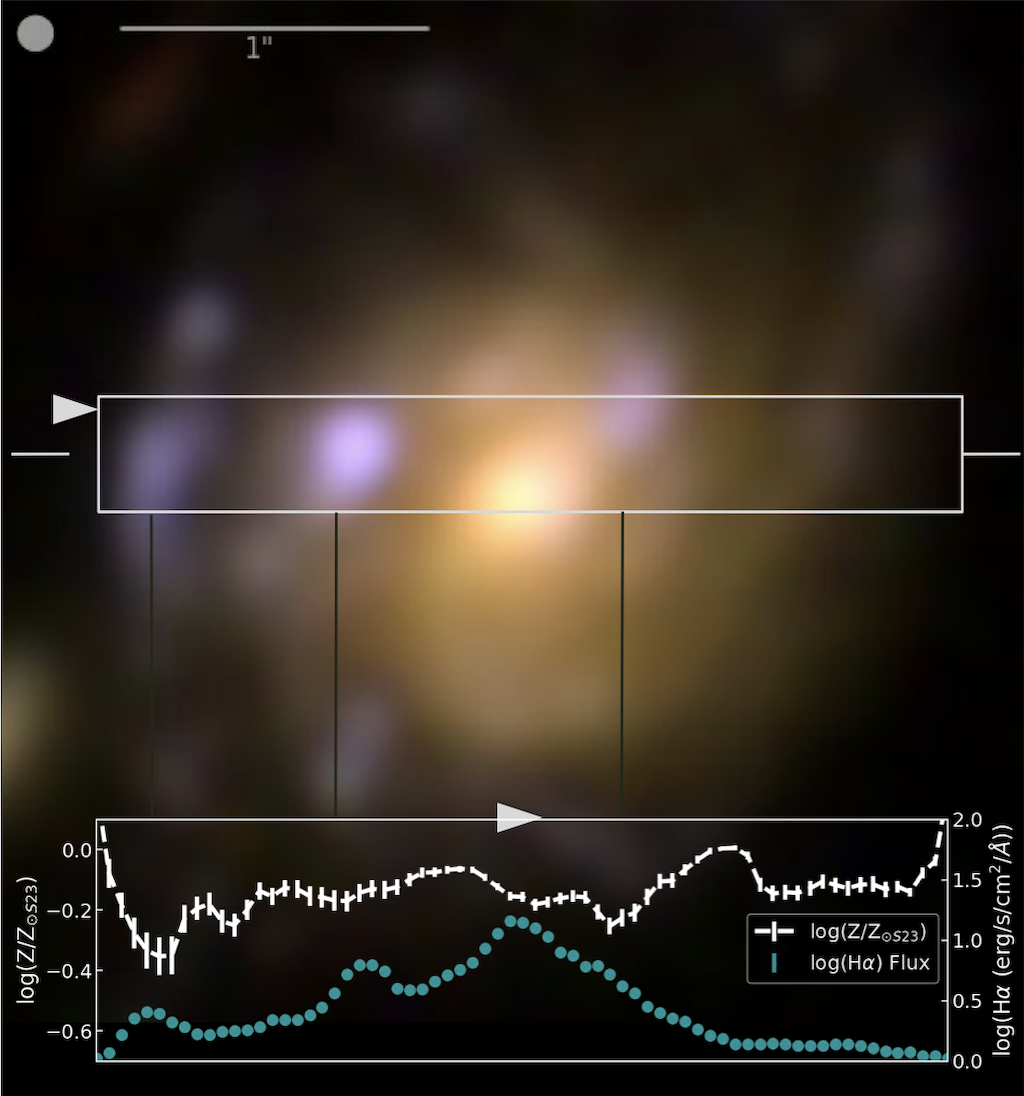
The paper also emphasizes that clumps are not chemically uniform blobs. In at least one detailed example, the peaks in Hα (highest star formation) coincide with local minima in metallicity along a cut through the galaxy (Figure 2), suggesting internal Star Formation Rate (SFR) and metallicity gradients that reinforce the same story, intense star formation goes hand-in-hand with lower metallicity in the clump regions.
Are these clumps really “in situ,” or could they be small satellites?
A reasonable alternative is that some clumps are actually small companion galaxies projected onto the disk. These could also look metal-poor, because low-mass galaxies tend to be low-metallicity. The authors look for evidence using face-on systems and find that more massive clumps tend to sit closer to galaxy centers, which is consistent with in-situ clumps that form in the disk and migrate inward, though it does not rule out satellites. They argue that kinematics from JWST/NIRSpec IFU will be needed for a definitive separation.
Why this matters
Gas inflow, star formation, and feedback, together known as the baryon cycle, are key drivers of how galaxies grow. What this paper adds is a spatially resolved view that compares each clump to its local environment, showing that regions of elevated star formation also tend to be locally metal-poor. That pairing is hard to explain as a simple metallicity gradient or a galaxy-wide averaging effect, and it is exactly what you would expect if at least some clumps are being fueled by relatively metal-poor inflows. In short, these clumps may be snapshots of galaxies refueling in real time.
Astrobite edited by: Ryan White
Featured Image Credit: Niloofar Sharei (Made in Canva)
