
Paper Title: Fast Rotating Blue Straggler Stars in the globular cluster NGC 1851
Authors: A. Billi, L. Monaco, F. R. Ferraro, A. Mucciarelli, B. Lanzoni, M. Cadelano, and I. Trangolao.
First Author’s Institution: Dipartimento di Fisica e Astronomia, Università degli Studi di Bologna.
INAF, Osservatorio di Astrofisica e Scienza dello Spazio di Bologna.
Status: Published in Astronomy & Astrophysics [open access]
by Arthur Magalhães

This guest post was written by Arthur Magalhães, a final-year MSc student at Universidade de São Paulo, Brazil. Since completing his bachelor’s degree in the same university, his research has focused on star clusters and stellar formation. During his master’s, he completed an exchange semester at Uppsala University (Sweden), where he studied atomic diffusion in globular clusters. Outside of astrophysics he enjoys reading, music and Formula 1.
Star clusters are home to stars that share a common birth day and place, therefore presenting similar properties such as age, chemical composition and radial velocity. However, clusters can also hold an “exotic” population called Blue Straggler Stars (BSSs), which appear hotter, bluer, and brighter than the other cluster stars. The complete understanding of how and under which conditions these stars are formed is still a topic of ongoing research, and todays paper helps to shed some light in this mystery by analyzing the rotational velocity of a sample of BSSs in the globular cluster NGC 1851.
How did that blue get there?
Stars spend most of their lives fusing hydrogen into helium on what’s called the ‘main sequence‘. This main sequence presents as a dense diagonal line of stars on the Hertzsprung-Russell (HR) diagram of a globular cluster’s stellar population. After the hydrogen fuel is exhausted, the star leaves the main sequence, and it marks a special place on the HR diagram called the main sequence turn-off (MSTO) where it proceeds to the next evolutionary stage. However, BSSs populate the region to the left of the main sequence and normally above the MSTO, casting challenges to classical stellar evolutionary models that don’t predict any objects in that region (see the HR diagram of NGC 1851 in Figure 1).
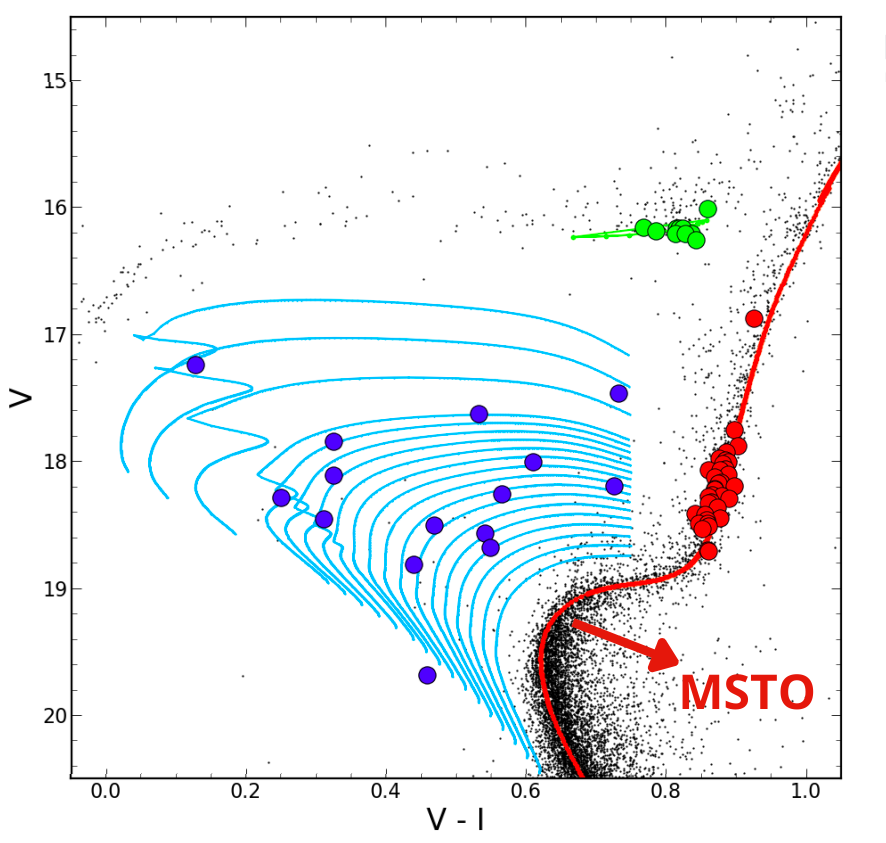
Figure 1: Color-Magnitude diagram of NGC 1851 (black dots), with the BSSs marked in blue, and the other evolutionary stages after the MSTO marked in red (Red Giant Branch) and green (Horizontal Branch). The blue lines show evolutionary tracks of different masses for the BSSs, and the red line represents the cluster’s evolutionary track (isochrone) of 11 Gyr. Source: Adapted from Figure 1 in the original paper.
The formation of such objects is not completely understood, but two scenarios proposed are studied in this paper: a binary system with mass transfer from the companion star to the young BSSs, or the direct collision between stars (which makes sense in a dense stellar environment such as a globular cluster!). One way of distinguishing between these two scenarios is by studying how fast the stars are spinning (its rotational velocity); this may not fully separate the two cases, but can be used in order to probe the age of the BSSs, and therefore study the link between its formation and the environment.
How fast are they spinning?
Astronomers are able to measure the rotational velocities of stars using one of our greatest tools: spectroscopy! In this study, the authors collected spectra using the Very Large Telescope (VLT), focusing on the magnesium triplet lines, which are particularly sensitive to the stellar rotational velocity, becoming broader as the velocity increases.
With this data, they were able to analyze a set of 15 BSSs in NGC 1851. Though they have a detection limit of 15 km/s, due to instrumentation constraints, the authors found that these BSSs have a a peculiar rotational velocity distribution compared to standard cluster stars, therefore contributing to their “exotic” origin (see Figure 2). Furthermore, one of the stars analyzed showed an extremely high rotational velocity of almost 150 km/s, placing this star within a family of fast rotating BSSs (FR-BSSs) with rotational velocities above 40 km/s.
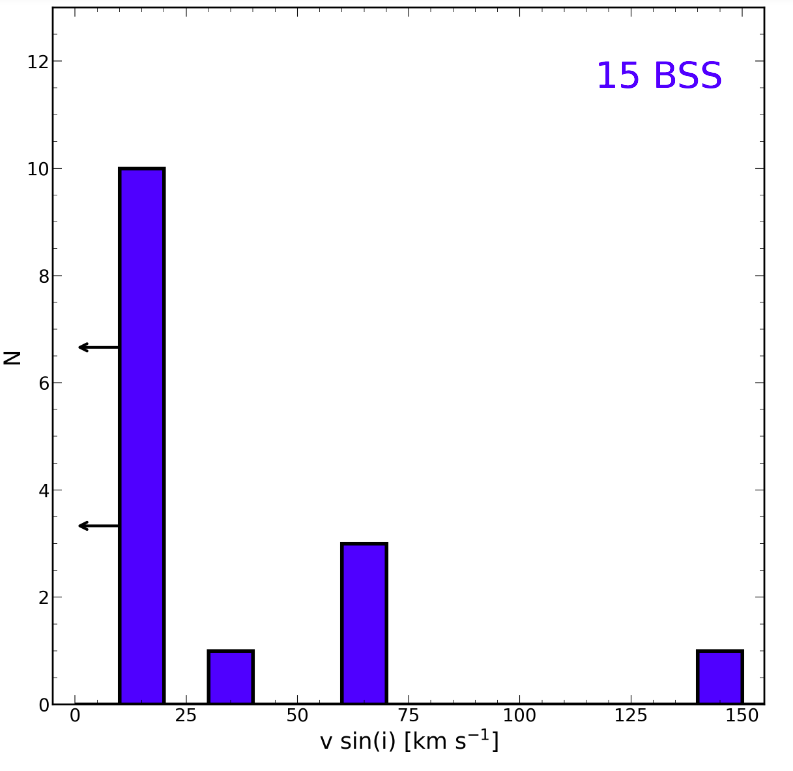
Figure 2: Rotational velocity distribution of the 15 BSSs analyzed in the paper. The left arrows indicate the upper limit of 15 km/s adopted for very slow rotating BSSs. The quantity represents the projected rotational velocity, where is the inclination angle between the rotation axis of the star and the line of sight. Source: Figure 4 in today’s paper.
The high rotational velocity can be interpreted as evidence of recent BSS formation, meaning that the faster it spins, the younger it is (just like kids that seem to never get tired). This is because the mechanisms that make the BSSs slow down have not yet had time to dominate. Additionally, no clear trend was found between the rotational velocities of BSSs and their radial distributions within the cluster, meaning that the rotation of a BSSs may be completely unrelated to its position inside the cluster.
Next steps
While this study helps to highlight the importance of understanding BSS formation, and the mechanisms to do it via spectroscopy and rotational velocity, there is still a lot of work to be done. These results, compared to other studies of the same field, create room to contrast different hypotheses, such as the large rate of binary interactions that may explain the broad percentage of FR-BSSs in NGC 1851.
In order to verify these conclusions, further work is needed with a larger sample of BSSs and even higher quality spectral data. This is a challenge with the currently available instrumentation, but will be possible in the future with further advances in instrumentation and analysis.
Astrobite edited by Ryan White
Featured image credit: ESA/Hubble, M. Kornmesser, Arthur Magalhães (Canva)
