Title: Eridanus III and DELVE 1: Carbon-rich Primordial Star Clusters or the Smallest Dwarf Galaxies?
Authors: Joshua D. Simon, Ting S. Li, Alexander P. Ji, Andrew B. Pace, Terese T. Hansen, William Cerny, Ivanna Escala, Sergey E. Koposov, Alex Drlica-Wagner, Sidney Mau, Evan N. Kirby
First Author’s Institution: Observatories of the Carnegie Institution for Science, 813 Santa Barbara St., Pasadena, CA 91101, USA
Status: Published in the Astrophysical Journal (2024 November 27) [open access]
What is that Thing, anyway?
Imagine you’re an astronomer with access to the data of a powerful survey telescope. After combing through the survey’s many images, you discover a blurry clump of dots in the outskirts of the Milky Way. “Could be noise, but could also be a thing,” you mumble to yourself. If it is something, then it must be a tiny and faint satellite orbiting around our Galaxy.
You run a few statistical tests and find that the clump of dots is indeed a Thing. You then run even more tests and find that most of the dots are stars of the Thing (the others are either foreground Milky Way stars or distant background galaxies). For good measure, you also check the literature to see if others have found the same Thing. When you find no other papers on your Thing, your veins start to rush with excitement. Congratulations, you just discovered a new Thing!
But what is that Thing, anyway? Once upon a time, it was relatively straightforward to answer this “what” question. If the Thing is small in size (smaller than 10 pc in radius), doesn’t live in a dark matter halo, and its constituent stars have reasonably similar chemical compositions, then it’s probably a globular cluster. Otherwise, if it’s large in size (larger than 10 pc in radius), lives in a dark matter halo, and its stars have noticeably different chemical compositions, then it’s probably a dwarf galaxy. Figure 1 (Figure 1 in the paper) shows the easily separable groups of dwarf galaxies (blue dots) and globular clusters (gray triangles) in size-luminosity space.
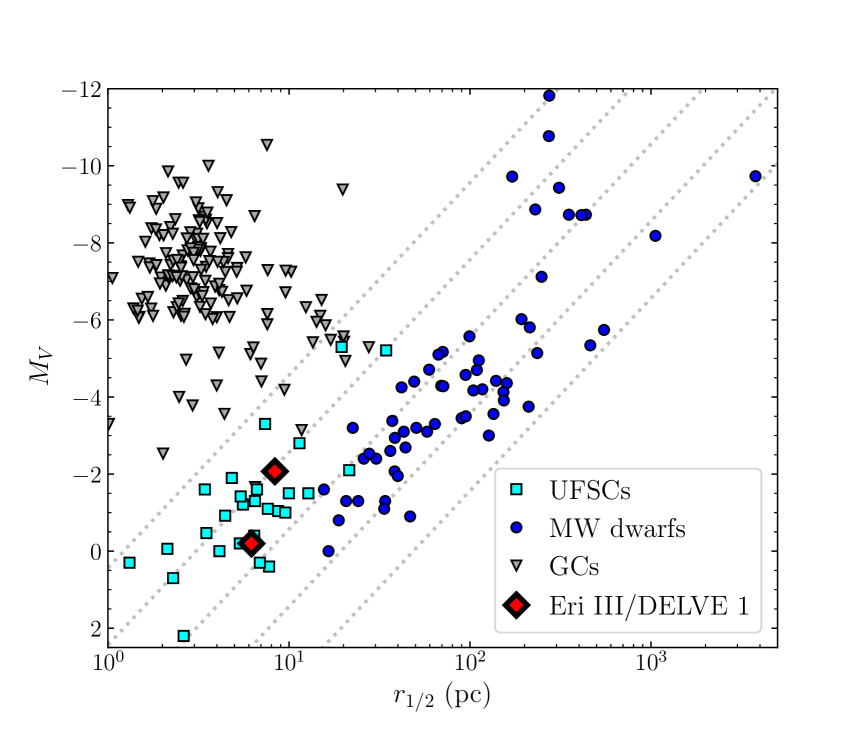
Now, however, the distinction between clusters and dwarfs is no longer as cut and dry. With more powerful surveys like DELVE, Pan-STARRS, and the Dark Energy Survey, we have discovered objects that are kind of like dwarfs but also kind of like clusters. These objects live in the “valley of ambiguity,” the region roughly occupied by the cyan squares in Figure 1. Many of these objects have not been definitively confirmed as clusters or dwarfs.
Two of these classification-defying objects are Eridanus III (aka Eri III) and DELVE 1—the subjects of today’s paper. Their chemical abundances suggest that they could be dwarf galaxies but their tiny half-light radii (8 pc for Eri III and 6 pc for DELVE 1) suggest that they could be clusters. In either case, Eri III and DELVE 1 would be among the most extreme objects of their kind!
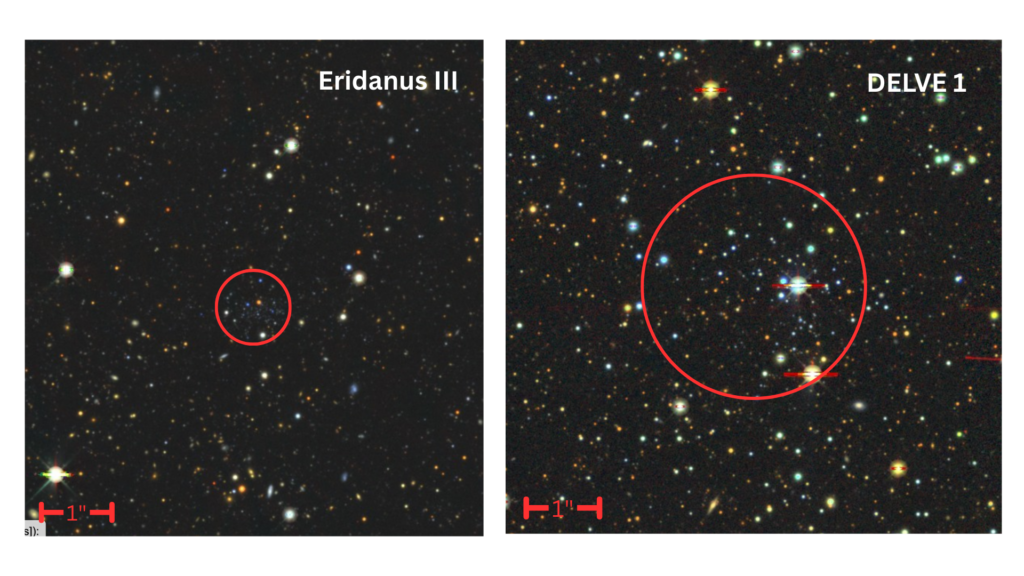
Figure 2 shows DESI images of the two objects, and if you’re squinting at them wondering where exactly Eri III and DELVE 1 are—don’t worry, that’s the point. These systems are hard to find. Almost all of the dots inside the circles are impostors: foreground Milky Way stars or distant background galaxies masquerading as members. In fact, only eight stars in each system are confirmed as true members. This Hubble image of Leo IV, another ultra-faint dwarf galaxy, is yet another example showing the challenge of teasing out the members from the contaminants.
Today we dive into the detailed work of classifying (or attempting to classify) Eri III and DELVE 1. While this classification might seem like a pedantic taxonomic exercise, it is not. Dwarf galaxies and globular clusters are principally governed by different physical phenomena. For instance, dwarf galaxies reside in dark matter halos, whose deep gravitational potential wells allow them to retain gas and metals, leading to their more complex chemical evolution. Globular clusters, by contrast, lack dark matter halos and are therefore unable to sustain prolonged chemical enrichment.
With more objects like Eri III and DELVE 1 waiting to be discovered by future surveys, we need to know how to classify these objects now.
…Could be a cluster?
Eri III was discovered in 2015 through the Dark Energy Survey, while DELVE 1 was discovered in 2020 through the DELVE survey (though notably both surveys were on the same telescope). As part of a larger effort to classify ambiguous systems like these, the authors obtained medium-resolution spectra of their stars using an instrument called IMACS at Las Campanas Observatory in Chile.
These medium-resolution spectra provide information on the stars’ velocities and metallicities—and consequently their membership within Eri III or DELVE 1. If a certain star has a velocity or metallicity that is similar to that of other stars in the system, then it is likely to be a member. Otherwise it is rejected and identified as a foreground star.
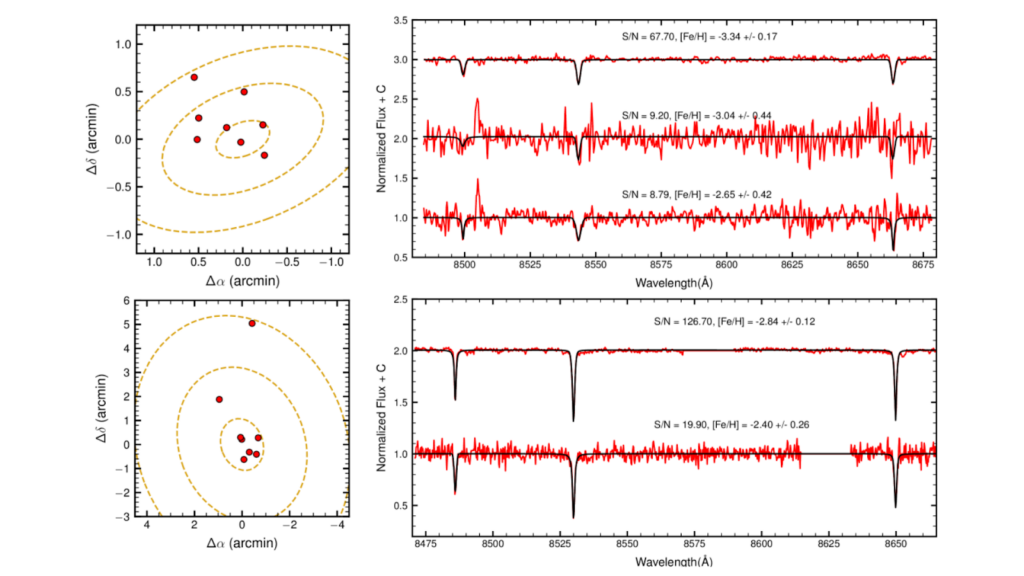
The authors found 8 member stars for Eri III, all of which are moving away from the Sun at around 50 km/s and have metallicities of around [Fe/H] = -3.2 (equivalent to 0.06% the metal content of the Sun). Likewise, they found 8 member stars for DELVE 1, but this system is moving faster at 400 km/s towards the Sun and is relatively more metal-rich at [Fe/H] = -2.7 (equivalent to 0.2% the metal content of the Sun). Figure 3 (Figure 3 in the paper) shows the distribution of the member stars in the sky as well as medium-resolution spectra of selected members.
Another important quantity that the authors calculated for both systems is velocity dispersion, i.e., the spread of velocity values. Systems with larger velocity dispersions are likely to live in a dark matter halo and are consequently identified as dwarf galaxies. Unfortunately, because only a few stars had measured velocities and the measurements had large uncertainties, the authors could only place upper limits on their velocity dispersions: <9.1 km/s for Eri III and <1.2 km/s for DELVE 1.* Much smaller dispersions of <1 km/s are expected if they were clusters. These weak constraints cannot rule out the possibility of dark matter in both systems. Therefore, Eri III and DELVE 1 cannot be clearly identified as clusters.
…But also could be a dwarf?
To learn more about these systems, the authors obtained high-resolution spectra of the brightest star in Eri III (named Eri III-S1) and the same in DELVE 1 (likewise named DELVE 1-S1). These spectra were obtained using the MIKE spectrograph, also at Las Campanas Observatory.
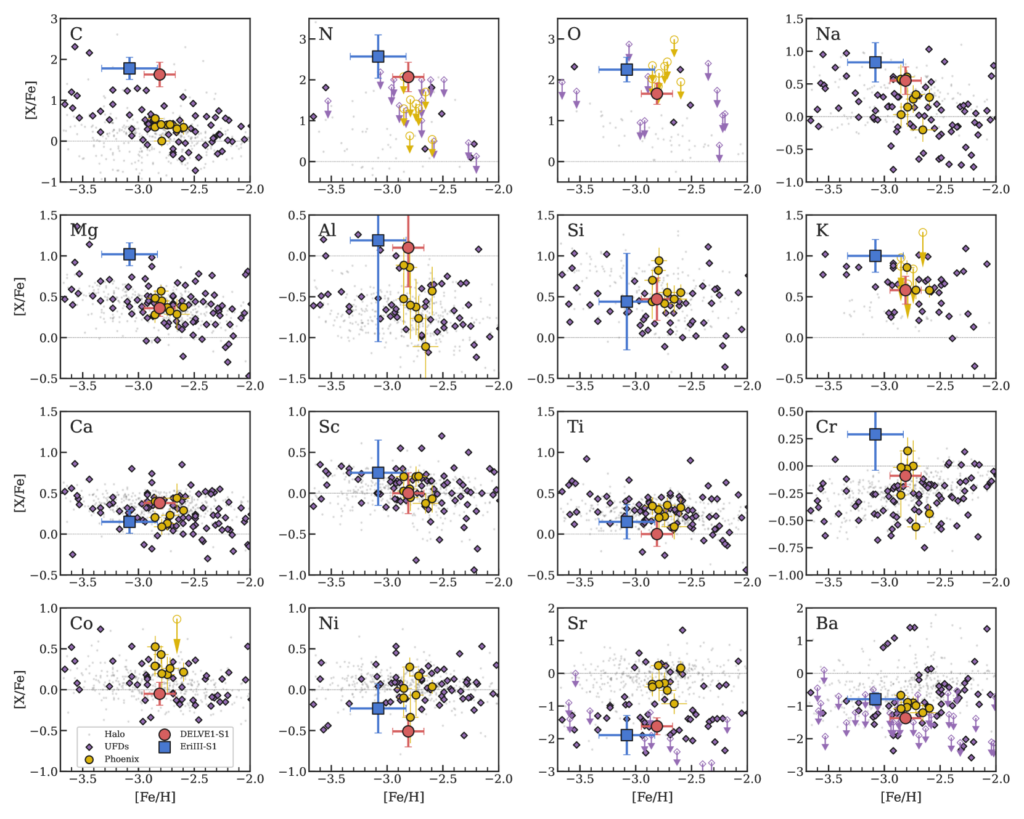
Interestingly, both of these bright stars are 1) extremely metal-poor (i.e., poor in iron) and 2) highly enhanced in carbon and nitrogen, with 3) particularly low abundances of strontium and barium (the so-called “neutron-capture elements“). Figure 4 (Figure 5 in the paper) shows the chemical abundances of these stars relative to stars in dwarfs and stars in a (former) globular cluster.
Stars with these three chemical characteristics have never been found inside globular clusters. Not only that, carbon-rich cluster members are typically nitrogen-poor, unlike Eri III-S1 and DELVE 1-S1 which are both rich in carbon and nitrogen. In addition, the Milky Way doesn’t have any surviving clusters with metallicities this low. We’ve only found former clusters—now observable as stellar streams (see this bite on them!)—with similar metallicities.
On the other hand, these chemical characteristics fit well with the general patterns observed in ultra-faint dwarf galaxies. So can we now say that Eri III and DELVE 1 are dwarf galaxies? Well, not quite. Eri III and DELVE 1 have radii of 8 pc and 6 pc, respectively, at least a factor of 3 smaller than the smallest previously confirmed ultra-faint dwarf galaxy. How do you get a galaxy to be this small? Perhaps these galaxies were bigger but tidal stripping (where the galaxy’s tidal forces tear a stellar system apart) could have reduced them to their diminutive sizes. Unfortunately, their metallicities don’t align with this stripping hypothesis.
tl;dr: We still don’t know ¯\(ツ)/¯
In light of all the evidence, the authors still cannot conclusively classify Eri III and DELVE 1. In order to get a clearer identification, they suggest getting chemical abundances for more stars in both systems. Alternatively, they also suggest gathering more data on similar ambiguous systems.
Nonetheless, whichever bin Eri III and DELVE 1 end up in, we are sure to learn about an exciting new regime of astrophysics.
If they are clusters, then we would learn about chemical evolution never before seen in clusters. Given their extremely low metallicities (which could indicate their very old ages), these clusters might even carry clues about how chemical enrichment happened in the earliest epochs of the universe.
On the other hand, if they are dwarf galaxies, then we would have found some of the smallest galaxies ever discovered. This could have crucial implications for our understanding of dark matter and galaxy formation at the smallest scales. Soon, the Legacy Survey of Space and Time at the Rubin Observatory will release its first deluge of data; and just like its predecessors, it will likely discover more ambiguous systems like Eri III and DELVE 1. How will these tiny, confusing objects change our broader understanding of the universe?
Astrobite edited by Sarah Stevenson
Featured image credit: Legacy Surveys / D. Lang (Perimeter Institute)