
Title: Clump-like Structures in High-Redshift Galaxies: Mass Scaling and Radial Trends from JADES
Authors: Yongda Zhu , Marcia J. Rieke , Zhiyuan Ji , Andrew J. Bunker , Courtney Carreira , A. Lola Danhaive, Qiao Duan , Eiichi Egami , Daniel J. Eisenstein et al.
First Author’s Institute: Steward Observatory, University of Arizona, Tucson, AZ, USA
Status: Preprint on arXiv
If you want to understand how galaxies build their structure, you can learn a lot by studying their “clumps”. In the local Universe, star-forming disks often look fairly smooth, with starlight spread out across spiral arms and diffuse regions. But at high redshift, many galaxies look much more “clumpy”, their light is broken up into compact, bright knots that stand out against the rest of the galaxy. The catch is that we still do not know what clumps do over their lifetimes. Are they short-lived bursts that get shredded by feedback, or can they survive, drift inward, and help build central bulges?
This paper approaches that question with a big sample using JWST/NIRCam imaging from JADES, looking at clump-like structures across roughly 2 ≲ z ≲ 8 in about 3600 galaxies to ask what clumps look like on average, and how their properties change with cosmic time and distance from the center of their host galaxies.
Finding clumps can be tricky, because they are not separate objects floating in space, but are embedded in a galaxy. So the authors fit each galaxy with a Sérsic model (a standard parametric model for galaxy light profiles), subtract it, then identify significant residual peaks as clump candidates using an image processing method called watershed segmentation . They detect clumps in a band close to rest-frame 5000 Å to keep the selection roughly consistent across redshifts.
Once clumps are defined, the first question is: how clump abundance varies across galaxies and cosmic time?
The authors find that clump frequency increases from earlier cosmic times (higher redshift) to a peak around z ∼ 2 (Cosmic Noon), although they caution that incompleteness becomes important at the highest redshifts. In very distant galaxies, clumps can be harder to identify because the galaxies are fainter and less well resolved, and the central regions are more crowded. Interestingly, the number of clumps correlates more strongly with the Gini coefficient than with the Sérsic index. The Gini coefficient is a measure of how unevenly the light is distributed among pixels. High Gini here usually means the galaxy has multiple bright regions rather than a smooth profile. In other words, “clumpiness” is captured better by internal light contrast than by a single Sérsic shape parameter.
To connect structure to physics, the team fits clump photometry with Prospector (using the Parrot emulator for speed). Deblending from the host galaxy is not perfect, so properties like age should be treated cautiously, but the headline result is that typical clumps are low mass (around 10^7–10^8 solar mass) and they are actively star-forming with modest dust.
Size–mass scaling with a twist
A classic question is whether a clump is a self-gravitating structure, meaning a tightly bound group of stars and gas, or a looser, short-lived overdensity in a turbulent disk. One simple observational clue is a size–mass relation: do more massive clumps tend to be bigger, and with what slope?
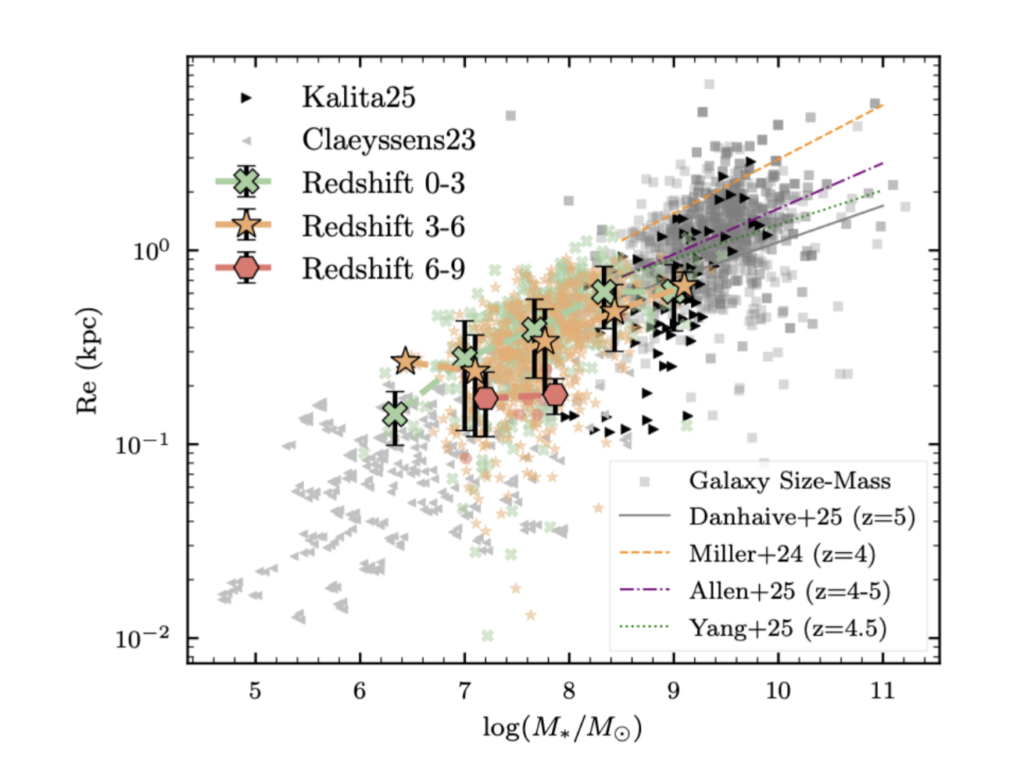
The authors find a clear positive size–mass trend, and they also find that clumps are larger at later cosmic times at fixed stellar mass. In the data, typical clump sizes drop from about 0.4 kpc at z ∼ 2.5 to about 0.25 kpc at z ∼ 7, and the average separation between clumps within galaxies also decreases toward higher redshift (Figure 1). This matches the intuitive picture of the early Universe: galaxies were smaller, denser, and likely more turbulent, so fragmentation happens on smaller physical scales.
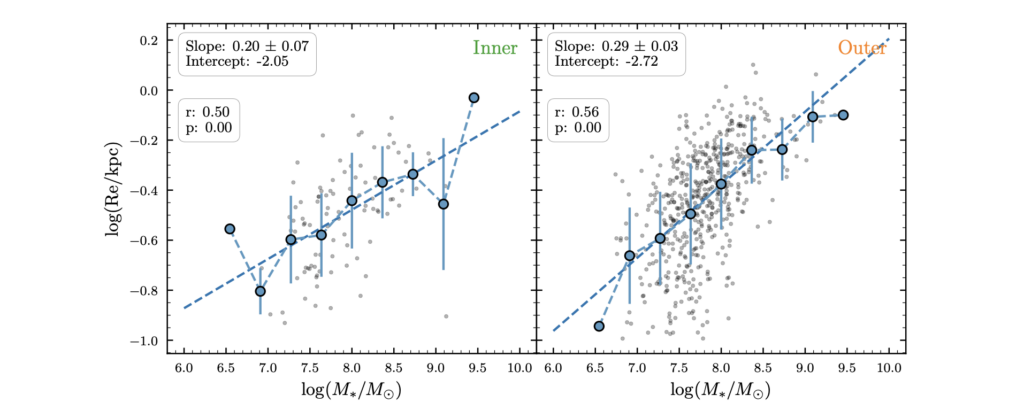
The twist comes when clumps are split by galactocentric radius (normalized by the galaxy effective radius Re). Outer clumps follow a steeper size–mass slope, closer to what you might expect for more self-gravitating structures, while inner clumps near the center show a flatter relation and are more compact for their mass (Figure 2). That pattern fits naturally with the idea that clumps evolve as they move inward, through compression, disruption, or both.
No young clumps in the center?
The authors also look at inferred clump age versus radius and find a pattern: there is a central region (roughly R/Re ≲ 0.3) where young clumps are underrepresented. They call this a central “deadzone”.
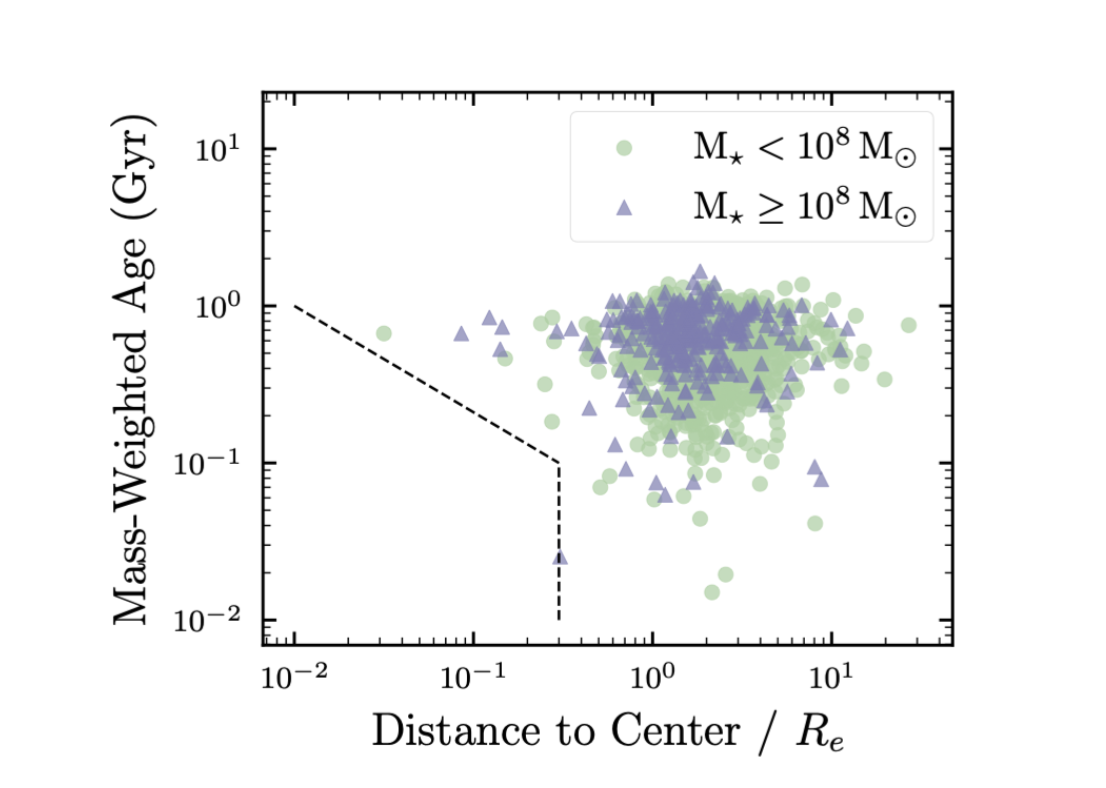
They are careful about interpretation. A deadzone could be physical, for example if clumps migrate inward and become older near the center, or if feedback and shear destroy young clumps before they can survive in the inner environment. But it could also be partly observational, because subtracting a bright Sérsic model near the center can make it harder to reliably detect central clumps. Their injection-recovery tests show that completeness does decline toward galaxy centers, so some of the deficit could be enhanced by detection bias, even if the trend is not purely an artifact.
Finally, the paper measures the clump stellar mass function, the distribution of clump counts as a function of mass. They find it follows a power law with slope α ≈ −1.5 (over the completeness-limited range they adopt). In other words, low-mass clumps are much more common than high-mass clumps, but not as extreme as some “self-similar” expectations. This slope is consistent with a picture where clumps form via fragmentation in turbulent disks, shaped by gravity plus feedback, rather than being dominated purely by mergers or by a single, self-similar fragmentation process that would produce the same pattern at all mass scales.
Why this matters
Clumps are not just pretty substructures. If a fraction of massive clumps survive long enough to migrate inward, they can transport mass toward galaxy centers and contribute to bulge growth and morphological transformation. What this paper adds is a large-sample, JWST-based view that connects three clues into a consistent story: (1) clump sizes and spacing evolve with redshift, (2) clump structure changes with radius in a way consistent with inward evolution, and (3) there is a central region where young clumps are rarer. Together, these trends provide new observational constraints on how fragmentation, survival, and migration shape galaxies during the peak era of galaxy assembly.
Astrobite edited by: Ansh Gupta
Featured Image Credit: Niloofar Sharei (Made in Canva)
