
Authors: S. Marino,⋆, L. Matrà, A. M. Hughes, J. Ehrhardt, G. M. Kennedy, C. del Burgo, A. Brennan, Y. Han, M. R. Jankovic, J. B. Lovell, S. Mac Manamon, J. Milli12, P. Weber, B. Zawadzki, R. Bendahan-West, A. Fehr, E. Mansell, J. Olofsson, T. D. Pearce, A. Bayo, B. C. Matthews, T. Löhne, M. C. Wyatt, P. Ábrahám, M. Bonduelle, M. Booth, G. Cataldi, J. M. Carpenter, E. Chiang, S. Ertel, A. S. Hales, Th. Henning, Á. Kóspál, A. V. Krivov, P. Luppe, M. A. MacGregor, J. P. Marshall, A. Moór, S. Pérez, A. A. Sefilian, A. G. Sepulveda, and D. J. Wilner
First-author institution: Department of Physics and Astronomy, University of Exeter, Stocker Road, Exeter EX4 4QL, UK
Status: Published in Astronomy & Astrophysics (Open Access)
Searching for Young Exoplanets
Much of our understanding of exoplanetary systems has come from our own solar system and our observations of exoplanets. Astronomers use a variety of techniques, like measuring the change in starlight when exoplanets transit across their host star; measuring how they gravitationally pull on; even taking photos of the exoplanets directly. And there are still more techniques to list! But planets can be tens-to-hundreds-to-thousands of millions of years old. Observing younger planets can be more complex, often due to their protoplanetary discs hiding them, making it very difficult to detect them reliably.
However, not all is lost when it comes to finding young planets! After the protoplanetary disc is dispersed (scientists are working on the “how”), the host star can be left with a Kuiper belt-like object – an exoKuiper belt (or “debris disc”). Studying structure of the dust in debris discs can reveal how planets might be influencing the disc’s shape, so good observations are super important. There is, of course, a catch – current observations lack the resolution to truly understand the nature and structure of these debris discs, which is why the ARKS program (ALMA survey to Resolve exoKuiper belt Substructres) was created. It was specifically designed to acquire these much-needed, high-res observations for the first time. Today’s article gives an overview of this survey.
The ARKS’ Destination
Before we spoil the outcome, it’s worth knowing the goals of ARKS. The survey sought to find out how the dust and gas is distributed radially; how the dust is distributed vertically; and how the Carbon Monoxide (CO) gas in these exoKuiper belts is moving. The first two goals link directly to planets – how are they stirring up the dust and sculpting the asteroid-sized planetesimals that make up these exoKuiper belts? Previous surveys, like the REASONS Survey, however, lacked the resolution required to answer these questions. Cue the ARKS survey!
The Discs Aboard the ARK
The observations from the ARKS survey can be seen in Figure 1. The dust in these discs shows massive ring structures. First results show diversity in disc structure – some of them are very narrow (and may have therefore come from the preceding protoplanetary disc) and others are much broader. About a third of these discs exhibit gaps within their rings – substructure – which might be a sign of hidden planets!
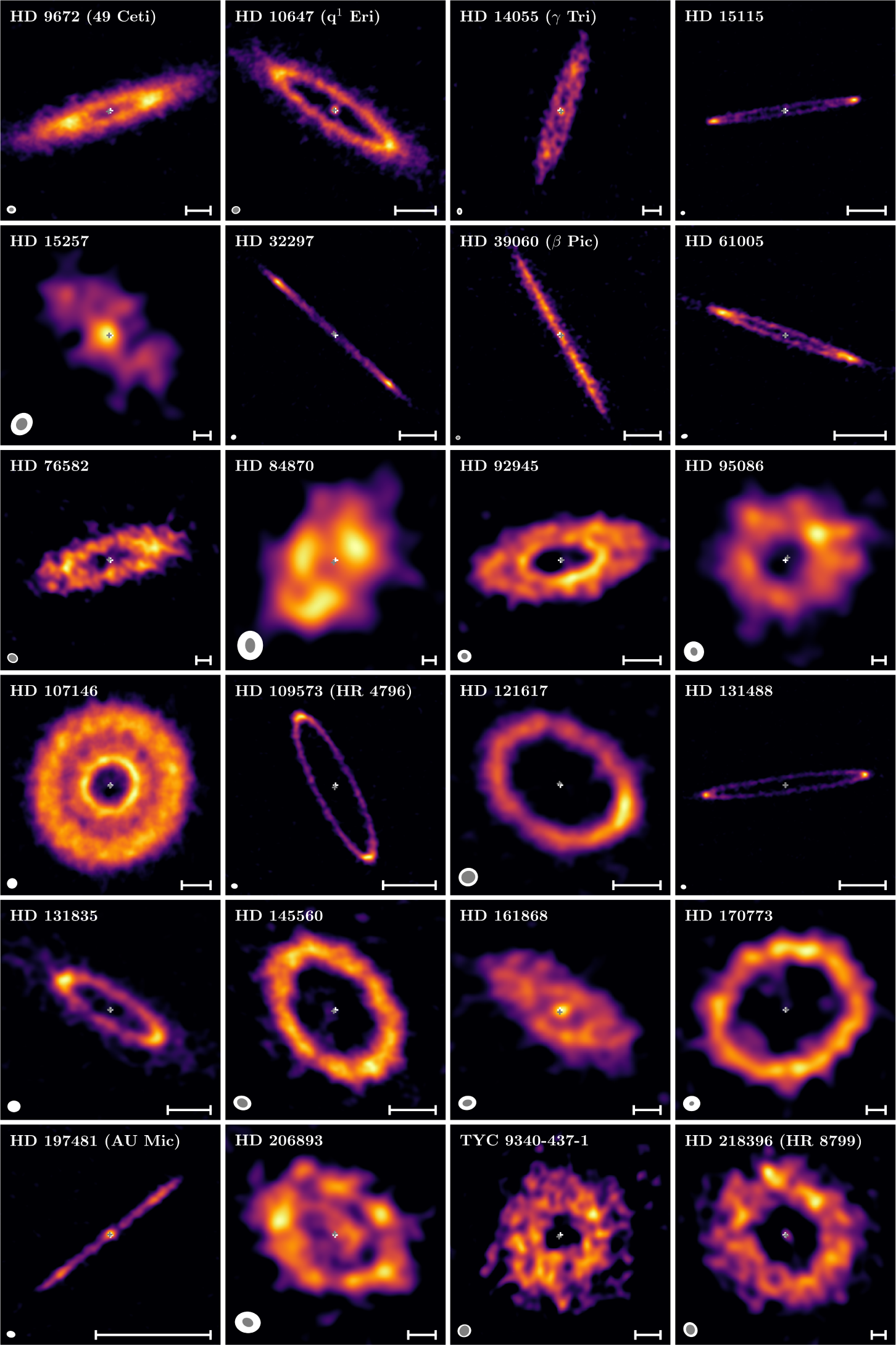
Regarding the vertical distribution of dust, the authors find that the discs exhibit a wide range of vertical extents – some are very thin, whereas some are a little thicker. The vertical distribution of the dust in debris discs is often modelled with a Gaussian distribution, although the authors find that non-Gaussian distributions, like Lorentzians, are a better fit to the data. They argue that this hints at multiple dust and planetesimal populations, highlighting the complexity of debris discs.
Finally, the authors looked at the observations of CO gas, shown as the blue rings in Figure 1. The authors found that the gas rings tend to be broader than the dust rings, and speculate on the origin of the gas. If it was recently produced in the debris disc by collisions between planetesimals (called “secondary origin”), then the gas may have broadened on its own. But if the gas came from the parent protoplanetary disc (called “primordial origin”), then the origin of the gas becomes a lot less clear. The authors hope that future work will help elucidate on where this gas comes from.
If the gas was produced in the debris disc phase (i.e. very recent, called “secondary origin”), then this breadth might be evidence of the gas being produced from planetesimal-planetesimal collisions, and then evolving on its own. If it has lingered from the protoplanetary disc phase (i.e. “primordial origin”), then the story is different: the origin of the gas isn’t as clear.
The ARKS survey has revealed a wealth of new information about debris discs. In fact, there are ten papers already published on this survey alone, which you can find on the ARKS survey’s dedicated website if you’d like to learn more. With this new data, astronomers will be able to learn much more about how exoplanets shape exoKuiper belts in other solar systems, helping hone in the search for the pesky celestial rocks.
Disclaimer: J. Williams is a member of the same faculty as the first author, S. Marino, but was not involved in the research carried out in the presented article.
Astrobite edited by Drew Lapeer.
Featured image credit: ARKS Collaboration
