Authors: J. Jackman, P. Wheatley, C. Pugh, D. Kolotkov, A. Broomhall, G. Kennedy, S. Murphy, R. Raddi, M. Burleigh, S. Caswell, P. Eigmueller, E. Gillen, M. Guenther, J. Jenkins, T. Louden, J. McCormac, L. Raynard, K. Poppenhaeger, S. Udry, C. Watson, R. West
First Author’s Institution: University of Warwick Centre for Exoplanets and Habitability, Coventry, England
Status: Accepted to Monthly Notices of the Royal Astronomical Society [open access]
If you live above 40° north latitude, you may have seen a colorful aurora during the February and November solar storms. Our Sun produces intense, high-energy bursts called solar flares. Occasionally, these flares are accompanied by coronal mass ejections (CMEs), large masses of plasma ejected from the flare location. If the CME collides with Earth, the ions in the ejected plasma can produce vibrant auroral lights, which you may have seen in images on the news or on social media. Although solar storms can disrupt satellites and electronics, the rarity of extreme flares means they pose no existential threat to life on Earth. However, on far more active stars in the galaxy, flares may significantly challenge the habitability of their exoplanets.
On the Origins of Stellar Flares
Stars are giant balls of plasma that produce light and energy through fusion. Energy transfer in stars is primarily driven by convection and radiation. The convection of plasma generates magnetic fields that permeate the surface of lower mass (<1.5 times the mass of the Sun, M☉) stars. Like rubber bands, these magnetic field lines can “twist” (known as magnetic helicity), storing energy that can build up and be released in a process called magnetic reconnection, producing stellar flares and CMEs. This process is highlighted in Figure 1.
M Dwarfs as Exoplanet Hosts
M dwarfs are cool, small stars around half the size of the Sun with surface temperatures < 4000 K (in astronomy this temperature is known as the effective temperature, Teff). They are the focus of many exoplanet habitability studies for three main reasons. First, they are the most common type of star in the Milky Way (~70% of all stars). Secondly, M dwarfs are the stars around which exoplanets are most easily detected. Their small radii make exoplanet transits deeper and easier to see. Lastly, the low temperatures of M dwarfs lead to habitable zones much closer to the star. Potentially habitable exoplanets therefore transit with greater frequency, which leads to higher data volume and more robust characterization.
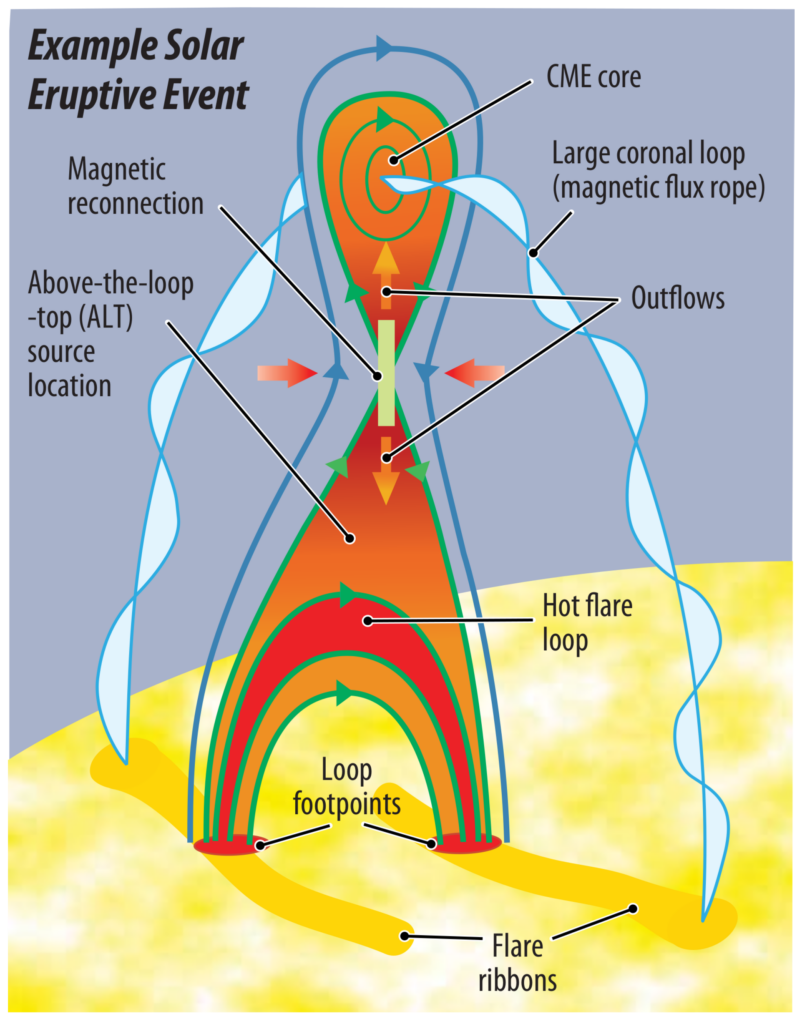
The strong convective envelopes of M dwarfs drive powerful, complex magnetic fields, producing frequent and violent stellar flares and CMEs. Potentially habitable planets wind up in the cross-hairs of this space weather, leading to questions about whether intense and frequent flares can prevent the development of life around these stars. Today’s authors present the detection of such a flare around the M dwarf NGTS J121939.5–355557 using the Next-Generation Transit Survey (NGTS). By analyzing the energy and frequency of flares around this star, the authors aim to understand the conditions life must contend with around similar stars.
Explosive Developments
Stellar flares are commonly observed in long-duration survey missions, such as the Kepler, Transiting Exoplanet Survey Satellite (TESS), and NGTS missions. Figure 2 shows the data obtained by NGTS, during the flare’s progression. The primary metric to characterize flares is the bolometric flare energy, or the total energy of the flare across all wavelengths of light. Flares release energy across the electromagnetic spectrum, but are almost always observed in a single wavelength band. To estimate the flare energy, we need two ingredients: the area under the flare curve, computed from the data in Figure 2, and the ratio of the spectral energy density between the star and the flare, which compares how much energy the star and the flare emit in the observing range. The flare spectral energy density is assumed to be a blackbody with Teff=9000±500 K. The authors find the energy of this flare to be 3.2±4.2×1029 Joules, which is 10,000 times more energetic than our Sun’s Carrington Event, the most energetic solar flare ever recorded! This estimate is also likely lower than the flare’s true energy, given that the observation started midway through the flare’s progress.
Another important metric with regard to the habitability around flaring stars is the flare occurrence rate, which describes how often flares of a particular energy occur on a given star. This is estimated by first measuring the energies of many flares over time, then calculating the rate of flares of a certain energy over a given time frame. In this star’s case, the authors predict 70 flares per year with an energy of at least 1026 Joules, which is ten times more energetic than the Carrington event!
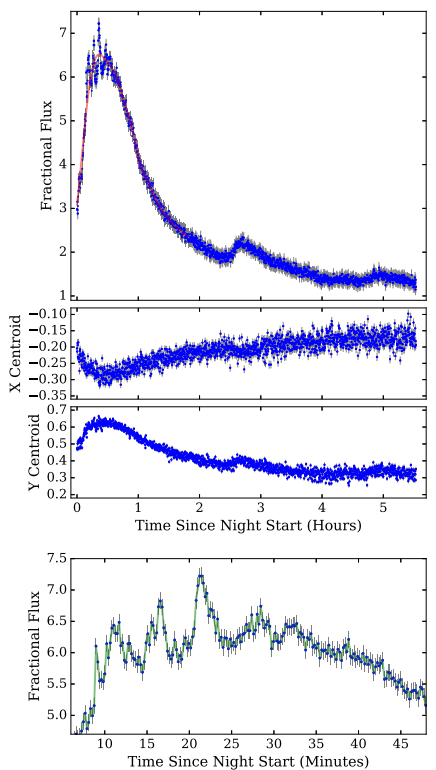
Figure 2. Top: A plot showing the fractional flux of NGTS J121939.5–355557 over time. The ‘quiet’ flux of the star is set at 0. The scale indicates that the star became 7.2 times brighter than normal at the flare’s peak. Notable features include the two peaks at ~0.5 hr and ~2.6 hr. Middle: Plots showing how flux changes with position on the detector. Bottom: A zoomed-in look at the flare’s peak.
Life Burned Out, or Rising from the Ashes?
The authors highlight the potential effects that such events can have on forming and existing planets. Frequent CMEs can weaken the formation of planetary magnetic fields, which can increase the risk of photoevaporation, the loss of atmosphere due to stellar radiation. Additionally, flares are known to be strong sources of X-rays and UV radiation, which can erode protective atmospheric layers like ozone and damage organic compounds like DNA (the same reason why it’s so important to wear sunscreen!). With frequent and energetic events like the one in this study, planetary safeguards like the magnetosphere and atmosphere are at great risk. While the X-rays and UV radiation may be hazardous to existing life, the authors propose that these flares could actually catalyze the creation of life from pre-biotic chemical compounds. Because M dwarfs are so cool, they do not emit strongly in the near-ultraviolet (NUV) compared to Sun-like stars. NUV is thought to play a key role in abiogenesis, which is the generation of life from lifeless compounds. So, if their hypothesis is correct, the additional NUV radiation from frequent flares could actually help planets around M dwarfs to develop life!
Are planets around M dwarfs doomed to be inhospitable and lifeless? Only by deepening our understanding of the space weather around our most common, but ill-tempered, stellar neighbors can we answer the most profound question that faces us: are we alone in our galaxy?
Astrobite edited by Laurie Amen & Ansh Gupta
Featured image credit: NASA, ESA, D. Player (STScI)