
Title: Stability of a Schwarzschild Singularity
Authors: Tullio Regge, John A. Wheeler
First Author’s Institution: Istituto Di Fisica della Università di Torino, Torino, Italy
Status: Published in Physical Review (1957) [closed access]
Today, “black hole” is a familiar term to both astrophysicists and science-fiction fans. From LIGO’s gravitational-wave detections to Interstellar’s iconic visuals, these objects feel almost mainstream. However, in the 1950s, this term hadn’t even been coined. Long before the term existed, John Wheeler and Tullio Regge were studying whether these objects were stable against gentle disturbances. Their work, as discussed here, laid the groundwork for what we now call black hole perturbation theory and introduced tools that remain central to the field.
What were Regge and Wheeler trying to do?
We now understand that Einstein’s theory of general relativity establishes that gravity is not a force but the bending of spacetime by anything with mass or energy. This relationship is mathematically depicted in the Einstein Field Equations. These equations admit many solutions, each describing a different spacetime geometry produced by a particular distribution of matter and energy. An important one is the Schwarzschild solution, which captures the precise geometry of spacetime outside a spherical mass. This makes it the most straightforward example of how a still, round object warps the space around it. But in the 1950s, its physical meaning was far less obvious.
This is what the authors of today’s paper wanted to explore: what happens when you poke this perfect shape? Does it settle down or blow up? (See Figure 1.) The motivation behind this work was to establish if such an object could exist in the physical world.
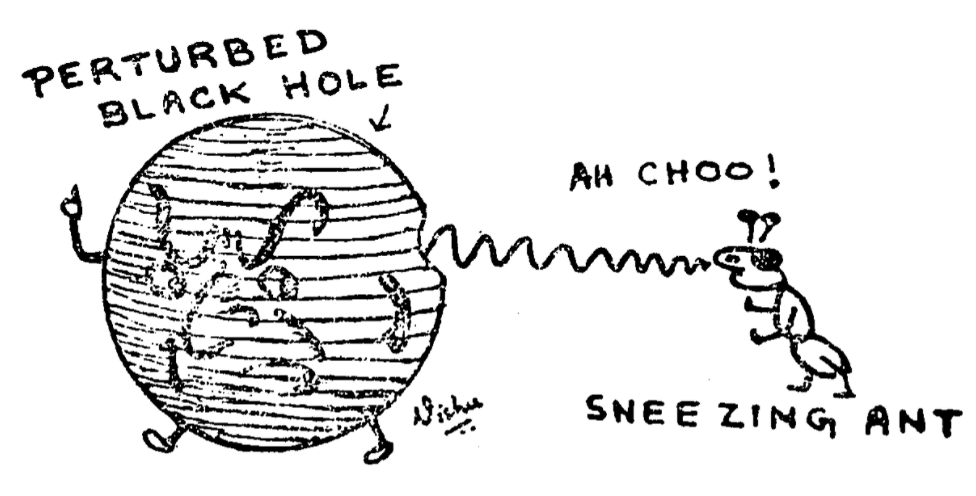
How do you poke a black hole?
To see how a black hole responds to a nudge, you gently disturb the shape of its spacetime — almost like tapping a bell to hear how it rings. Instead of staying perfectly round, the black hole’s geometry wiggles just a little. The authors studied these wiggles by breaking them down into components using spherical harmonics, the same mathematical patterns used for modeling the shapes of atomic orbitals. This separation produces two types of perturbations, where each one describes a different kind of distortion of the sphere:
- Odd (axial) modes: These twist the sphere, and are linked to angular momentum-like distortions.
- Even (polar) modes: These squash and stretch the sphere, and are more like radial deformations.
The authors state, “Different waves can represent the same physical phenomena viewed in different systems of coordinates”, implying how not all of these distortions reflect real perturbations in spacetime. Some of these are simply artifacts of how the coordinates are chosen. They used this freedom to strip away these non-physical terms, and this streamlined description became the Regge–Wheeler gauge, a benchmark for how these calculations are done today.
The Regge-Wheeler Equation
For the twisting, odd-parity disturbances of a Schwarzschild black hole, the authors discovered something remarkable: the entire complicated problem reduces to one elegant ‘master equation’:
\[ \frac{d^2 Q}{dr^{*2}} + \big[ \omega^2 – V_{\text{RW}}(r) \big] Q = 0. \]Here, Q measures the size of the perturbation, r* is a radial coordinate (the “tortoise” coordinate) that rescales distances so that the horizon appears infinitely far away, ω is the frequency of the oscillation, and VRW(r) is an effective potential that tells how the black hole responds to a small external disturbance. What makes this equation so powerful is that it looks almost exactly like the Schrödinger equation from quantum mechanics. That similarity gives an immediate intuition for what the solutions mean:
- If the solution oscillates, like a regular wave trapped in a potential, the spacetime simply “rings”, loses energy and settles down.
- If the solution grows uncontrollably, it would indicate a true instability in the black hole’s geometry.
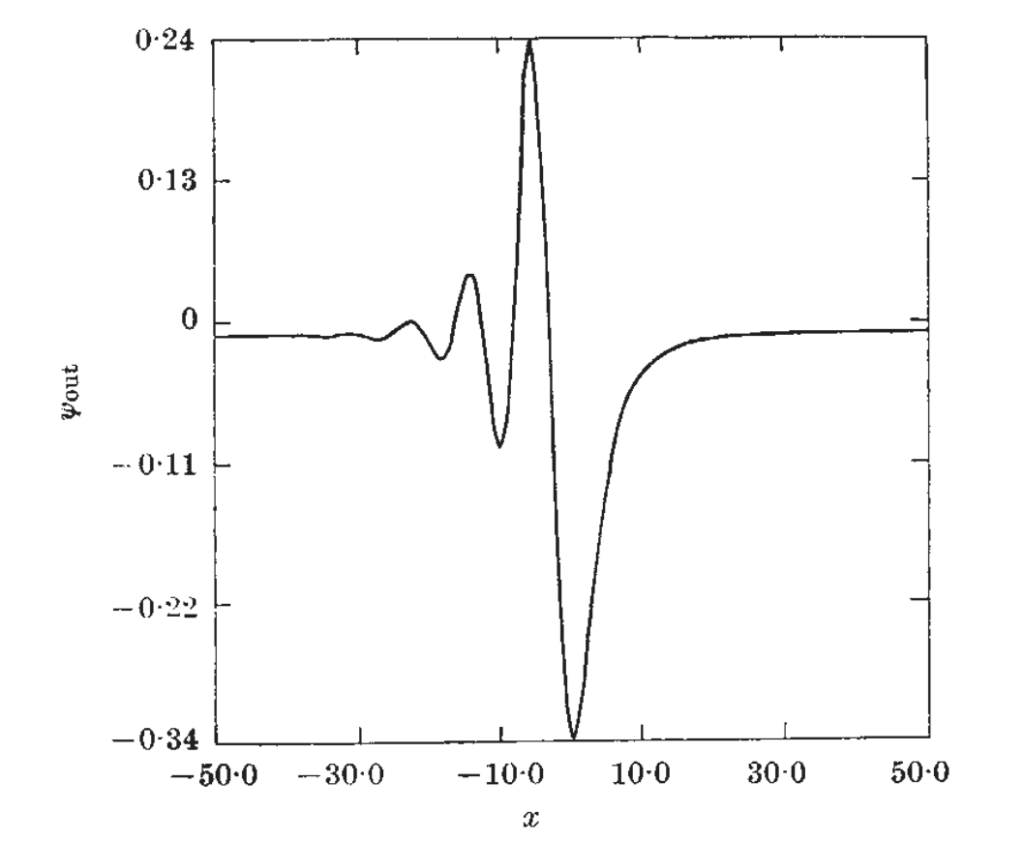
The authors found oscillatory solutions that lose energy over time, showing that the Schwarzschild black hole is dynamically stable (See Figure 2). This was the first demonstration that black holes are not fragile mathematical curiosities but physically plausible objects that ring like bells.
The story of how this result came together is just as striking as the physics itself. Here is an excerpt from Wheeler’s autobiography where he describes working with Regge on the problem:
“Since I had a vision of how the whole problem should be tackled and how it would work itself out, I sat down and wrote a paper with spaces left for equations, and sent it to Regge. He rose to the occasion, and filled in the blanks. Then, early in 1956, I was able to round up travel funds … to bring Regge to Leiden [Netherlands, where I was on an 8 month sabbatical, January to September]. We spent ten days together and made the pieces of our work fit smoothly together. Indeed, the Schwarzschild singularity is stable.“
Although Regge and Wheeler were working long before anyone had ever “seen” a black hole, their ideas now sit at the heart of modern gravitational-wave astronomy. The ringdown phase (after the merger of two bodies such as black holes, neutron stars, or a black hole-neutron star pair) that LIGO detects is described using the very framework they developed in 1957. Their master equation for odd modes was later paired with Frank Zerilli’s equation for even modes, and together they still serve as the starting point for almost every black hole perturbation calculation.
This powers a huge range of current research: testing the no-hair theorem, looking for signs of new physics, and checking whether exotic compact objects could mimic black holes. It’s no exaggeration to say that this paper planted the first seeds of black hole spectroscopy, which uses black holes as “gravitational atoms” to probe their different properties.
More than sixty years later, every time we listen to a black hole “ring,” we’re hearing echoes of the theory they built!
Astrobite edited by Serat Saad, Neev Shah
Featured image credit: Akshita Mittal

Thank you for a fantastic description of this work!
Great article!