
Title: The chemical habitability of Earth and rocky planets prescribed by core formation
Authors: Craig R. Walton, Laura K. Rogers, Amy Bonsor, Rob Spaargaren, Oliver Shorttle & Maria Schönbächler
First author’s institution: Institute of Particle Physics and Astrophysics, ETH Zürich and the Institute of Astronomy, University of Cambridge
Status: Published in Nature Astronomy [open access]
Scientists have often talked about looking for life on exoplanets by focusing on the habitable zone, or the “Goldilocks zone.” This is the area around a star where it’s not too hot and not too cold, so liquid water can exist. In our Solar System, Earth is in this zone, while Venus is too hot and Mars is too cold. Astronomers care about liquid water because all known life depends on it.
When a new exoplanet is discovered, scientists can estimate whether water could exist there. Today, more than 6,000 exoplanets have been found, and approximately 70 of them might have the right temperatures for liquid water. However, having water does not automatically mean a planet can support life. A planet also needs other important chemical ingredients that living things require. One way to better judge whether a planet might be habitable is to check if it contains these building blocks for life. This paper explores whether astronomers can find out, from Earth, whether planets host these other necessary life building blocks.
This research focuses on whether two important elements, phosphorus (element P) and nitrogen (element N), are present on a planet’s surface. On Earth, all life uses phosphorus to store and transfer energy; nitrogen is essential for building RNA and DNA. For life to develop, these elements need to be available at the planet’s surface. If phosphorus and nitrogen are locked deep inside the planet’s core or high up in the atmosphere, living organisms would not be able to use them. In other words, a planet needs the right starting conditions, a chemical “Goldilocks” zone, so that phosphorus and nitrogen are accessible at the surface where life forms.
The first step is to figure out whether phosphorus and nitrogen exist in a planet at all. Then, the astronomers can see if the phosphorus and nitrogen is on a planetary surface. Finding whether these elements exist in a planet is relatively straightforward: astronomers just need to look at the star’s composition. A star forms via the collapse of gas and dust, and the leftover gas and dust makes planets. Consequently, planets share similar chemical makeups to their star. Astronomers can therefore use spectroscopy to see if a star has nitrogen and phosphorus; if the star has these elements, the planet must have them as well.
Finding out if a planet has nitrogen and phosphorus on the surface is a more complex calculation. Astronomers can do this by exploring a planet’s formation.
Earth and other rocky planets started as a hot lava ocean, with all the initial ingredients from its star mixed up together across the entire planet. As the planet cooled, heavier elements sank to the centre and lighter ones rose to the surface, creating layers: an iron core, a rocky outer layer (the mantle), and an atmosphere. However, the amount of initial oxygen complicates this: it can control whether elements sink to the core or stay in the mantle. If there’s too much oxygen, all the phosphorus is in the core, and if there’s too little oxygen, there’s too much nitrogen in the atmosphere, as seen in Figure 1. The authors determined this by modeling planetary formation with different starting ingredients. Therefore, to have nitrogen and phosphorus on the surface, there’s a chemical Goldilocks zone of initial composition, with just the right amount of nitrogen, phosphorus, and oxygen. On Earth, we have this chemical Goldilocks zone: almost all the initial phosphorus is in the core, with some on the surface; nitrogen is mostly on the surface, with a lot in the atmosphere.
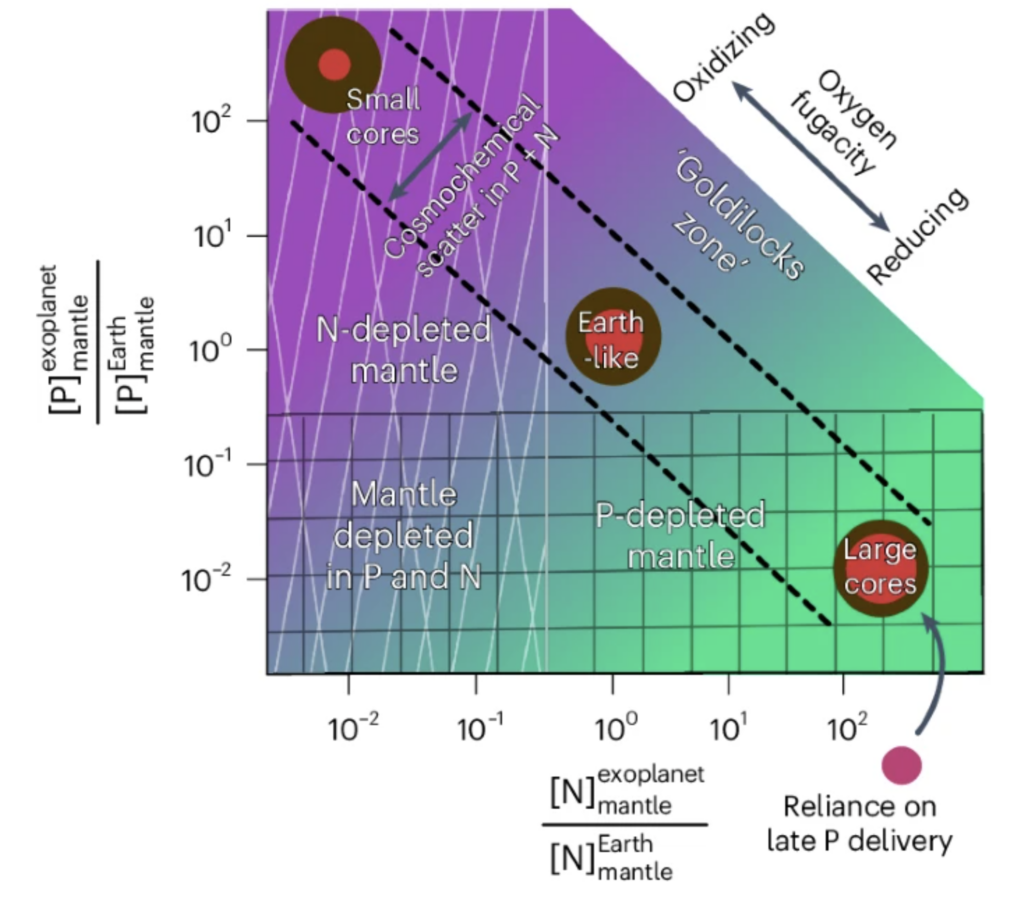
This research found that exoplanets do not need to have exactly the same amounts of nitrogen and phosphorus as Earth to support life. They could still have less than about half of Earth’s levels of these elements. But this zone is still narrow: fewer than half of nearby stars appear to have the right amounts of nitrogen and phosphorus to form planets with these favorable conditions. As a result, only a small number of exoplanets may fall within this chemical sweet spot for life.
One might wonder what would happen if there’s not enough nitrogen, phosphorus, and/or oxygen on a planetary surface. Does that mean life can’t form? Not necessarily: this research, is focused on life as we know it (i.e., life on Earth) like other similar papers looking at planetary habitability. That’s because that’s our only example of life that we’ve seen. If life was extremely dissimilar to anything on Earth, it could potentially not need phosphorus and nitrogen. A planet with no phosphorus in the initial mantle could also get more via meteor strikes (shown in Figure 1 with an arrow reading “reliance on late P delivery”).
That said, scientists do believe that elements like phosphorus and nitrogen because they are chemically versatile enough to be useful for any biochemistry. Life elsewhere may not use phosphorus-based cellular energy or nitrogen-based DNA, but they will still likely use phosphorus and nitrogen. Their presence on the surface of a planet would likely be important for other forms of life, even for fantastic and far-out aliens.
Astrobite edited by Sandy Chiu, Wasi Naqvi
Featured image credit: bpawesome/Getty Images

Galileo!
5th planet Jupiter: Pentagon (5)
6th planet Saturn: Hexagon (6)
7th planet Uranus: Heptagon (7)