
Authors: E. Poggio, S. Khanna, R. Drimmel, E. Zari, E. D’Onghia, M. G. Lattanzi, P. A. Palicio, A. Recio-Blanco and L. Thulasidharan
First Author’s Institution: INAF – Osservatorio Astrofisico di Torino, via Osservatorio 20, 10025 Pino Torinese (TO), Italy, and Université Côte d’Azur, Observatoire de la Côte d’Azur, CNRS, Laboratoire Lagrange, France
Status: Published in Astronomy & Astrophysics [open access]
When you look up at the night sky, the Milky Way seems to spread out like a straight band across the celestial dome. The shape and motions within our galaxy are not as easily described. They are affected by a plethora of physical mechanisms – and a new one just entered the chat!
The Milky Way is a spiral galaxy, meaning that the stars and gas in the disk are concentrated in spiral arms which wrap around the centre. In addition to the overall rotation of the disk, these arms move like spiralling density waves through the gas and stars, compressing and decompressing the material as they pass.
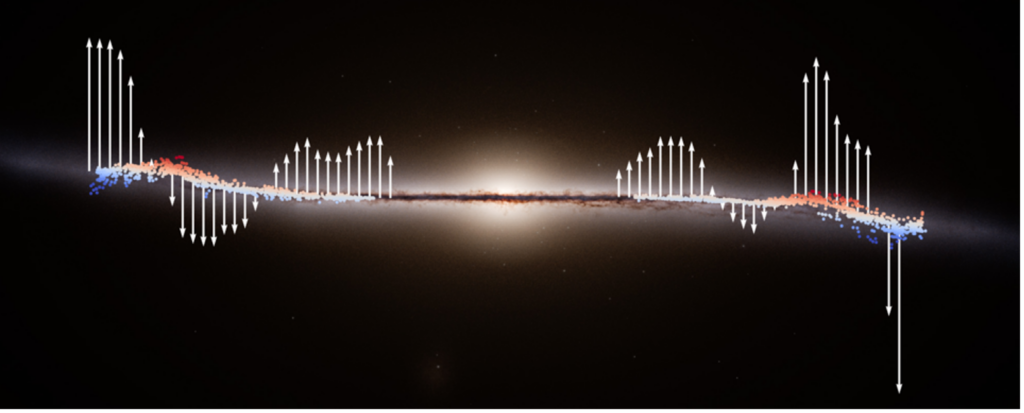
Classical illustrations of spiral galaxies may have led you to believe that the Milky Way disk is flat. This is not entirely true; the outskirts bend (or warp) away slightly from the plane of the disk, up on one side and down on the other (see Figure 1). This warp is also rotating, or precessing, around the disk, making the galaxy behave like a tilted spinning-top.
All of this (and more) forms a complex image of galactic dynamics, and the authors of today’s paper just added another layer. They found evidence of a large wave rolling out through the disk of the galaxy, which contradicts our previous understanding of stellar motions.
Mapping Motions with Bright Babies
When the Gaia Space Telescope sent out its first data in 2016, many Milky Way astronomers got stars in their eyes. For the first time, we got detailed measurements of how the stars move across the sky, allowing a whole new set of dimensions to be studied. The authors of this paper looked at some of the brightest stars in the Gaia data, young giants and Cepheids, to compare movements in different parts of the galaxy.
The young giants are newly created, very bright stars, of which there are about 17,000 in the sample. Cepheids are variable stars, rarer than the young giants (about 3,000 in this study). The authors combined the two samples, enabling them to study the 3D motions of stars covering almost half of the galactic disk, out to a radial distance twice as large as that of the sun (see Figure 2). And what they found surprised them: the stars are moving in a wavelike pattern, rippling out from the centre – as if someone dropped a piece of cosmic cereal in the centre of the Milky (Way) bowl.
The Ripple Effects
The movement could at first glance look like a consequence of the preceding warp, or motion induced by the spiral arms, which also form a wave-like pattern. However, by modeling the galactic motions including warp, spirals and several other components, they conclude that the known structures alone can’t account for what they are seeing. The model that fits the best is a wave moving radially outward, in addition to the motion of the warp.
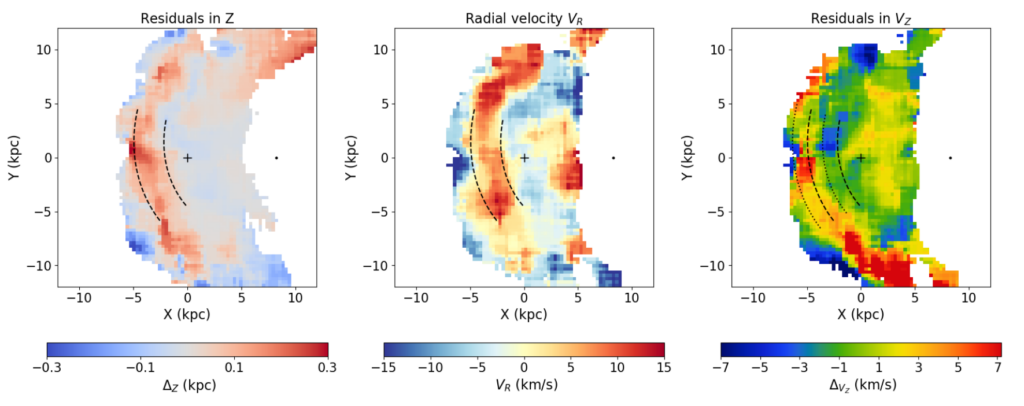
What could have caused such movement? The authors of this paper are not sure. They suggest an earlier collision between the Milky Way and a smaller dwarf galaxy, such as the Sagittarius Dwarf galaxy, which was accreted by the Milky Way roughly a billion years ago. But a more detailed wave origin story is left to future studies.
When astronomers study the movement of stars in the Milky Way, it is often assumed that their vertical and radial motions are independent of each other. Today’s paper presents a case where the two components of the motion are coupled. This is surprising, and will ultimately affect how we interpret the dynamics of stars in all galaxies, and especially in the Milky Way – even if we currently don’t know what caused the ripples in our home pond.
Astrobite edited by Nicki Bond and Ryan White.
Featured image credit: ESA/Gaia/DPAC, S. Payne-Wardenaar, E. Poggio et al (2025).

Where do the Fermi Bubbles intersect the plane of the Galaxy on Fig. 1? I wonder if whatever led to their creation was energetic enough and the timing consistent enough to have played a role in the formation of this wave.