
Title: Coherent radio bursts from known M-dwarf planet-host YZ Ceti
Authors: J. Sebastian Pineda & Jackie Villadsen
First Author’s Institution: Laboratory for Atmospheric and Space Physics, University of Colorado Boulder, Boulder, USA
Status: published in Nature Astronomy [open access]
Mysteries of Magnetic Fields
Earth’s magnetic field is an invisible shield. It protects our atmosphere, and us, from the Sun’s harmful radiation. This raises the question: if Earth’s magnetic field plays such an important role here, what about on other worlds? Detecting exoplanetary magnetic fields could be key to uncovering which worlds have been blasted into airless, radiation-scoured rocks, and which might still cradle calm, pleasant atmospheres.
Hunting Star-Planet Radio Signals
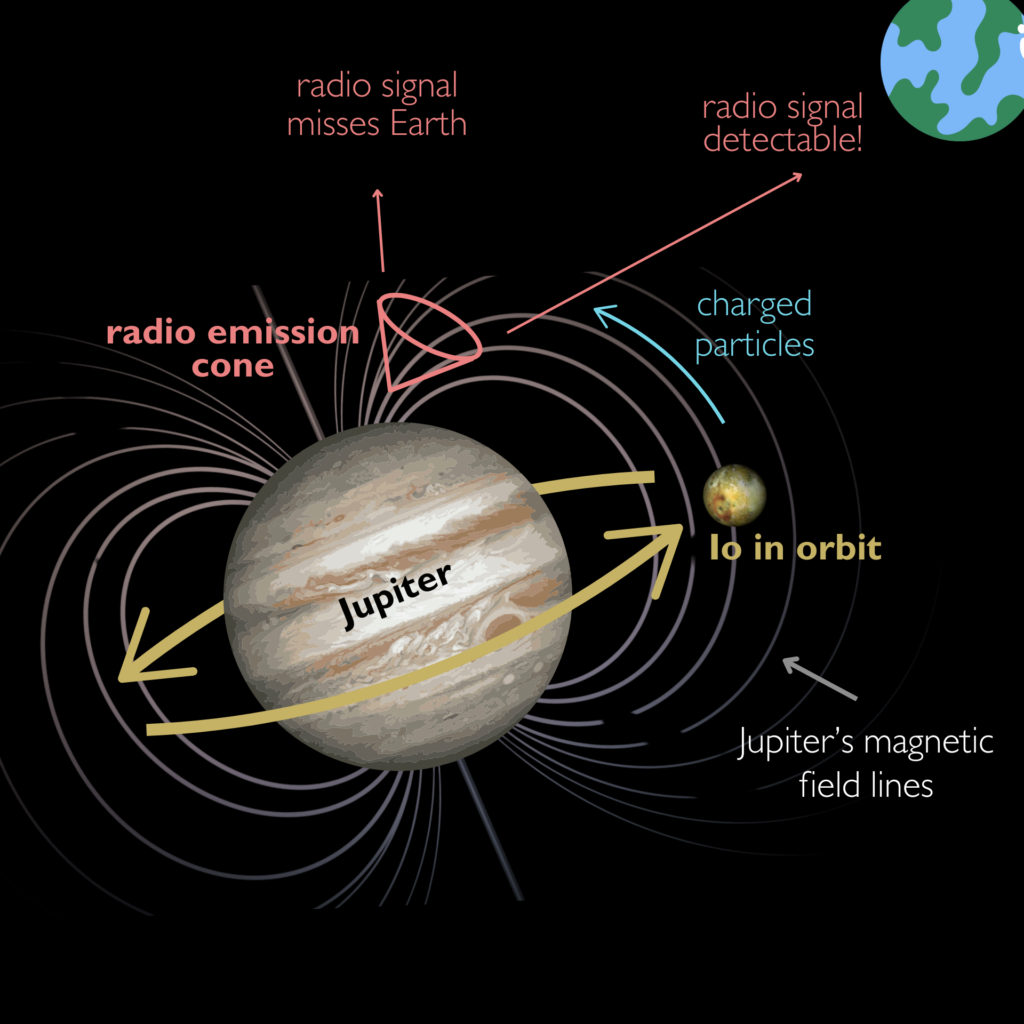
So far, no one has managed to confidently detect an exoplanet’s magnetic field. How might we do this? With radio observations! This idea comes from a familiar example in our own backyard: Jupiter and its moon Io, which flash radio waves at us. As Io orbits Jupiter, their magnetic fields interact, funneling charged particles along Jupiter’s magnetic field lines towards its poles. The accelerating particles create a beam of radio emission along a cone-like shape. When that beam sweeps across Earth, which happens at certain points (i.e. “phases”) in Io’s orbit, we pick it up as a burst of radio light (see Figure 1).
Now imagine scaling up the Jupiter-Io system. Replace Jupiter with a star, and Io with a planet, and you get the basis for magnetic star-planet interactions (SPI) detectable at radio wavelengths. The properties of the resulting radio emission would be influenced by the planet’s magnetic field strength. So, if we can spot SPI-driven radio bursts, we might finally infer an exoplanet’s magnetic field: our holy grail!
This has for a long time proven to be “easier said than done”. Many teams have searched, and most have come away with silence.
Enter, YZ Ceti
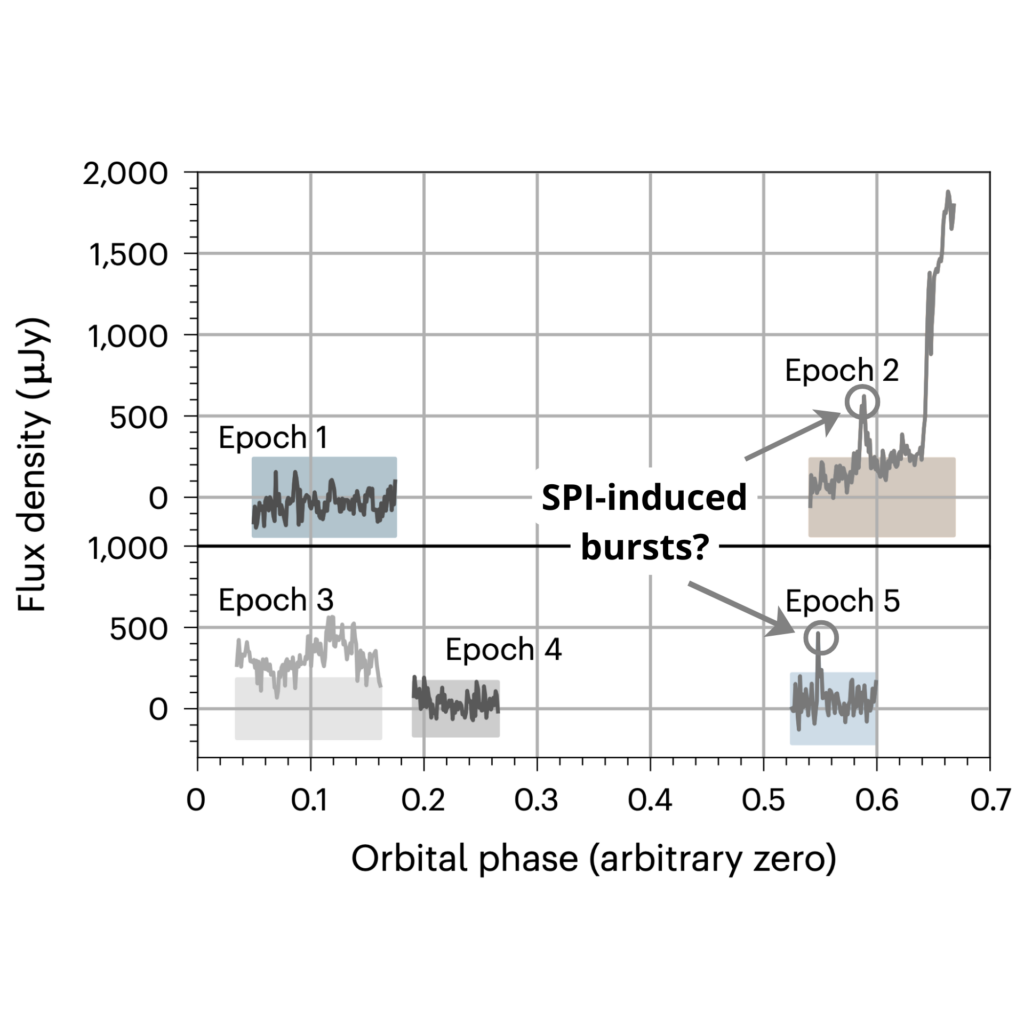
Today’s authors present a tantalizing SPI candidate: YZ Ceti. This is a compact system, hosting several planets at close orbits. The authors initially observed YZ Ceti with the Jansky Very Large Array during three planned observations (here referred to as “epochs”) in 2019 and 2020. The first epoch showed nothing, but the second and third revealed some radio signals (see Figure 2). Unfortunately (for today’s authors) stars can also produce radio signals by themselves. So how can we tell if any of these signals actually come from an orbiting planet?
SPI-induced radio emission has some distinct properties. First of all, SPI-induced radio emission is highly circularly polarized. See this Astrobite for a primer on polarization, but briefly: polarization describes the orientation of the electric fields in electromagnetic waves. In regular, unpolarized light, the electric field is pointed in any and all directions randomly. In the case of circular polarization, the electric fields rotate structurally in a smooth spiral as the wave travels forward. This type of polarization is often linked to magnetic fields.
And bingo! A radio burst in epoch 2 is almost fully circularly polarized!
Circular polarization alone isn’t enough to prove SPI, however, since stellar activity can still produce similar signals. Therefore, the authors also model the system’s environment, testing two scenarios with different magnetic field geometries and stellar wind strengths. Using these models, they can estimate the expected SPI-induced radio brightness.
And bingo! The predictions, though containing many uncertain assumptions, do not rule out an SPI origin.
The real “smoking-gun” evidence of SPI is periodicity, caused by the emission beam moving in and out of our line of sight throughout the system’s orbit, as seen in Jupiter and Io. In other words, if the planet returns back to the position it was in during the observed radio burst, we should see another burst! To test whether this is the case in YZ Ceti, the authors scheduled another two observing runs.
Again, bingo!
Epoch 5 revealed another strongly polarized radio burst, right when the planet closest to the star, YZ Ceti b, was at almost exactly the same orbital phase as during the earlier epoch 2 burst.
Almost…
Can this be SPI?
The second potential SPI-induced burst appeared about two hours earlier in the planet’s two-day orbit than the first (see Figure 2). That’s not quite the periodicity we’d love to see, but it’s tantalizingly close. We could even account for this small offset, if we consider that changes in the star’s surface magnetic field can nudge the timing of SPI emission.
Of course, there’s another possibility: these bursts might simply come from ordinary stellar activity. The authors estimate the odds of this. With two bursts detected over 26 hours of observing, a rate of about 0.077 per hour, they calculate a ~24% chance of seeing at least one random burst during the 3.6-hour span of epoch 5. But the probability of catching two unrelated stellar bursts – on separate visits of four hours, and both within two hours of a given orbital phase – drops to just 5.1%.
So where does that leave us? YZ Ceti now joins the small but growing group of SPI candidates uncovered so far. And with more follow-up observations, it may well become the first to make the leap from “candidate” to “definitive detection”.
Astrobite edited by Isha Loudon and Sarah Stevenson
Featured image credit: adapted from NASA
