
Title: Orbit of a Possible Planet X
Authors: Amir Siraj, Christopher F. Chyba & Scott Tremaine
Status: Published 2025 January 7 in The Astrophysical Journal, Volume 978, Number 2
Citation: Amir Siraj et al 2025 ApJ 978 139
In 2006, the International Astronomical Union decided to demote Pluto from its status as a fully fledged planet. The IAU required a fully formed planet to have its very own orbit, a test which Pluto unfortunately failed, sharing its orbit with thousands of smaller icy objects in the Kuiper Belt, a region that’s between 2.5 and 4.5 billion miles (4.5 and 7.4 billion kilometers) away from the sun. I saw an 8th grader wearing a “Pluto is a planet, Fight me!” T-Shirt recently. They may not have been born then. They definitely were not conscious enough to understand the IAU’s criterion. In a protest that has reverberated throughout generations, humanity has not given up, somehow manifesting its search for a ninth planet in our solar system.
Planet 9 is the Solar System’s favorite ghost story. Every so often, strange motions of distant objects hint at a hidden world lurking beyond Neptune. Most of these hints have evaporated with better data, but one puzzle has stubbornly remained: a group of far-flung icy bodies whose orbits seem oddly aligned. Could they be circling under the gravitational spell of an unseen planet?
The new paper Orbit of a Possible Planet X revisits this mystery with a much larger dataset and the machinery of computer simulations. The authors ask two key questions:
- Is the orbital alignment of distant trans-Neptunian objects really there, or just a selection effect?
- If a planet is really hiding under there, what is it like?
The curious case of the distant TNOs
Trans-Neptunian objects (TNOs) are small, icy bodies orbiting beyond Neptune. A subset with very large semi-major axes (Sun to object distance) and perihelia (the angle in space where each orbit comes closest to the Sun) far from Neptune are “dynamically detached”: they hardly ever come close enough to the known giant planets to have their orbits scrambled. That makes them excellent fossils of whatever shaped the outer Solar System.
Previous work claimed that these extreme TNOs have longitudes of perihelion (location in the orbits where they reach perihelion is similar)that cluster together, which could be caused by the shepherding gravity of a distant planet—popularly known as “Planet Nine”. Other studies argued that the clustering might just be due to the quirks of where and how surveys look for TNOs.
The paper first tackles the existing data itself. They integrate the orbits of known distant TNOs over billions of years to decide which ones are long-term stable; those are the objects they trust to carry information about a hypothetical planet. Using this expanded, stability-vetted sample, they find that for TNOs with semi-major axes greater than 170 AU, the longitudes of perihelion are indeed clustered at about the 3-sigma level—unlikely to be a random fluke—while other orbital angles show no significant pattern.
So the alignment is real enough to be interesting. If a planet is causing it, what would that planet look like?
To answer that, the authors run 300 N-body simulations, numerical models that follow the gravitational dance of many bodies at once. Each simulation includes:
- The Sun and the four giant planets;
- A disk of massless test particles representing distant Kuiper Belt objects;
- One extra planet (“Planet X”) whose mass, semi-major axis, eccentricity, and inclination are varied from run to run over plausible ranges.
They evolve each system for 1–2 billion years and track how the test particles’ longitudes of perihelion are distributed as a function of the semi-major axis. For each simulation, they compute a log-likelihood: essentially, how well that simulated distribution matches the real TNOs. There is not a single perfect value, but there is a region of parameter space that consistently performs well.
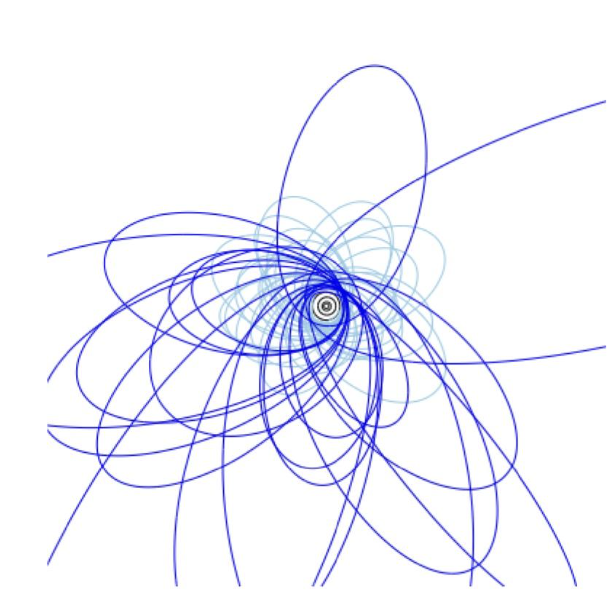
Figure 1: All the orbits of distant Kuiper Belt objects. Dark blue curves show the orbits of objects with a > 170 AU, while light blue indicate those with a < 170 AU. The black loops at the center are the giant planets.
From the best-fitting simulations, they infer that if Planet X exists, it is most likely has the following characteristics:
- Mass: approximately 4.4 ± 1.1 Earth masses;
- Semi-major axis: about 290 ± 30 AU;
- Eccentricity: about 0.29 ± 0.13;
- Inclination: about 6.8° ± 5.0°.
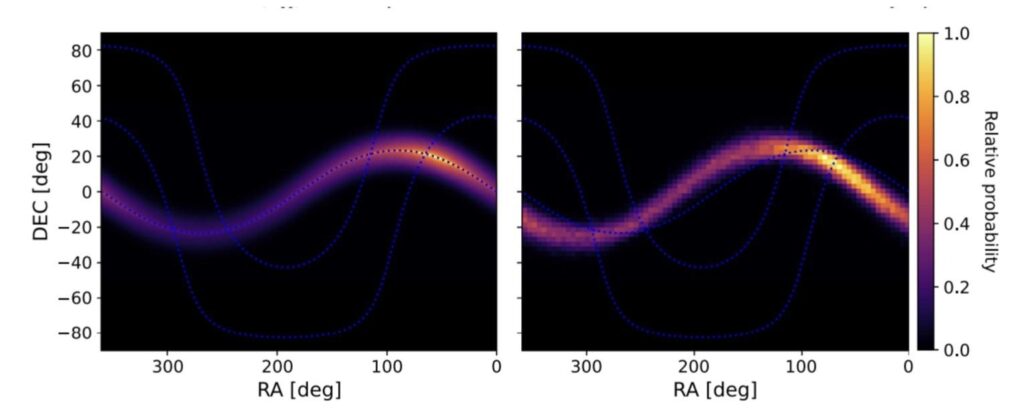
Figure 2: Where Planet X might be on sky. Left: Relative probability density for the unseen planet in right ascension (RA) and declination (Dec) based on the best-fitting simulations of Siraj et al. Right: Probability density from the model of Brown & Batygin (2021). Blue dashed curves indicate the ecliptic and ±20° from the Galactic plane.
This is a colder, slightly less massive, and less inclined world than the canonical Planet Nine orbit proposed in earlier work: only about 0.06% of those Planet Nine models land within the 1-sigma region preferred by this new study.
A major practical output of the paper is a sky map showing where this hypothetical planet is most likely to be in right ascension (RA) and declination (Dec), based on the best-fitting simulations.
However, the result is not a slam-dunk detection. The significance is suggestive rather than decisive, and the dynamics of the distant Kuiper Belt are messy. Alternate ideas, such as a self-gravitating disk of many small bodies instead of one large one, are still on the table.
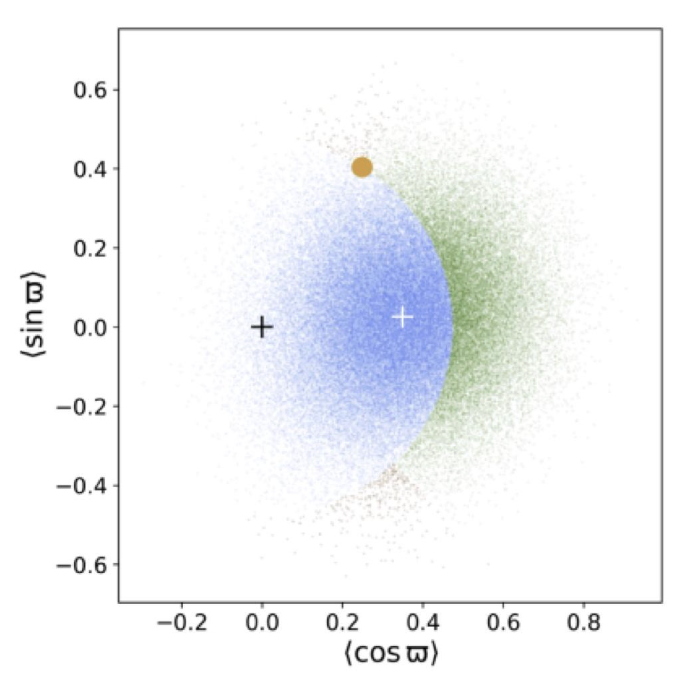
Figure 3: Synthetic vs. observed perihelion-direction clustering. Each small point represents a synthetic realization of distant (170 AU < a < 1000 AU) stable or metastable TNOs, generated using the detection efficiencies of OSSOS, DES, and the Sheppard–Trujillo surveys applied to a uniformly distributed population. Coordinates are ⟨cosϖ⟩ and ⟨sinϖ⟩, where random orientations would fill the plane symmetrically. The large orange point marks the real TNOs. Brown points are synthetic samples that reproduce both the observed clustering strength and its offset from the preferred direction; green points reproduce the strength alone. The remaining synthetic samples are shown in blue. The white plus gives the mean of all synthetic samples, while the black plus marks the origin.
So… did they find Planet X?
Editor Names: Maria Vincent, Madison VanWyngarden.
Featured Image Credits: Nicholas Forder for Live Science

Thanks for the overview of the current state for the search for planet X!
However it seems all three figures point to the same image. Is this correct, and if not, can this please be fixed?