
Title: Neutrino emission from fast radio burst-emitting magnetars
Authors: Yuanhong Qu, Bing Zhang
First Author’s Institution: Nevada Center for Astrophysics, University of Nevada, Las Vegas, NV, USA
Status: Published in Monthly Notices of the Royal Astronomical Society [open access]
As the name indicates, fast radio bursts (FRBs) are extremely bright flashes of radio emission that typically last a few milliseconds. The origin of fast radio bursts is a mystery and a hot topic in the astrophysics community. However, In recent years, one object has become one of the most promising FRB source candidates: magnetars.
Magnetars are a special type of neutron star characterized by an extremely strong magnetic field, about a quadrillion times stronger than the Earth’s magnetic field, and a billion times stronger than the strongest human-made magnet. They also produce powerful bursts of X-rays, called magnetar flares. Many of the most popular FRB models theorize that magnetars could also be emitting FRBs during these flaring events. Astronomers came up with this hypothesis after a Galactic FRB named FRB 200428 occurred in April 2020, in the same region of the sky and at the same time as an X-ray burst from a magnetar.
Introducing… Neutrinos?
Today’s paper does not focus on explaining how magnetars make FRBs. Instead, it uses FRB-emitting magnetars to address a different mystery: high-energy cosmic neutrinos. Neutrinos with energies in the teraelectronvolt (TeV) range (about a million times more energetic than neutrinos from the sun) and beyond have been detected by neutrino observatories such as IceCube. However, their exact origin remains uncertain, although their high energies suggest they originate from outside our Galaxy and are produced by extremely high-energy processes. The authors propose that FRB-emitting magnetars could be one of these highly energetic sources of neutrinos. In particular, their goal is to estimate if and how much magnetars could contribute to the background of high-energy neutrinos we detect from Earth.
The Photomeson Interaction: How To Make a Neutrino
How could magnetars produce high energy neutrinos? The process starts with the interaction of a free proton with a high-energy photon (like an X-ray), and after a series of intermediate steps, we end up with three neutrinos plus a couple other particles. This neutrino-making recipe is called the photomeson interaction.
In a magnetar, free protons can be stripped from its atmosphere and accelerated outward during flaring episodes that power X-ray bursts and potentially FRBs. Now we have protons.
Next, for the photomeson interaction to happen, the proton and photon must meet a minimum energy threshold, often expressed as a requirement on the product of their energies. Using observed photon energies from the X-ray burst that coincided with FRB 200428, the authors estimate the minimum kinetic energy to which a proton would need to be accelerated for the photomeson interaction to occur, and it turns out that this energy is enough to produce TeV neutrinos, as wanted!
Tour of the Magnetar Neutrino Factory
One problem remains: Can magnetars actually accelerate protons to the required energies? This paper investigates three different regions of a magnetar where protons could be accelerated then interact with X-ray photons to create neutrinos (see Figure 1).
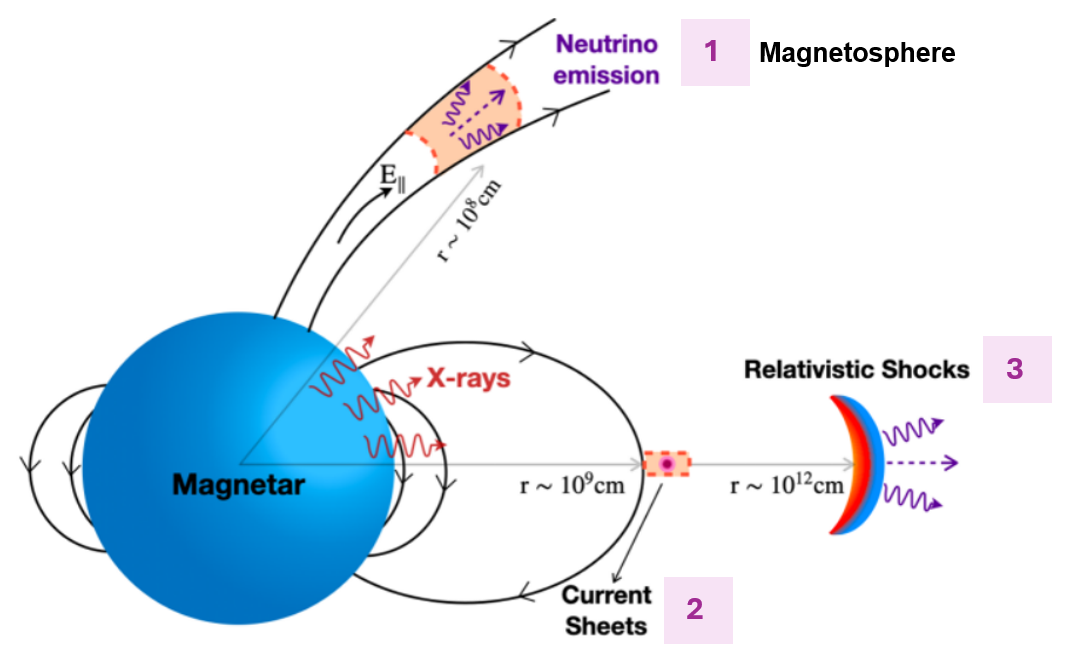
- Magnetosphere: The magnetosphere is the region surrounding the magnetar where charged particles are strongly affected by its magnetic field. Leading theories predict that FRBs could be emitted by bunches of charged particles moving along the curved magnetic field lines, accelerated to relativistic speeds by a parallel electric field generated during magnetar flares. In that same electric field, protons could also be accelerated to high energies.
- Current Sheet: Another FRB emission theory suggests that FRBs could be emitted when open magnetic field lines with opposite directions meet and reconnect at a region in the magnetosphere called the current sheet. This violent magnetic reconnection can result in radio emission and accelerate free protons to high energies.
- Relativistic Shocks: Magnetar flares can eject particles at relativistic speeds beyond the magnetosphere. Collisions between these particles and previously emitted particles cause relativistic shocks, which can both produce FRB emission via a chain-reaction-like stimulated emission of radio photons, and accelerate charged particles such as protons.
Good news: the authors’ modeling shows that all three of these regions could accelerate protons to energies high enough for the photomeson interaction to occur and produce TeV neutrinos such as those detected by IceCube!
FRB 200428 Neutrino Spectrum
Now that we’ve got three candidate sites for producing TeV neutrinos in an FRB-emitting magnetar, the next question is: how many neutrinos should an event like FRB 200428 produce, and could we detect such a burst of neutrinos?
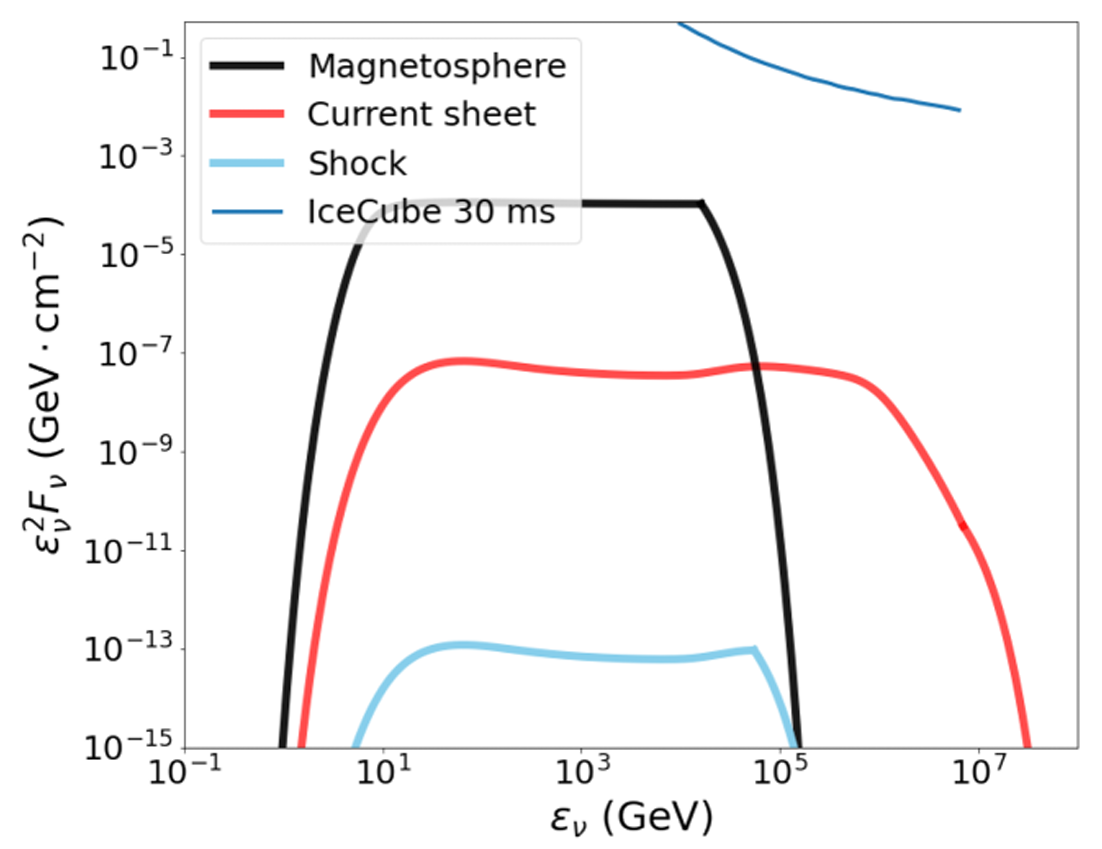
The authors use the measured X-ray fluence spectrum (how much X-ray energy was received from the burst per unit detector area, depending on photon energy) of the X-ray burst that coincided with FRB 200428 to compute an estimate of the neutrino fluence spectrum (same idea, but with neutrino energy) that should be expected from the photomeson interaction in each of the three regions for this specific event. They find that even in the most optimistic case (the magnetosphere model), the expected neutrino fluence spectrum for FRB 200428 is still four orders of magnitude below IceCube’s detection sensitivity, as seen in Figure 2.
Diffuse Magnetar Neutrino Background
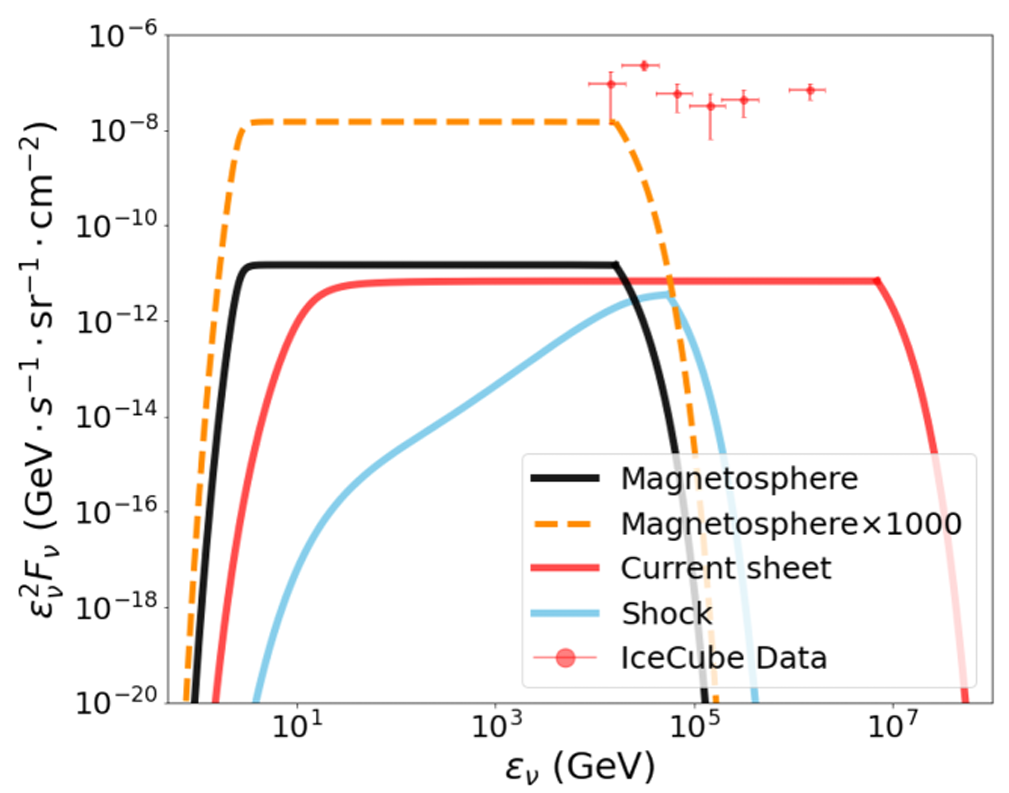
Alright, if we can’t detect neutrinos from single events like FRB 200428 with IceCube, could neutrino emission from FRB-emitting magnetars at least explain part of the diffuse high-energy neutrino background? To test this, the authors estimate the total rate of FRBs throughout the entire Universe’s history, and assume these bursts are all emitted by magnetars. They can then predict the total neutrino fluence from the entire population of FRB-emitting magnetars. From the results shown in Figure 3, it seems that even if FRB-emitting magnetars do exist, they can’t explain more than a negligible fraction of the diffuse high-energy neutrino background that has been measured by IceCube. To fully explain this background using magnetars, we would need 1,000 times more (non-FRB-accompanied) X-ray bursts, assuming they can still emit neutrinos by the same mechanisms.
Neutri-yes or Neutri-no?
Can magnetars be sources of both FRBs and high-energy neutrinos? Neutri-maybe. Although the calculations in today’s paper show that high-energy neutrinos could theoretically be emitted by FRB-emitting magnetars, we are still far away from confirming this theory with observations due to current instrument sensitivity limits. Nonetheless, this paper showed that FRB-emitting magnetars would be unlikely to explain the high-energy cosmic neutrino background measured by IceCube on their own, so the search for extragalactic neutrino sources continues…
Astrobite edited by Niloofar Sharei and Annika Salmi
Featured image credit: Original magnetar image by ESA, cartoon neutrinos and question mark designed and added by Laurie Amen
