
Title: DECADE+DES Y3 Weak Lensing Mass Map: A 13,000 deg2 View of Cosmic Structure from 270 Million Galaxies
Authors: M. Gatti, D. Anbajagane, C. Chang, D. J. Bacon, J. Prat, M. Adamow, A. Alarcon, M. R. Becker, J. A. Carballo–Bello, N. Chicoine, C. Doux, A. Drlica–Wagner, P. S. Ferguson, D. Gruen, R. A. Gruendl, K. Herron, N. Jeffrey, D. J. James, A. Kovács, C. E. Martínez–Vázquez, P. Massana, S. Mau, J. McCullough, G. E. Medina, B. Mutlu–Pakdil, N. E. D. Noël, A. B. Pace, G. Pollina, A. H. Riley, D. J. Sand, L. F. Secco, G. S. Stringfellow, D. Suson, C. Y. Tan, R. Teixeira, E. J. Tollerud, M. A. Troxel, L. Whiteway, A. Zenteno, Z. Zhang
First Author’s Institution: Kavli Institute for Cosmological Physics, University of Chicago, Chicago, IL 60637, USA
Status: Published in Physical Review Letters [closed access]
What is weak lensing?
Einstein famously proposed that matter warps space-time. One consequence of this is gravitational lensing, the bending of light rays by matter. Many of us are likely familiar with the more extreme cases of gravitational lensing, aptly named “strong lensing”, but more subtle distortion of light due to less massive lenses is commonly known as “weak lensing”.. While strong lensing might give us some pretty pictures, weak lensing is detected as minor distortions in galaxy shapes, and is only really measurable using large samples of galaxies and complex statistical methods.
No pretty pictures? Why do we care about weak lensing then?
A huge strength of weak lensing as a cosmological probe is its ability to trace the distribution of normal, baryonic matter and the ever mysterious dark matter. Using large samples of galaxies, cosmologists can measure subtle distortions in their light to measure large-scale structure, the organization of the Universe at the largest scales. Maps of large scale structure, called mass maps, allows cosmologists to constrain parameters (like the Hubble parameter) crucial to our models and understanding of cosmology, and test theories surrounding the nature of dark energy.
The DECADE+DES Y3 Map
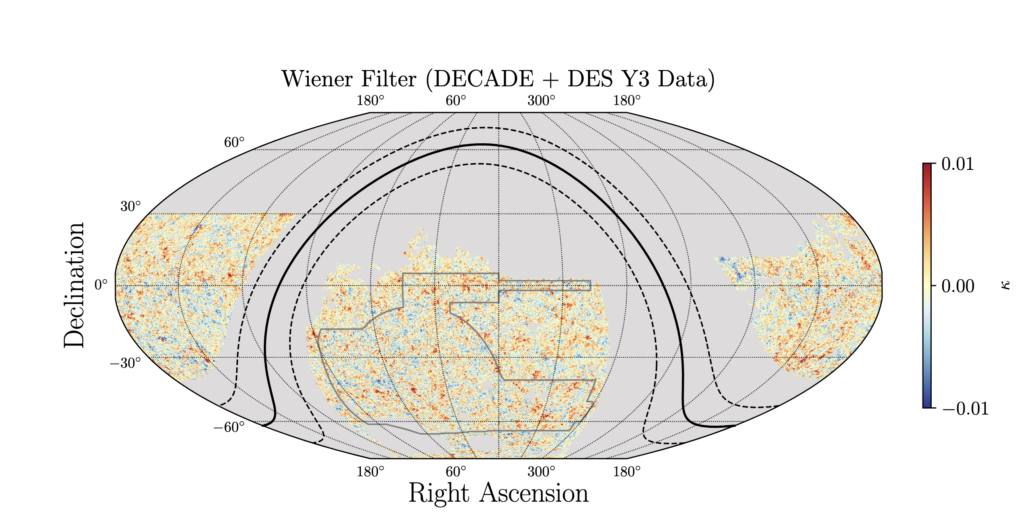
Today’s PRJ letter uses data from the Dark Energy Camera All Data Everywhere (DECADE) and Dark Energy Survey (DES) programs, totaling 270 million galaxies, to construct the largest weak-lensing mass map ever. Figure 1 shows the new map in all its glory, covering roughly 13,000 square degrees on the sky (this is about ~65,000 times larger than the full Moon as seen on Earth). The map is color coded towards red in areas with lots of matter, and blue in areas with a lack of matter normally called cosmic voids.
Awesome! What can we do with it?
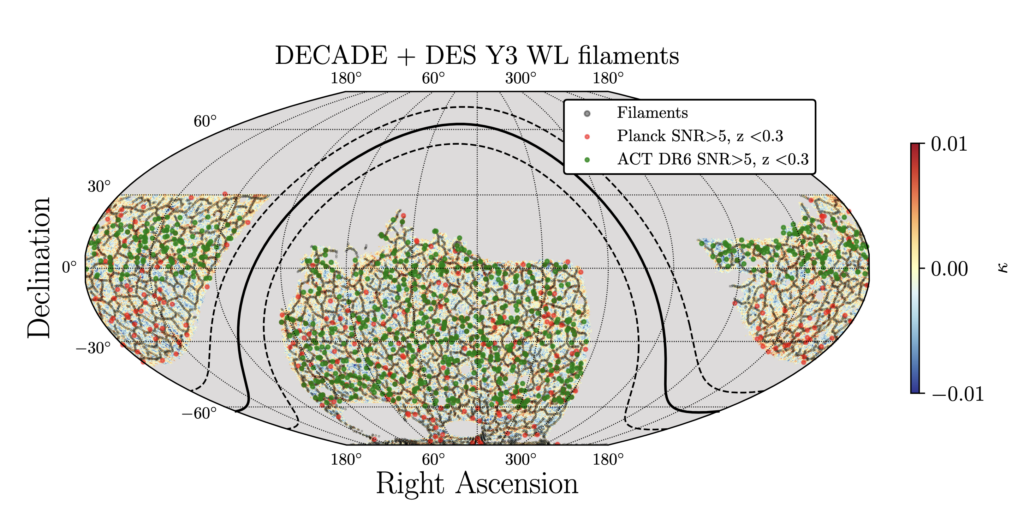
As a proof of concept, today’s authors use the fancy new map to trace filamentary structure throughout the local universe, a first-of-its-kind analysis. Filaments can be thought of as the bridges between nodes in the cosmic web, bridging regions populated with galaxies. As seen in Figure 2, the filaments (black points) connect nodes in the cosmic web detected, tracing the distribution of galaxy clusters (green and red points). Going forward, the author’s new map will act as an important resource as astronomers head into the era of large-volume surveys with observatories like Rubin and Roman, which promise to further revolutionize our understanding of large scale structure.
Astrobite edited by Joe Williams
Featured image credit: University of Arizona
