
Title: The Universal Eccentricity Distribution for Dynamical Gravitational-Wave Merger Channels
Authors: Mor Rozner, Teagan A. Clarke, Isobel M. Romero-Shaw, Johan Samsing
First Author’s Institution: Institute for Advanced Study, Einstein Drive, Princeton, NJ 08540, USA
Status: Available on arXiv
The formation of binary black holes
Our desire to understand how the universe brings two black holes together to have them violently merge has grown drastically over the last decade. Since the first detection of gravitational waves from these cataclysmic collisions in 2015, scientists have sought to put together tragically romantic stories of how binary black hole systems form. Perhaps the black holes were born together through isolated stellar evolution, like childhood friends, or perhaps they happened across each other dynamically in a dense astrophysical environment, like two strangers at a party. Is their story encoded in their brutal end?
Unfortunately, it’s hard to disentangle different formation channels based on properties we can typically measure from a gravitational wave signal, like the black holes’ masses and spins. The orbital eccentricity may be a better place to look. Eccentricity measures how squashed an orbit is, with a value of 0 describing a perfectly circular orbit and 1 describing a parabolic orbit. While binaries formed through isolated channels are expected to have circular orbits, binaries formed dynamically are expected to have more eccentric orbits, at least when they form.
As two black holes spiral inward, the emission of gravitational waves causes their orbit to lose eccentricity and become more circular. Current gravitational-wave detectors, like LIGO, Virgo, and KAGRA, are designed to observe the final moments of a binary’s orbit and merger. Therefore, only a small fraction of binaries retain measurable eccentricity by the time their gravitational waves enter the LIGO/Virgo/KAGRA (LVK) frequency band. Today’s authors refer to the tiny window of black hole trajectories that form these eccentric binaries as the “pinhole regime,” which is visualized in Figure 1.
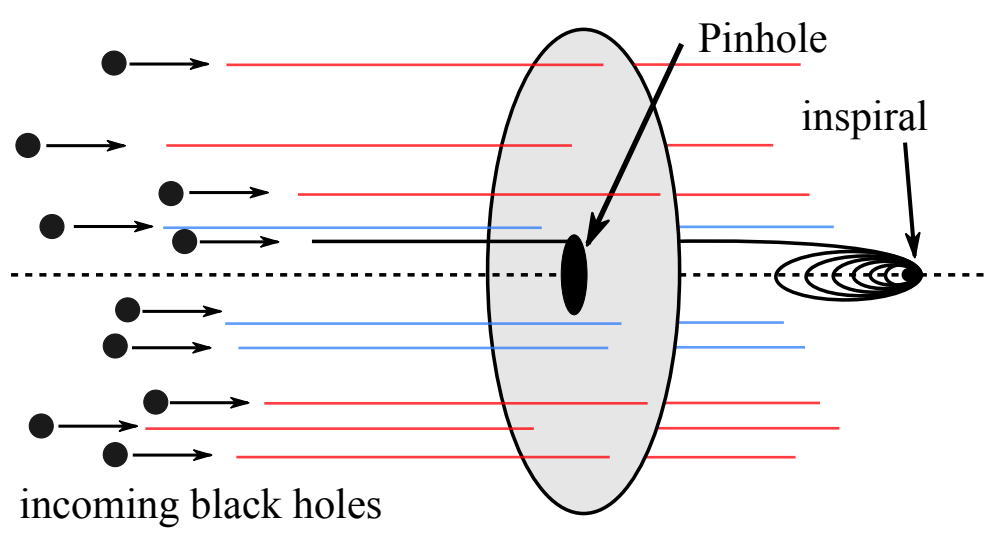
The authors show that, in the pinhole regime, most (if not all) dynamical channels result in a common eccentricity distribution. In other words, regardless of how a dynamical binary formed and merged, such as in galactic nuclei, globular clusters, or through the gravitational push of another nearby object, the binary eccentricity distribution that detectors see is the same.
Deriving the eccentricity distribution
To reach this conclusion, the authors derived an analytical expression for the eccentricity distribution. The key insight is noting the huge difference in the scales of this problem: the astrophysical environment (globular cluster, galactic nucleus, etc) is much larger than the pinhole. Because of this, black holes entering the pinhole are essentially coming in from random directions, uniformly distributed across the pinhole’s area. This means the number of black holes that enter the pinhole is proportional to the pinhole’s area, a simple starting point.
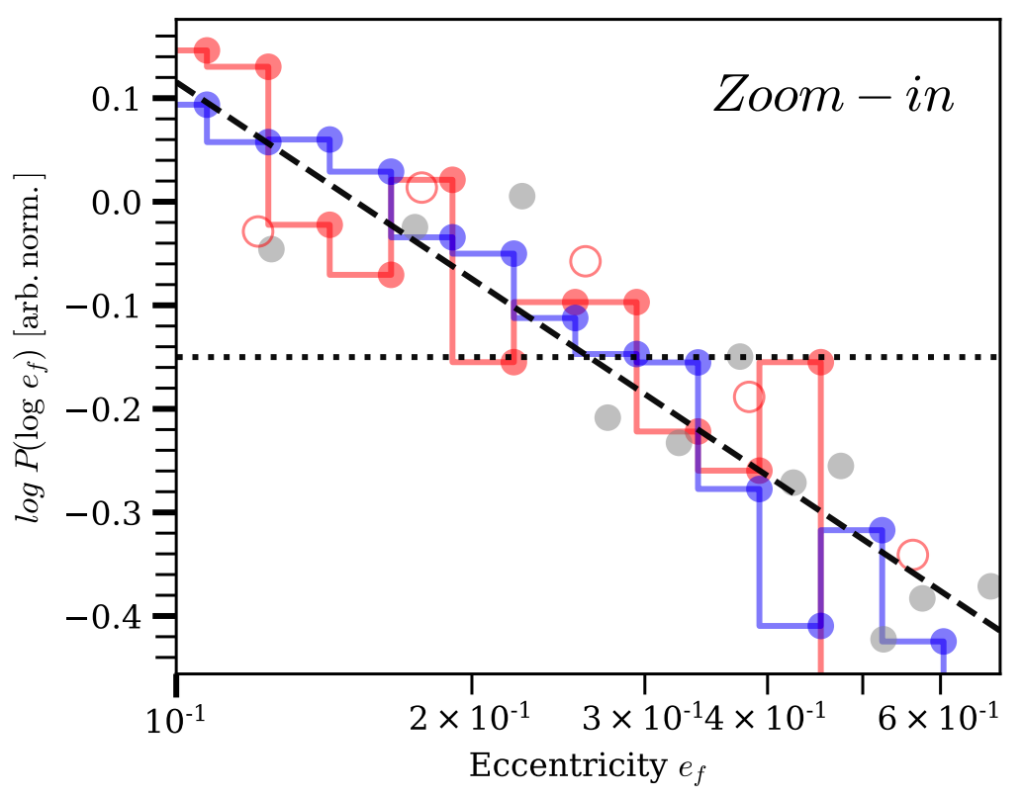
From there, the authors obtain a chain of relationships. The distribution of incoming black holes determines the distribution of how close two black holes can get at their nearest approach, which in turn determines the distribution of orbital eccentricities. Finally, they find that at LVK frequencies, the eccentricity distribution scales with the eccentricity \( e \) as \( e^{-31/19} \). This is a meaningful departure from previous analyses, which have typically assumed a scaling of \( e^{-1} \).
To validate their analytical expression, the authors use simulations of dynamical scenarios. They consider brief scatterings between a binary and a single black hole (“binary-single interaction”), as well as binaries driven to merge by a stable third companion (“hierarchical triple evolution”). Figure 2 shows the excellent agreement between the eccentricity distribution from the simulations and the solution they obtained. Despite these different environments and initial conditions, all the simulated scenarios follow the same distribution.
Implications
If all dynamical channels produce the same eccentricity distribution, then measuring eccentricity alone can’t tell you which dynamical channel was responsible for the formation of the binary. While the pinhole regime holds for high eccentricities that can survive to be observed at LVK frequencies, at lower eccentricities, environmental effects could play a role in shaping the distribution. Therefore, we’ll have to wait for future detectors that will measure a broader frequency band, or get creative by combining eccentricity with other observables to break the degeneracy.
For now, studies that consider eccentricity can rest easy, confident that a universal eccentricity distribution can describe mergers across a variety of dynamical formation channels, at least within current detector sensitivities. Observational analyses can be improved by using this paper’s eccentricity distribution, which is more physically motivated and agrees with astrophysical simulations better than its predecessor.
We may be looking through a pinhole now, but as our view expands, the story of how black holes find each other will finally come into focus.
Astrobite edited by Anavi Uppal.
Featured image credit: Adapted from Figure 1 in the paper.
