
Title: First detection of ultra-high energy emission from gamma-ray binary LS I +61 303
Authors: The LHAASO Collaboration
Status: Published in Physical Review Letters [closed access]
Introducing a Gamma Ray Mystery…
Gamma rays are photons pushed to the very highest energies found in the electromagnetic spectrum. They are direct byproducts of extreme particle acceleration processes – such as relativistic jets and accretion winds – which can occur in the most energetic systems in our galactic environment.
The subject of today’s article are gamma rays found from one such system. The particles were seen to reach extremely high, previously undetected, energies (>100 Tera electronvolts, or TeV, termed the UHE limit). This leaves us with a mystery on our hands: who, or what, is responsible for the production of these extremely energetic gamma rays?
The Scene of the Crime: LS I + 61 303
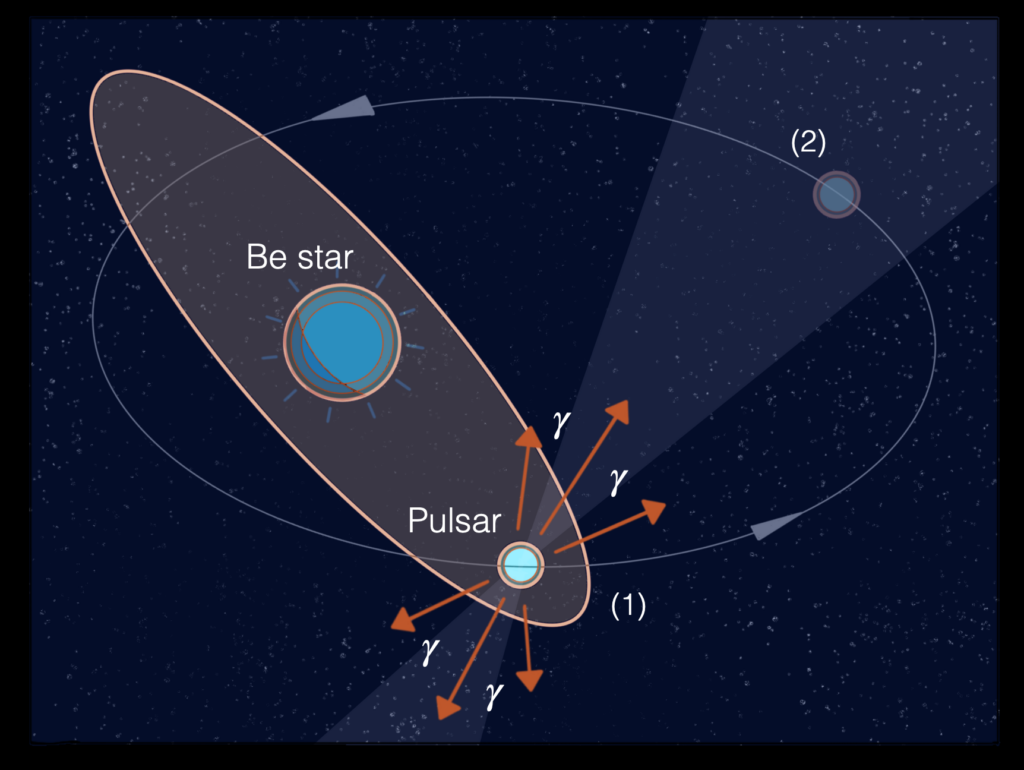
The gamma rays originated from the LS I +61 303 system, classified as a gamma ray binary. These binaries consist of two objects in a shared orbit: a massive young star, and a compact object of some form: in the case of LS I +61 303, likely a pulsar (see Figure 1).
The system was first discovered in 1959, and has since been found to exhibit an orbit of 26.5 days, leading to an interesting discovery: past observations (by the MAGIC and VERITAS telescopes) showed the strength of the gamma ray emission periodically increasing or decreasing, depending on the positions of the two objects orbiting around each other. This effect, termed orbital modulation, will turn out to be a key piece of evidence in the case. But first, we have to introduce one more, very important, character.
The Witness: the LHAASO Observatory
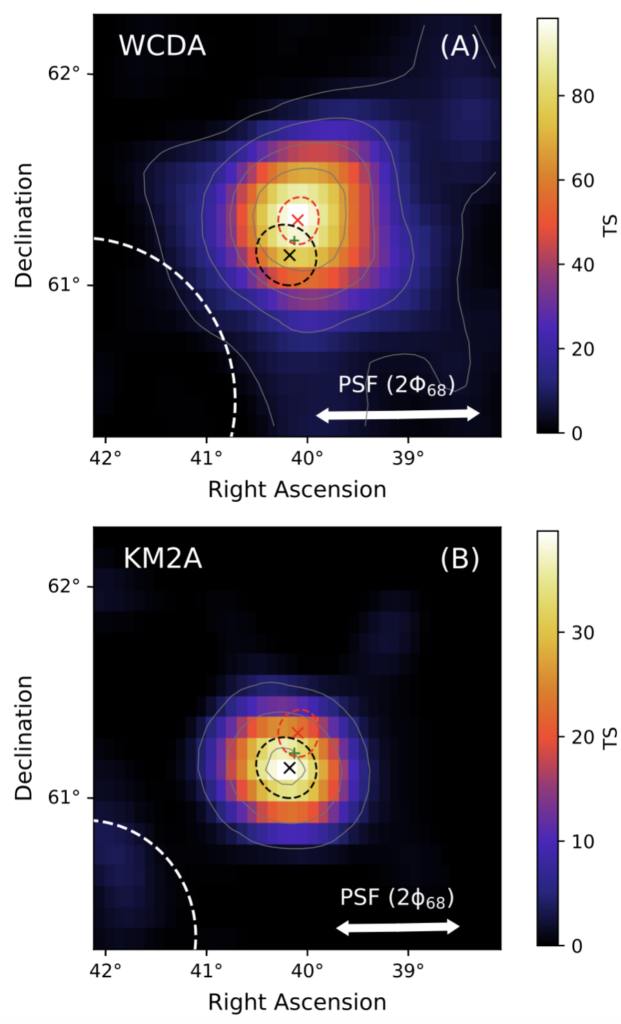
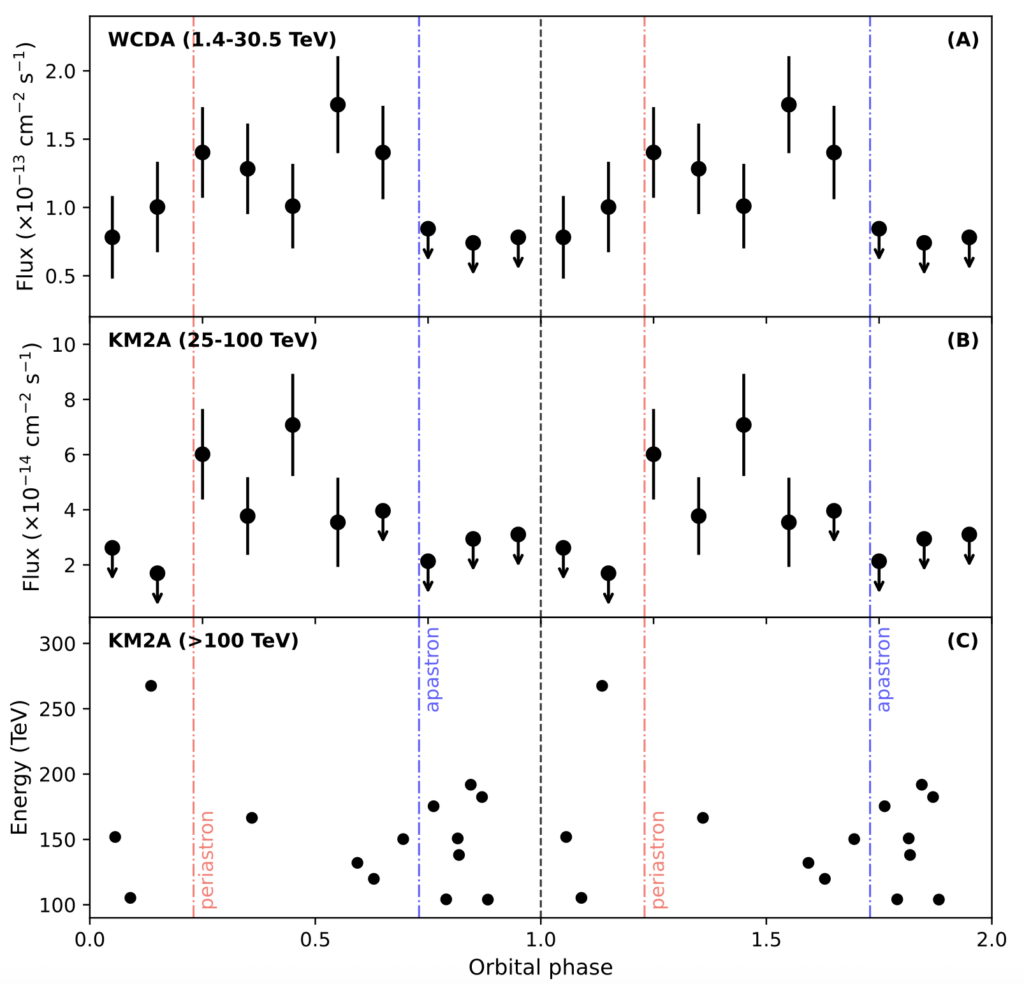
LHAASO (the Large High Altitude Air Shower Observatory) is a high-energy cosmic ray detector, located 4.4 kilometres high in Sichuan, China. One of its goals is to monitor the sky for cosmic gamma rays between GeV – PeV energies, and it is responsible for the gamma ray detections at the heart of this mystery. In today’s article, the LHAASO collaboration report significant detections originating from LS I +61 303, the positions of which on the sky are indicated in Figure 2. The detections span a broad energy range (over a few hundred TeV) as shown in Figure 3, where they are plotted according to the orbital positions (phase) they originated from. Here, we can see that the orbital modulation effect spotted previously has also been found in the LHAASO detections, providing the last piece of evidence needed.
Now, with all the pieces on the board, we can turn our attention towards solving this case. Using information on the system established from previous observations – combined with hints given by the orbital modulation effect – the authors begin to narrow down what might be producing the energetic gamma ray emission.
The Suspects: Processes Leptonic or Hadronic
The production of gamma ray photons can occur via either leptonic or hadronic processes. The former involves charged particles within the system radiating photons, whereas the latter generate photons as byproducts of proton collisions. And since either one of these processes could be playing a role in the extreme environment of LS I +61 303, narrowing down the culprit requires a little more investigation.
The specific leptonic process of interest is Inverse Compton scattering, in which high energy electrons scatter stellar photons, increasing the outgoing photon energy. The authors determine that Inverse Compton scattering is indeed capable of generating gamma rays up to tens of TeV. However, above these energies, we encounter some problems: the emission efficiency becomes strongly suppressed, and electron energy limits, set by the properties of the LS I +61 303 system, start to kick in. This makes it much more difficult to produce the highest energy gamma rays, and while it isn’t ruled out all together, the authors conclude that a leptonic origin seems unlikely.
On the other hand, hadronic processes may have an ace up their sleeve; it is possible that at certain points during the system’s orbit, the ambient matter density increases due to circumstellar disk crossings (marked in Figure 1) – boosting the hadronic efficiency. During these disk crossing times, the authors calculate that it would in fact be possible to produce the UHE gamma rays seen! However, the case isn’t closed yet; at all other times, the efficiency boost disappears and the production becomes unsustainable. Therefore, hadronic processes can explain some, but not all, of the emission detected.
The Big Reveal: Partners in Crime
In the end, neither of these processes alone appear responsible for the detections. But together, this is no longer the case! In this combined scenario, leptonic processes are responsible for the majority of the emission below ~25 TeV, after which hadronic processes take over, generating the remaining high energy gamma rays.
And a significant piece of supporting evidence for this is the orbital modulation. The authors investigated archival data of LS I +61 303 obtained for lower energy photons, and found the same modulation pattern, suggesting that the emission in this energy range shares a common (leptonic) origin. However, at higher energies, the modulation appears to shift, clustering around apastron, rather than periastron (Figure 3). This could indicate that the dominant emission process has also changed, switching from leptonic to hadronic – as predicted under the combined lepto-hadronic scenario.
Mystery solved?
By laying out the pieces of the puzzle behind the gamma ray detections of LS I +61 303, the authors make a compelling argument, charging both leptonic and hadronic processes as the guilty parties. However, testing this scenario (e.g. modelling and quantifying the emission) will require more data gained from future multi-wavelength observations, allowing features such as the modulation shift at the highest energies to be more clearly defined. Nevertheless, LS I +61 303 is definitely a system to watch out for in the future!
Astrobite edited by Shalini Kurinchi-Vendhan.
Featured image credit: Pulsar and companion star by Dana Berry/NASA Goddard Space Flight Center, Public domain, via Wikimedia Commons. Magnifying glass by Kurt Kaiser, CC0, via Wikimedia Commons. Deerstalker Hat icon by Icons8. Adapted by Isha Loudon.
