On April 1st at approximately 6:30 PM EST, a NASA Space Launch System (SLS) rocket sent four astronauts, Reid Wiseman, Victor Glover, Christina Koch, and Jeremey Hansen, on a ten day mission to perform a lunar flyby. It has been over 50 years since humans have made the long journey to the moon. So, why are we going back?
Early Lunar Exploration
Few events in human history match the bravado of the Apollo 11 mission. With the first steps on the Moon by Neil Armstrong in 1969, man could envision a future beyond Earth. Over the next three years, Apollo 12, 14, 15, 16, and 17 built upon the success of Apollo 11, deploying a bevy of scientific instruments to measure phenomena like moon-quakes (Figure 1), interior heat flow, and solar wind composition. Most importantly, the Apollo missions allowed for the return of over 382 kilograms (almost half a ton!) of lunar samples, revealing the Moon’s complex past and how it was once part of Earth! These samples are still being analyzed today.
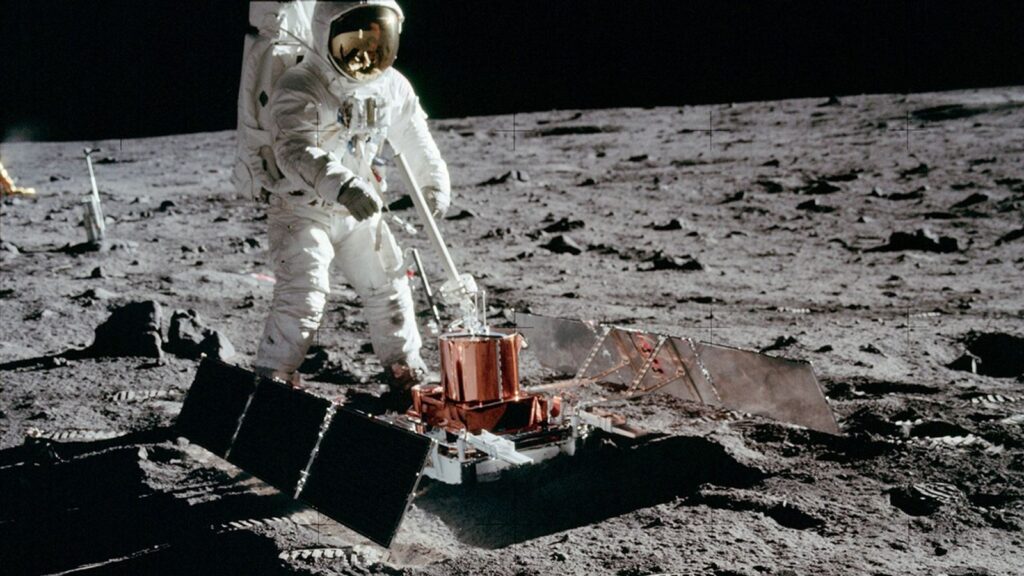
As technology advanced through the 80s and 90s and the novelty of men on the moon waned, crewed missions to the Moon were seen as unnecessary, since robotic rovers and orbiters could achieve the same scientific objectives while avoiding the risks associated with sending astronauts. Missions became increasingly focused on extracting as much scientific information as possible, with orbiters like Clementine providing detailed topography and the Chang’e missions, which included autonomous sample collection and surface exploration. But as exploration goals evolved from understanding the Moon to living and working on it, the limitations of purely robotic exploration became clear, motivating a return to human lunar missions through the Artemis program.
The Artemis Program
The Artemis program is a bold stepping stone in our exploration of our Solar System. Through a sequence of increasingly complex missions, the program will enable a sustained human presence on the Moon, ultimately establishing a permanent lunar base to support large-scale projects and future interplanetary travel. The Moon’s reduced gravity (1/6th that of Earth’s) and lack of atmosphere are ideal conditions for launching missions to Mars and other Solar System objects. This advantage can only be leveraged if a significant amount of mass in the rocket, including propellant and oxygen, can be acquired off-Earth.
Accordingly, part of the Artemis program focuses on extracting and utilizing lunar resources, such as water ice (one of the few ways to extract oxygen, an essential oxidizer in rocket fuel, on the Moon!), to support these goals. The in-between of this scifi-esque goal is the robust testing and monitoring of technologies and methods we plan to use to achieve these goals. This is where Artemis II debuts.
Artemis II: A Pivotal Test
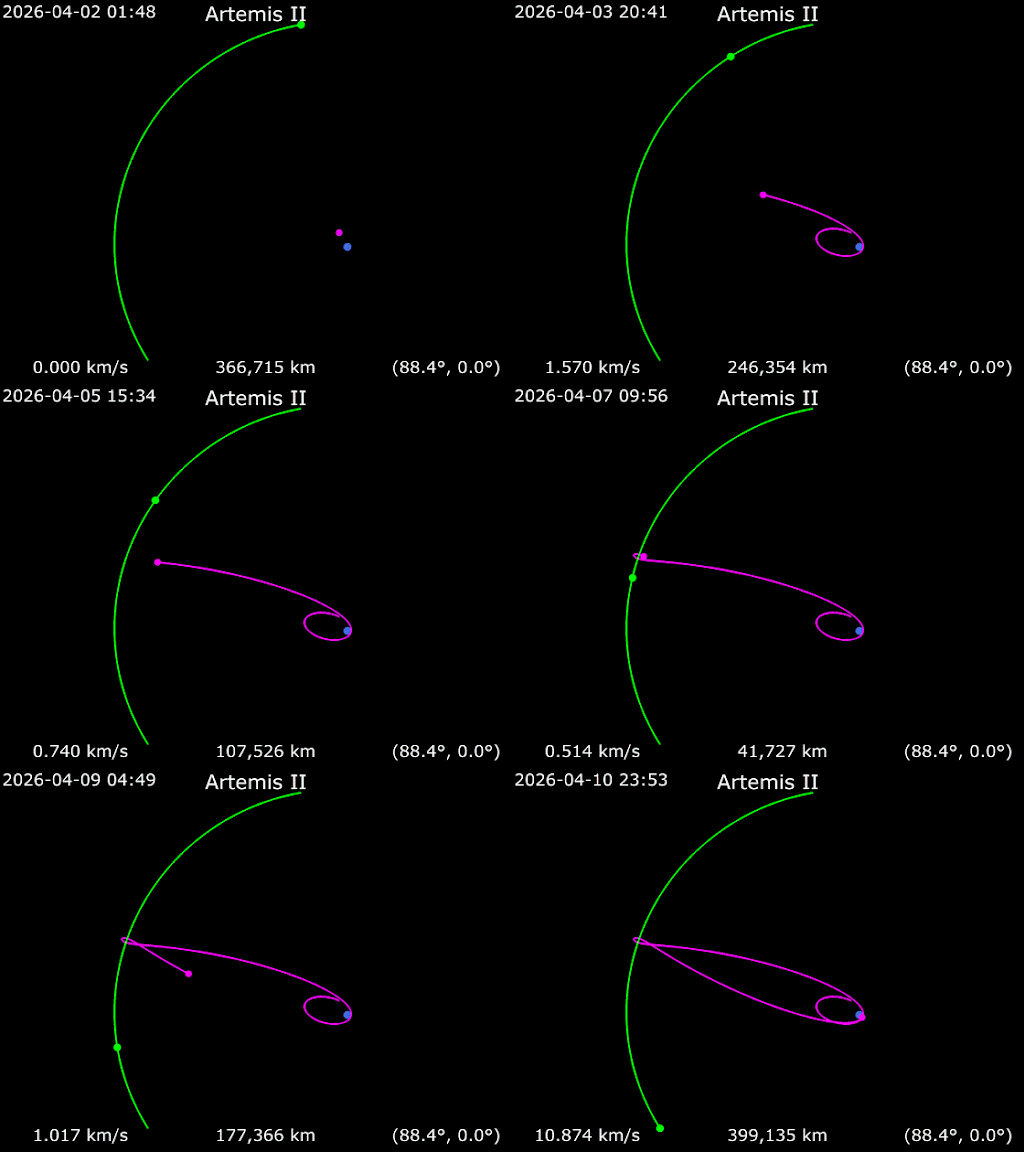
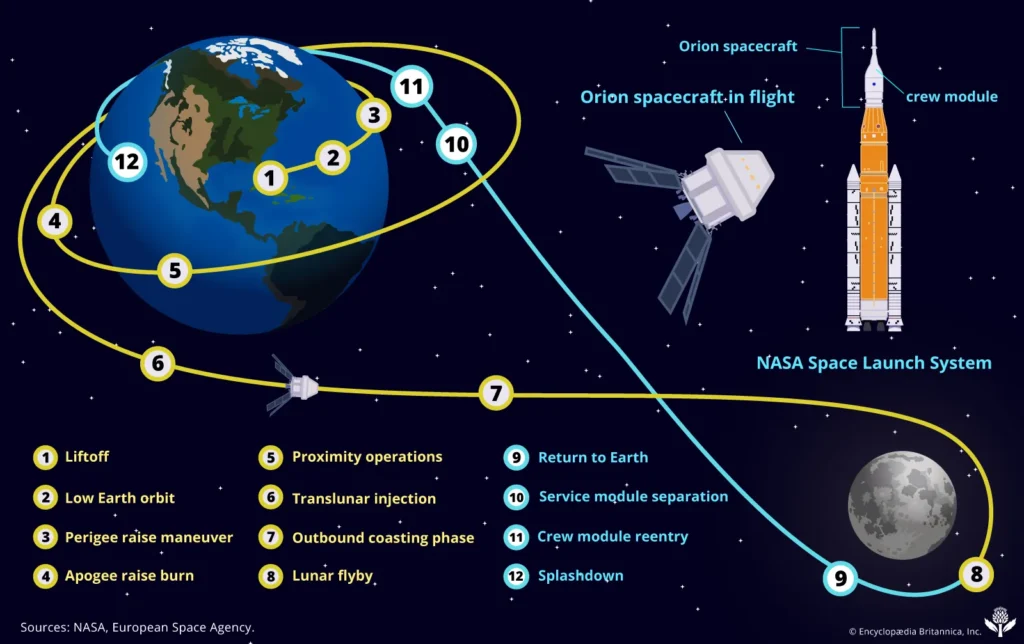
Just like the Apollo 4 mission, whose goal was to verify the integrity of the three-stage Saturn V launch, Artemis II’s primary goal is to ensure the system design of the SLS rocket and the Orion spacecraft. The 10 day flight takes the astronauts initially away from Earth, but uses the Earth’s gravity to ‘slingshot’ them around to the Moon, where then the Moon’s gravity redirects them back to Earth without using substantial fuel to redirect their approach (known as a free-return trajectory), as seen in Figure 3. Additionally, the presence of the crew will test the deep-space capability of the Orion capsule, including navigational, life support, and communication systems. Importantly, 75 minutes of the mission will be dedicated to testing the proximity operations (ship-to-ship maneuvering) of the Orion module, where it will use the detached Interim Cryogenic Propulsion Stage (ICPS) as a physical proxy for future ships or structures Orion may dock to. This is summarized in Figure 3.
Unlike the Apollo-era modules, Orion is designed for partial reuse, making reentry performance a central test of its long-term viability. This approach reflects a broader transition toward cost-effective, resource-efficient launch systems, exemplified by reusable vehicles such as SpaceX’s Falcon 9. With launch operations successfully completed, many of Artemis II’s mission objectives are already in progress. The mission is scheduled to conclude on April 10th with a splashdown in the Pacific Ocean off the coast of San Diego. While Artemis II may be “only” a systems test, it is a critical step toward establishing a permanent human presence in space, and toward a future where we travel to other planets and moons across our Solar System!
Astrobite edited by Drew Lapeer
Featured image credit: NASA, European Space Agency (ESA)