
Title: Bottom-heavy initial mass functions reveal hidden mass in early galaxies
Authors: Chloe M. Cheng , Martje Slob, Mariska Kriek, Aliza G. Beverage, Pieter G. van Dokkum, Rachel Bezanson, Gabriel Brammer, et al.
First Author’s Institute: Leiden Observatory, Leiden University, Netherlands
Status: Preprint on arXiv, Under Peer Review at Nature Astronomy
The James Webb Space Telescope (JWST) has been finding galaxies in the early Universe that look… kind of impossible. Some of the most extreme examples seem to have already assembled about 10^11 solar masses (M☉) in stars when the Universe was still very young.
A natural reaction is: maybe our mass estimates are off.
But today’s paper argues something more unsettling: some of those galaxies might actually be even more massive than we think, because a lot of their mass is hiding in stars that are too faint to see directly.
So what is the “hidden mass” here?
When we estimate a galaxy’s stellar mass from its light, we usually assume an initial mass function (IMF), basically a recipe for how many stars form at each mass. High-mass stars (several times the Sun’s mass) are bright and easy to notice, but they die fast. Low-mass stars are dim and hard to notice, but they form in huge numbers and live for a long time, so together they can make up a large fraction of a galaxy’s total stellar mass.
If a galaxy formed extra low-mass stars, it can look “normal” in light, but be much heavier in mass. That kind of IMF is called bottom-heavy.
The big question is: can we actually measure whether the IMF is bottom-heavy beyond the local Universe?
This is where JWST spectroscopy comes in. Even though low-mass stars are faint, they still leave fingerprints in a galaxy’s integrated spectrum, the combined light from all its stars. Some absorption features are especially sensitive to how much of that light comes from low-mass dwarf stars versus luminous giants.
The authors use ultra-deep JWST/NIRSpec spectra of nine massive, quiescent galaxies at z ≈ 0.7 from the IMFERNO program, then extend the wavelength coverage to bluer light using deep optical spectra from LEGA-C. They focus on quiescent galaxies because you are mostly seeing mature stellar populations, not a messy mix of hot young stars, nebular emission, and dust. That makes it much easier to read the “fine print” in the spectrum.
There is one complication, though: IMF-sensitive absorption lines can be mimicked by changes in element abundances. Sodium is a classic example: its absorption lines can look stronger either because the IMF is different or because the galaxy simply has more sodium.
So instead of measuring one line and calling it a day, the authors do full-spectrum fitting with a model that lets them vary lots of things at once, including stellar age, many individual elemental abundances, and the low-mass IMF slope.
Then they summarize the result using an “IMF mismatch” parameter, α_IMF. If α_IMF equals 1, the galaxy looks Milky Way-like. If α_IMF is greater than 1, the galaxy has a heavier mass-to-light ratio than the Milky Way, which usually means extra low-mass stars.
And yes, many of these galaxies look bottom-heavy.
They find that these z ≈ 0.7 quiescent galaxies often have α_IMF > 1, meaning an excess of low-mass stars compared to the Milky Way IMF. (Figure 1)
Even better, the galaxies follow the same kind of trend people have argued for in the local Universe. In Figure 1, the IMF mismatch tends to be larger in galaxies with higher velocity dispersion, which is basically a measure of how fast stars are moving around inside the galaxy and a proxy for how deep the galaxy’s gravitational potential well is. The IMF mismatch also trends with metallicity, often written as [Fe/H], which tells you how enriched the stars are in elements heavier than helium, a rough record of how much chemical “processing” previous generations of stars have already done.
![Two side-by-side scatter plots showing the IMF mismatch parameter (alpha_IMF) for galaxies. Left panel: alpha_IMF versus stellar velocity dispersion, with nine colored triangle points (the JWST-IMFERNO sample) over many gray comparison points; most triangles lie above alpha_IMF = 1. Right panel: alpha_IMF versus metallicity [Fe/H], again with colored triangles among gray points; higher metallicity generally corresponds to higher alpha_IMF. Error bars are shown, and a dashed horizontal line marks alpha_IMF = 1.](https://astrobites.org/wp-content/uploads/2026/02/Screenshot-2026-02-23-at-12.13.09-PM.png)
There is one clear outlier, galaxy 1158527, with a very bottom-heavy inferred IMF but a low measured velocity dispersion. The authors note that it is very round (axis ratio 0.97) and may be a face-on disc, so the velocity dispersion (σ_v), a line-of-sight measurement, may not capture the full gravitational potential. In that case, its virial mass would also be underestimated. Its high metallicity ([Fe/H]) points in the same direction, hinting that σ_v may be unrepresentative for this system.
Before trusting the new stellar masses, the authors do a sanity check using dynamics. If you crank up a galaxy’s stellar mass by a factor of a few, something awkward can happen: the stellar mass might exceed the total mass allowed by the galaxy’s dynamics. That is why they compare their IMF-based stellar masses to virial mass estimates. “Virial mass” here is basically a dynamics-based total mass budget inferred from the galaxy’s size and the speeds of its stars, in other words, what gravity says the galaxy can plausibly contain. In most cases, allowing a bottom-heavy IMF moves the stellar masses into better consistency with those virial constraints (Figure 2).
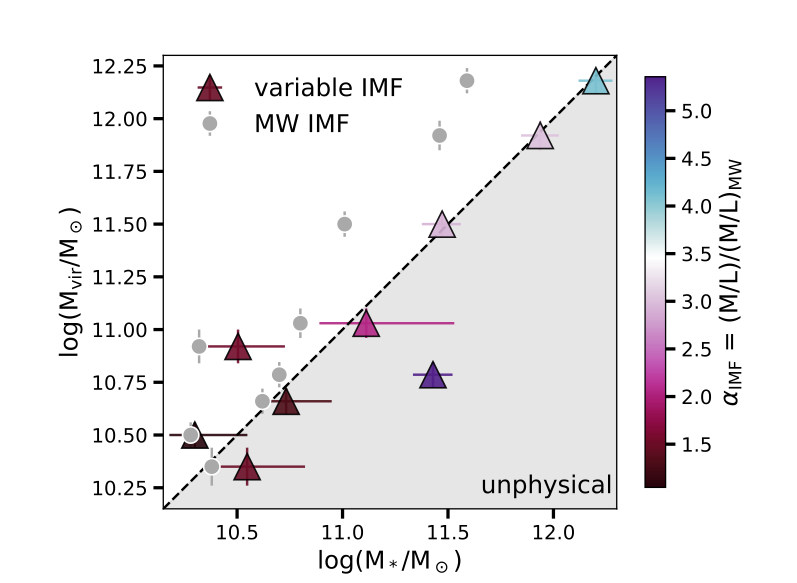
The oldest two galaxies are the scary ones
Even though the whole sample is observed at z ≈ 0.7, the spectral modeling suggests these two formed most of their stars much earlier, with formation redshifts z_form > 6. That implies these galaxies formed most of their stars when the Universe was only about ~1 billion years old.
That makes them plausible descendants of JWST’s “impossibly early” massive galaxies. For those two, the inferred bottom-heavy IMFs boost stellar masses by a factor of 3 to 4 compared to what you would infer with a Milky Way IMF. So if you were hoping IMF uncertainty would make the early massive galaxy problem go away, this paper’s answer is: nope, it might make it worse.
Why this matters
A galaxy’s stellar mass is not something we measure directly. It is something we infer, and the IMF is one of the most powerful assumptions hiding inside that inference. This paper is exciting because it offers IMF measurements beyond the local Universe, using the kind of ultra-deep JWST spectroscopy that finally makes dwarf-star sensitive features measurable at intermediate redshift. If bottom-heavy IMFs are common in the oldest massive systems, then some early galaxies may be carrying a lot more stellar mass than we have been counting, and galaxy formation models have even less time to explain how they built it.
Astrobite edited by: Joe Williams
Featured Image Credit: Niloofar Sharei (Made in Canva)
