Title: Improved constraint on the Hubble constant from dark sirens with LIGO/Virgo/KAGRA O4a
Authors: Viviane Alfradique, Clécio R. Bom, Gabriel Teixeira, and André Santos
First Author’s Institution: Brazilian Center for Research in Physics
Status: Preprint on ArXiV
Our universe is expanding, causing light from galactic objects to redshift. The further away the object, the more redshifted it is. This relationship between redshift and distance is characterized by the Hubble constant, and is essential to understanding cosmology. In the last two decades, measurements of the constant have become increasingly precise, with both the SH0ES and Planck collaborations producing their own measurements: the former using Cepheids and Type Ia Supernovae data, the latter using the cosmic microwave background (CMB). Both methods are respected, robust, and rigorous. They also disagree.
This is the Hubble tension, the disagreement between SH0ES’ local measurement of 73.04 ± 1.04 km/s/Mpc and Planck’s cosmological measurement 67.4 ± 0.5 km/s/Mpc. One of the most discussed problems in cosmology (and in astrobites!), this 5σ difference in the two measurements represents a crisis in our cosmological understanding, indicating errors in our physics theories, statistical methods or more. Hence, any independent measurements of the constant could be crucial in resolving the tension.
Gravitational waves (GWs) may be able to provide such a solution. Through the analysis of GW signals, the distance of a given GW source can be determined. This provides a reference for the source’s position known as a standard siren. If the source can be localized from the signal and emits electromagnetic (EM) radiation, the corresponding redshift can be determined from telescope data, giving an independent probe of the Hubble constant!
Unfortunately, despite the plethora of GW signals from the LIGO-Virgo-Kagra collaboration, only one GW signal thus far has had an unambiguous EM counterpart: GW170817. However, while the lack of these “bright” standard sirens is disappointing, all hope is not lost! Scientists have developed ways to determine the Hubble constant using “dark” standard sirens: GWs without an EM counterpart.
Statistical Sirens
There are several ways that dark sirens can be used to probe the Hubble constant, but the new results use the “statistical dark siren method”; in this method, well-localized GW signals are used in tandem with sky catalogs to determine the probability that the source is in a given galaxy. Each galaxy’s redshift is then estimated. Finally, the Hubble constant is measured from these redshifts, with each galaxy contributing differently to the total distribution based on their probability of containing the source.
To accomplish this, the authors analyzed 17 gravitational wave events using the DESI Legacy Survey for their catalog. The authors chose events that were close (luminosity distance within 1500 Mpc), well-localized (50% credible sky area within 1000 square degrees) and well-covered by the survey (at least 70% coverage). For surveys with less than 90% coverage, the authors also use simulated galaxies in addition to account for coverage effects. From there, the scientists use machine learning to estimate the photometric redshifts of each galaxy and thus their effect on the Hubble measurement.
An Improved Method
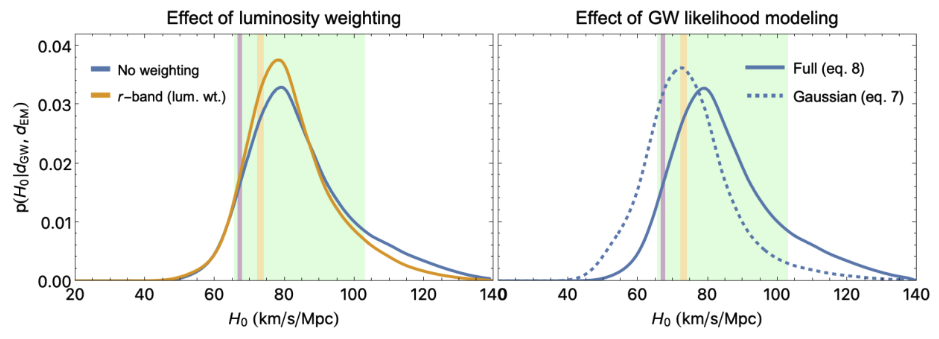
While this method had been used previously to produce Hubble measurements, the scientists in this new work apply novel techniques to yield more precise results. In particular, the scientists employ luminosity-weighting, a process by which brighter galaxies are given a higher likelihood of containing the GW source than dimmer galaxies. This is because the sources of dark sirens, binary black hole mergers, are expected to be more common in galaxies with high star formation rates and stellar masses — more luminous galaxies.
Ultimately, these new techniques lead to notable differences and improvements in dark siren measurements of the Hubble constant. Applying luminosity-weighting systematically increases the measured redshift of the source by .01-.1, and leads to an 14% reduction in the uncertainty. Additionally, using the full GW likelihood over the Gaussian approximation leads to a higher measurement of the Hubble constant, while selection effects have a minimal impact on the results.
The Tension is Still Tense
From the dark siren method alone, the researchers measured a Hubble constant of 78.2+12.0-11.0 km/s/Mpc. Combining this with the result from the bright siren GW170817, they measured a value of 78.2+4.1-4.0 km/s/Mpc instead. While this new result is dominated by the effect from the bright siren, the dark siren analysis improved the overall uncertainty of the bright-siren-only result by 11%. This suggests that bright siren and dark siren analyses are complementary to one another, and can be used in tandem to help measure the Hubble constant!
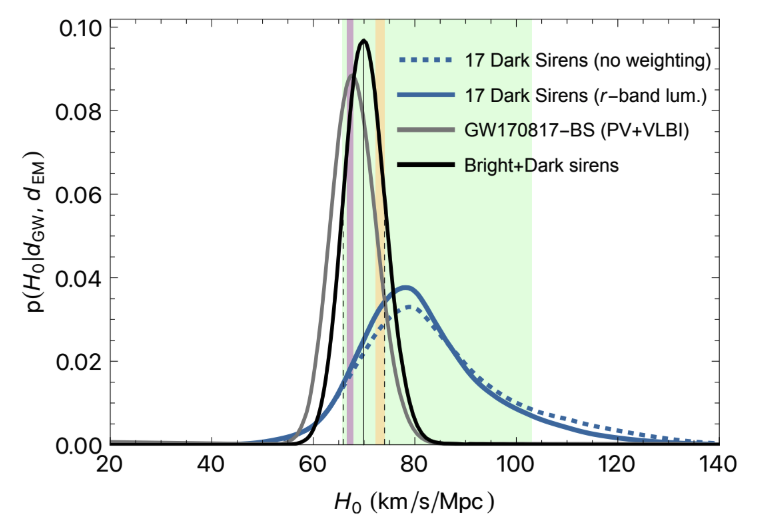
Ultimately, both the dark-sirens-only analysis and the combined analysis yield results that are consistent with both SH0ES and Planck. Simply put, we do not have enough information to resolve the Hubble tension with standard sirens: dark or otherwise. Even so, the method continues to develop and yield more precise constraints as time goes on and perhaps one day it will be precise enough to relax the tension completely.
Astrobite edited by Ryan White.
Featured image credit: Adapted from Figure 8 of Ezquiaga and Zumalacárregui.