Title: A 100 kpc ram pressure tail trailing the group galaxy NGC 2276
Authors:I. D. Roberts , R. J. van Weeren , F. de Gasperin, A. Botteon , H. W. Edler, A. Ignesti , L. Matijevi, N. Tomi
First Author’s Institution: Leiden Observatory, Leiden University, PO Box 9513, 2300 RA Leiden, The Netherlands
Status: Published in A&A (Open Access) , available on arXiv
The pressures of outer space
Space is never truly a vacuum, and the same is true for the space between galaxies.
Galaxies are usually a part of groups or clusters, the former being more sparse and the latter being a more dense collection of gravitationally associated and perhaps also dynamically bound galaxies. The intergalactic medium (IGM) pervades the space between galaxies within groups and clusters. This medium consists of ionized plasma which has been ejected or removed from galaxies due to various physical processes. The medium is more dense in clusters than in groups.As galaxies move through this medium, if the medium is dense enough, or if the velocity of the galaxy is high enough, or in most cases a combination of both, the medium can exert pressure on the gas inside the galaxy and remove it off the main body. This process is called ram pressure stripping. As galaxies lose gas, the stripped gas may appear as long jellyfish-like tails against its direction of motion in the medium.
So what gives?
Leaving a timely tail trail
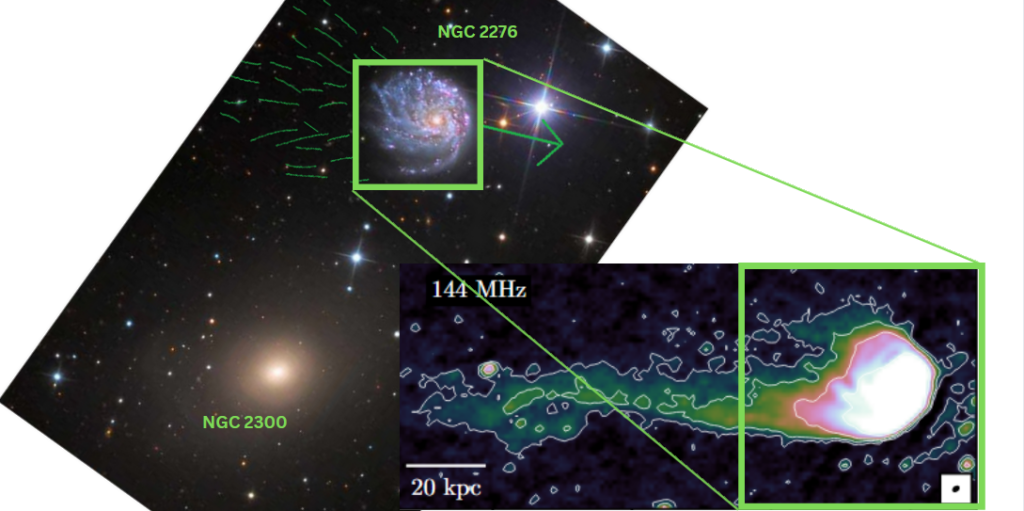
The spiral galaxy NGC 2276 is a part of the same group as the elliptical galaxy NGC 2300. Ram pressure stripping of NGC 2276 has been studied in the past with X-ray observations, and it has also been noted that one edge of the galaxy shows an increased rate of star formation. The external pressure from the medium can compress gas and trigger star formation in the galaxy, and since it is the galaxy’s leading edge interacting with the medium shows increased star formation, scientists think that ram pressure must be being applied.
The big discovery in this paper is that the resultant tail of gas, when observed using radio telescopes, seems to be 10 times longer, about 100 kiloparsecs.
This study observes NGC 2276 using two different radio telescopes: LOFAR, based in Europe, and uGMRT, based in India, both of which specialize in low frequency radio observations. The observation was carried out in multiple frequency bands. A frequency band is a range of the electromagnetic spectrum being observed. 7 bands from 54 MHz to 1230 MHz were used in their observations.
As the gas from the galactic disk is removed via ram stripping, it is ionized and slowly diffuses away into the IGM. The process of ionization also releases electrons, which also lose energy with time. The authors slice the image of the tail into small bins and calculate how much energy electrons in each bin have lost, and with it estimate how far they have traveled along the tail and how much time it took for them. With this they are able to figure out how long ago which part of the tail was stripped. It is an ingenious way to use the tail as a clock! The model used for this is called the synchrotron ageing model. We know how long the tail is, we know how fast the electrons travel down the tail, and how much energy they lose along the way. Putting it all together lets the authors calculate a velocity of 870 km/s for the tail in the sky plane.
Orbital dynamics of a galaxy, far far away?
For objects within the Milky Way, or in our immediate neighborhood, we have been able to use parallaxes and proper motions to very accurately estimate the 3D velocities of objects with revolutionary observatories such as GAIA. These become harder and harder to measure the farther away an object is, and with current observational capabilities, they do not work beyond the Local Group. This essentially means for slowly evolving systems (on human life timescales) like galaxies which are outside the local group, say for example in a cluster or group like the NGC 2300 group, obtaining 3D velocities ends up being very challenging.
3D velocities are crucial in characterizing dynamical interactions of galaxies.
The authors use the 870 km/s velocity for the tail on the sky plane to estimate the 3D orbital velocity of the galaxy. Apart from its motion with respect to the center of the group, the whole group also has its own motion with respect to the observer. The astronomers assume that the central elliptical galaxy NGC 2300 to be the rest frame for the group, it has a radial velocity of about 420 km/s. Using this, they calculate the 3D velocity of NGC 2276 to be 968 km/s.
Thus using the longest ram pressure tail discovered till the publication of this paper, the authors of this article are able to estimate the 3D velocity of a faraway galaxy! Extending this methodology to multiple galaxies in a group and cluster can help us get deeper insights into group/cluster dynamics and maybe even use them as a tool for estimating their masses in the future!
Astrobites edited by Joe Williams.
Featured image credit: Wikimedia Commons, the source pre-print,
Adam Block/Mount Lemmon SkyCenter/University of Arizona, CC BY-SA 3.0 us