
Two things I really love in life are space and going to the movies. In the past year I have seen 54 movies in theatres, and three of those trips in particular stood out for me: 2001: A Space Odyssey, Interstellar, and Project Hail Mary. These three movies differ in visual style, astronomical scale, and tone, but all fit into a genre of science fiction I would call “The Space Odyssey”, featuring rigorous scientific accuracy, a showcase of the fictional applicability of the most up-to-date astronomy research at the time, and a small crewed mission going deep into outer space. Each of these movies act as a time capsule — an insight into the ways real crewed space missions were being perceived by the public. So, today let’s have a brief rundown of the history of the relationship between the Space Odyssey and the Space Mission.
2001 and The Space Race
Stanley Kubrick’s 2001: A Space Odyssey (or just 2001 for short) was released in 1968 and is widely considered one of the most influential science fiction films of all time. Kubrick wrote the screenplay for 2001 with author Arthur C. Clarke, who worked on the novelization in parallel with Kubrick’s screenplay. The pair first met to begin work on the story on April 8th, 1964, just after the conclusion of the Project Mercury and exactly 2 weeks after Gemini I was launched. The influence of the Mercury, the Soviet Vostok programme, and the space race in general on 2001 is impossible to ignore, both aesthetically (Figure 1) and politically.
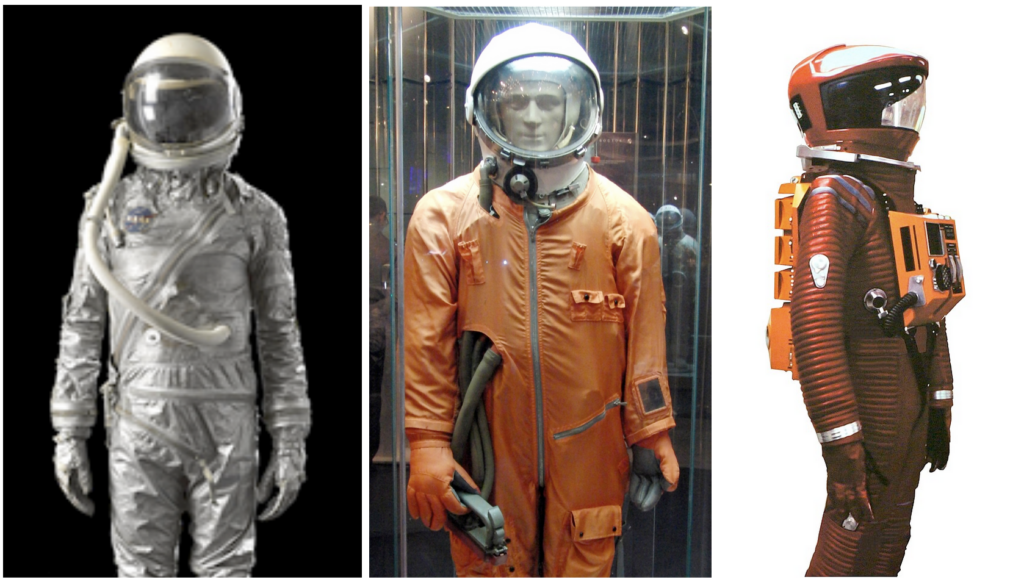
For one, Kubrick’s vision of advancements in space travel in less than 35 years was extremely optimistic, with scientists able to take frequent trips from Earth to space stations and permanent Moon bases. This reflected the rapid amount of progress that was made in a comparatively short amount of time during the Space Race between the USA and the USSR. For another, that feeling of international competition and cold-war era suspicion lingers in Kubrick’s 2001. When a mysterious monolith is found on the Moon by American scientists, the discovery is hidden from their Soviet counterparts, and when a mission is assembled to investigate where this monolith came from, the team is entirely American.
The motivations behind the journey undertaken in 2001, however, are also reflective of the optimism and momentum of the 1960s. In the film, there is no real pressing, Earth-bound need to travel to Jupiter to determine the origins of this monolith. Rather, it is motivated simply by the desire to explore and learn more about our place in the universe … and likely also to beat the Soviets.
Interstellar and The End of The Space Shuttle Era
A more recent film which has also begun to cement itself as an influential addition to the Space Odyssey canon is Christopher Nolan’s Interstellar, which was released in 2014. In the nearly 50 years since Kubrick’s 2001, Interstellar actually takes on a comparatively bleaker view of the future of human space travel. Jonathan Nolan, Christopher’s brother, was hired to write the screenplay in 2007. In the five years it took him to complete it, he witnessed a tanking of public and financial support for NASA crewed missions.
While in previous years the Space Shuttle program was viewed extremely positively, after the 2003 Challenger disaster and the 2008 financial crisis the American government no longer wanted to support spending on risky projects that seemingly could not directly improve the public’s lives in the short term. This also coincided with the beginning of a polarization in trust in scientific research, particularly in climate research (Figure 2).
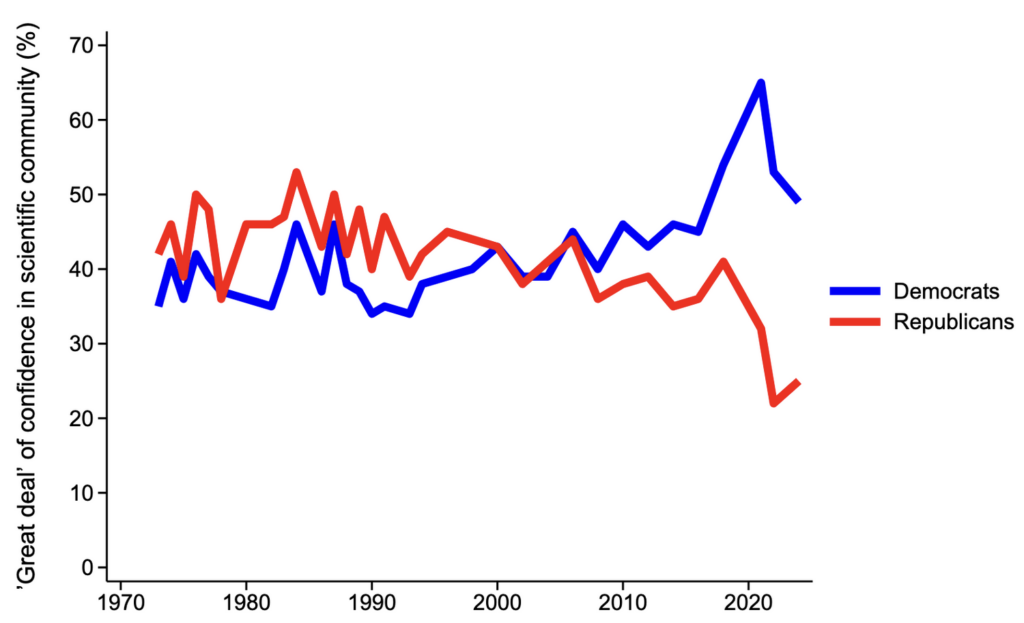
Alongside ballooning costs of the program, and the completion of construction on the International Space Station (ISS), the result was the retirement of the Space Shuttle program in 2011. The Nolan brothers considered this to be a disinvestment from American space exploration, and wanted to make a movie which could encourage the goal of human spaceflight, particularly beyond Earth orbit. The first trailer for Interstellar, in fact, directly references this.
Nolan’s Interstellar portrays this 2060s American landscape as one where an over-correction has been made to focus on short-term survival in the face of looming climate disaster. We learn that the public school system in the film teaches children that the Moon landing was a hoax, insisting that the technology for spaceflight never existed. NASA also was completely defunded and disbanded, forced to continue work in secret, while the majority of the world’s resources were shifted to agriculture to battle mass food shortages.
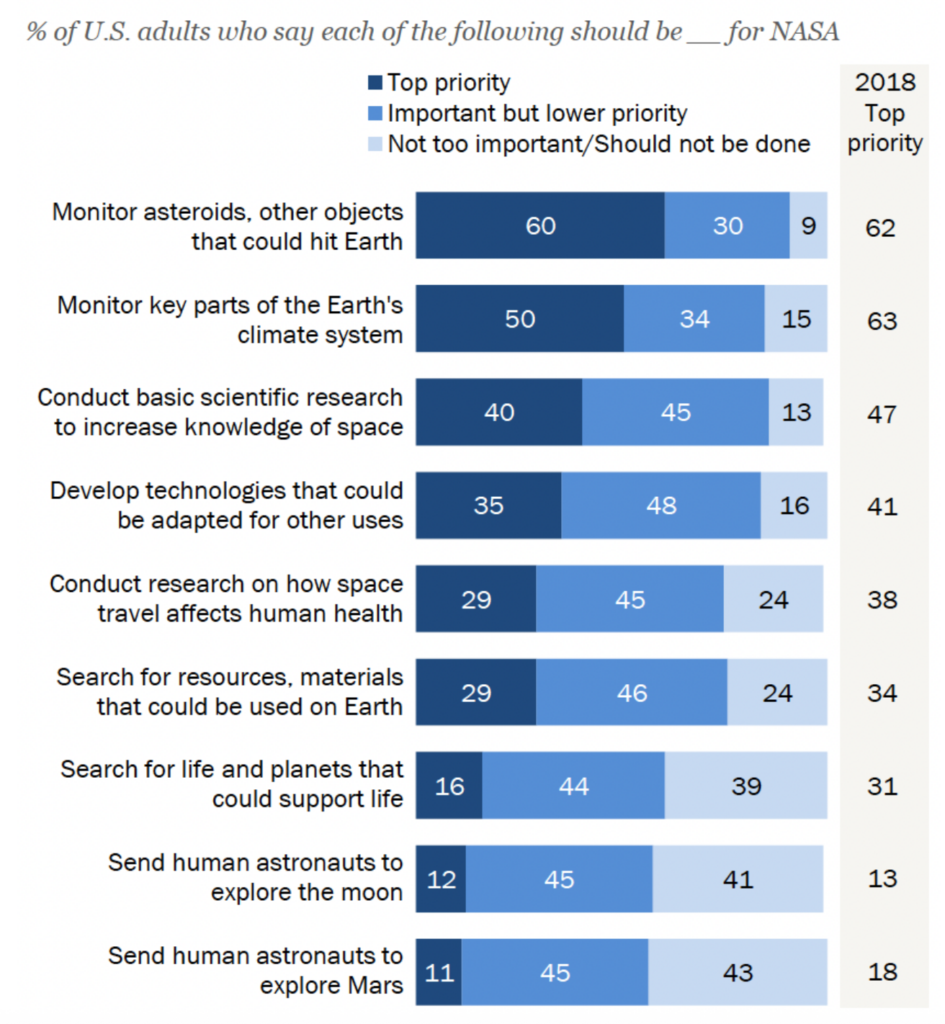
This results in one of the largest differences between 2001 and Interstellar: the motivations behind the respective missions. Interstellar’s search for a new planet positions its journey as providing an existentially necessary benefit for Earth, rather than for the sole sake of exploration. This is similar to the public’s opinion in the 2010s, as it was found that Americans overwhelmingly felt that NASA’s top priorities should be asteroid monitoring and climate research rather than human spaceflight, astronomical research, and the search for life on other planets (Figure 3).
Project Hail Mary and The International Space Station
Project Hail Mary was only released last month, and although it’s still not clear if it will stand the cultural test of time to be remembered alongside 2001 and Interstellar, its popularity is encouraging, and I would say it definitely is included in this “Space Odyssey” genre. Hail Mary is based on the 2021 novel by Andy Weir, who began writing it in the mid-to-late 2010s. The most prominent human space missions occurring during this time would have been the ISS expeditions.
Although the ISS has been continuously inhabited since 2000, the 2010s connected the public with astronauts like never before thanks to the high-speed internet connection that was set-up in January 2010. Since then, ISS astronauts have been able to directly speak with school groups, share day-to-day life and ongoing research, and, honestly, just have some fun! One of the biggest changes between 2001, Interstellar, and Hail Mary was the depictions of each of their astronaut protagonists. 2001 and Interstellar portray astronauts as they were largely viewed at the time: serious, straight-talking, brave. Hail Mary sharply deviates from this. Ryan Reynolds’ Dr. Grace is outrageously relatable, funny, and takes genuine, explicit delight in doing science, which lines up the most with real-life astronauts out of all three of these films.
Hail Mary also has the most collaborative and optimistic outlook on space exploration. Without spoiling too much if you haven’t seen it yet, Hail Mary takes that collaboration across languages and cultures found on the ISS to the extreme, putting an emphasis on trust, compassion, and friendship. The mission launched in Hail Mary is an entirely international endeavor, with Grace’s original crewmates coming from Russia and China, America’s previous and current space race competitors. This is a stark improvement on 2001’s distrust of other nations, and Interstellar’s entire lack of acknowledgement of the international community.
Similar to Interstellar, however, Hail Mary also positions its mission as existentially necessary for Earth. While both films either directly reference or utilize a metaphor for climate change, their goals also showcase a (hopefully) shifting optimism towards our ability to mitigate its effects. In Interstellar, the mission aims to find a new planet for humanity to live on, giving up on the ability to save Earth. Hail Mary, on the other hand, travels to another star system in an attempt to find a way to save our planet, remaining hopeful even when facing steep odds against success.
The Beginning of The Artemis Era
Finally, the release of Hail Mary coincides with a new era of crewed space missions, with Artemis II taking humans around the moon and back earlier this month for the first time since 1972. While the motivations behind the funding of these missions harken back to the 1960s, with the USA seemingly initiating a second space race with China, this aspect hasn’t been what the public has been connecting with so far.
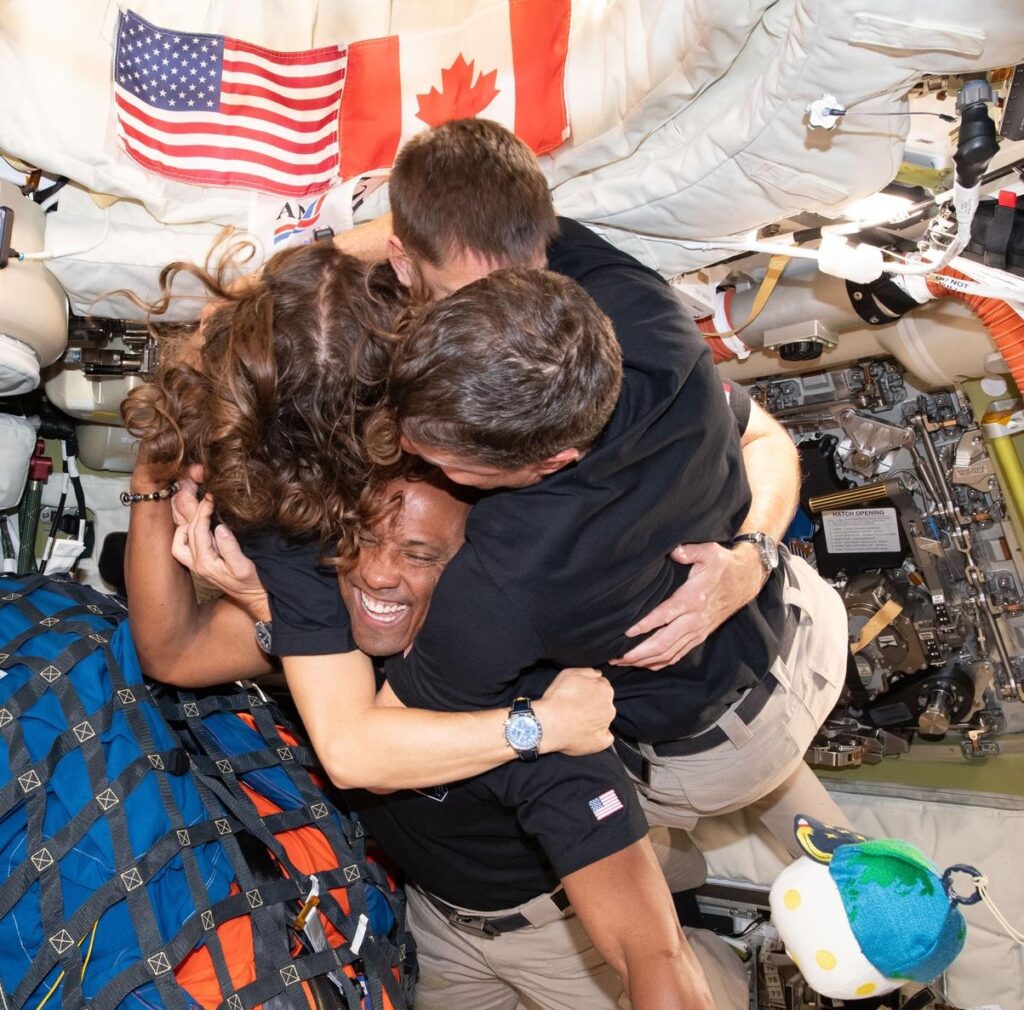
Instead, similar to the last 10 years of ISS expeditions and the appeal of Hail Mary, people are excited to see themselves in the astronauts exploring space and expanding our understanding of it. This means both representation on the demographic level, with the first woman and first person of colour (Christina Koch and Victor Glover) to journey to the Moon, and also representation on a more inter-personal level. One of the stand-out highlights of the Artemis II mission was the crew livestreaming moments of joy, wonder, grief, and connection, for all on Earth to participate in alongside them.
We have yet to see how these Artemis missions will play out, and if public support for them will change, but regardless, this new era of space exploration and science will no doubt influence the next sci-fi blockbuster hit.
Edited by: Sparrow Roch
Featured image credit: wikimedia commons and NASA

This was a great read. Really like the comparisons you gave between each film and the general progress and consensus about space at the time.
LOVE THIS!