
Title: JWST sighting of decametre main-belt asteroids and view on meteorite sources
Authors: Artem Y. Burdanov, Julien de Wit, Miroslav Brož, et al.
First Author’s Institution: Department of Earth, Atmospheric, and Planetary Sciences, Massachusetts Institute of Technology, Cambridge, MA, USA
Status: Published in Nature [closed access]
On June 30, 1908, a bright fireball streaked across the Siberian sky. An asteroid exploded near a Siberian river, Stony Tunguska, producing a shockwave that knocked people off their feet and flattened about 2,000 square kilometers of forest. Several incidents similar to this “Tunguska event” have been reported in our history, showing that asteroids a few tens of meters in size are not unlikely to hit the Earth.
Luckily, astronomers are on the look-out!
Finding a needle in a moving haystack
These decameter (a few tens-of-meters) asteroids are thought to originate in the main asteroid belt, between Mars and Jupiter, before some of them migrate into near-Earth space. Spotting them is a challenge: we’re looking for objects the size of a few student dorms, orbiting hundreds of millions of kilometers away.
These objects are so faint that we need to stack many observations. In this process, we add images of the same object together into a “stacked” image, which ultimately boosts the signal-to-noise ratio. Unfortunately, asteroids also have the annoying habit of moving around. This sets them apart from stars, which are so distant that they appear almost fixed in position. Instead of simply stacking images in a fixed frame, we now have to “shift and stack” the images along possible asteroid trajectories. Imagine guessing every possible path an asteroid could take across the image, shifting the frames accordingly, and checking whether a faint signal appears (see Fig. 1).
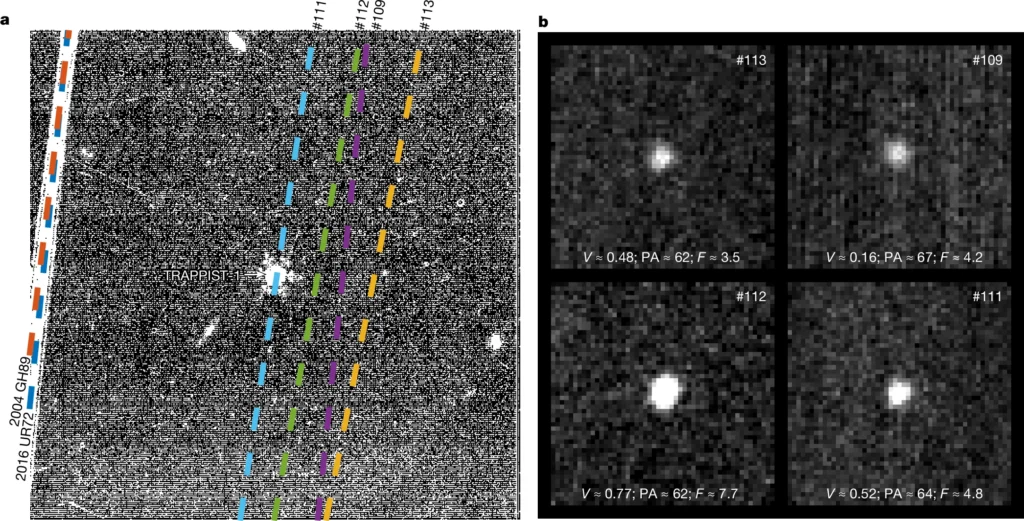
Free asteroids with your JWST observations
Today’s authors use the “shift and stack” method to find asteroids with the highly sensitive JWST. JWST has been hard at work since its launch in 2021, and many hours of observations have been conducted for a wide variety of science cases. Coincidentally, some long-duration observations happened to be looking in the direction of the main asteroid belt. Although these observations were not planned with the intention of finding asteroids, today’s authors find that they are practically gold-mines. With 93.5 hours of JWST observations, they spotted 138 previously unknown asteroids!
What can we learn about this new population of asteroids?
Where are these asteroids located?
Ideally, we would determine the full orbital configuration of these asteroids, but the short observational window makes that difficult. Instead, the authors assume that many small asteroids are fragments of larger “parent bodies” formed in past collisions, and therefore share similar orbits. The orbits of the parent bodies are typically well-known from other observations.
Using nearby large asteroids (i.e. possible parent bodies) as a guide, they recover the orbital configurations of 8 known objects in their data. Applying the same method to the newly detected asteroids, they find that most are primarily located in the main asteroid belt, which is where we expect our Tunguska-like asteroids to originate from.
How large are these asteroids?
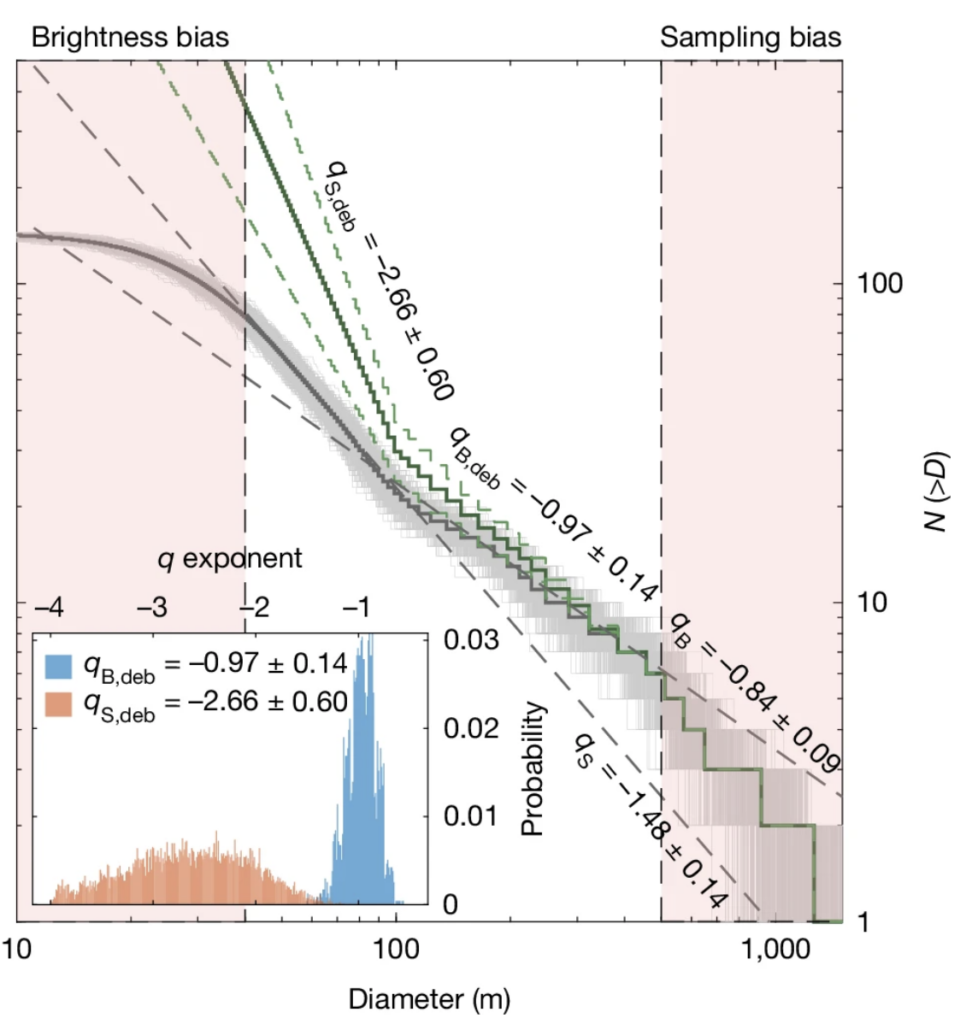
The JWST observations, combined with its infrared coverage, furthermore allow the authors to estimate asteroid sizes with relatively high precision. Most asteroids have historically been detected in optical light, which is dominated by reflected sunlight. Because optical observations depend on both size and surface reflectivity (albedo), it is often difficult to disentangle whether a bright object is large or simply very shiny and reflective. In the infrared, on the other hand, the signal is primarily thermal emission from the asteroid’s heat. Assuming the asteroid is in thermal equilibrium with sunlight, the authors can infer the asteroid size to higher precision.
This is a major step forward: previously, no main-belt asteroids smaller than ~500 m had been detected, but JWST pushes this down to tens of meters. The resulting cumulative size distribution reveals a clear population trend, following a slope downwards that can be quantified by an exponent q (see Figure 2). The exact value for q changes around ~100 m, as can be seen by a sudden change in slope. Intriguingly, Near-Earth Objects show a similar kink at roughly the same size, providing the first observational link between the two populations.
From first detections to large sample statistics
With more JWST observations to come, we’re set to go from a few hundred detections of these small asteroids to thousands. That shift turns future investigations from a simple “can we see them?” question into true population science, with enough data to study decameter asteroid origins and evolution in detail. So while JWST wasn’t designed as an asteroid survey mission, it’s quickly becoming a remarkably powerful one, allowing us to connect the dots between these distant asteroid families and the occasional, unsettling fireball in Earth’s sky.
Astrobite edited by Kelsie Taylor
Featured image credit: Richard Bartz
