
A note from Ryan…
In 2024 I started my honours research project at the University of Queensland in Australia. Just two months into my program, my research team was allocated several hours of time to use the most powerful optical interferometer in the world, the Very Large Telescope Interferometer (VLTI), so that we could observe a distant stellar triple with a curious enshrouding nebula. This nebula, named Apep after the Egyptian god of chaos, was first discovered a few years earlier using infrared imaging on the Very Large Telescope (VLT) and could not be done using any other instrument on the planet. Following this, I had my first experience writing and editing telescope proposals for our next round of observations with the VLTI where I was lucky enough to be awarded another several hours as the Principle Investigator of a VLTI program. This milestone in my academic career – telling one of the most complicated machines in the world where to point for several hours – is something that I’ll keep with me for the rest of my life.
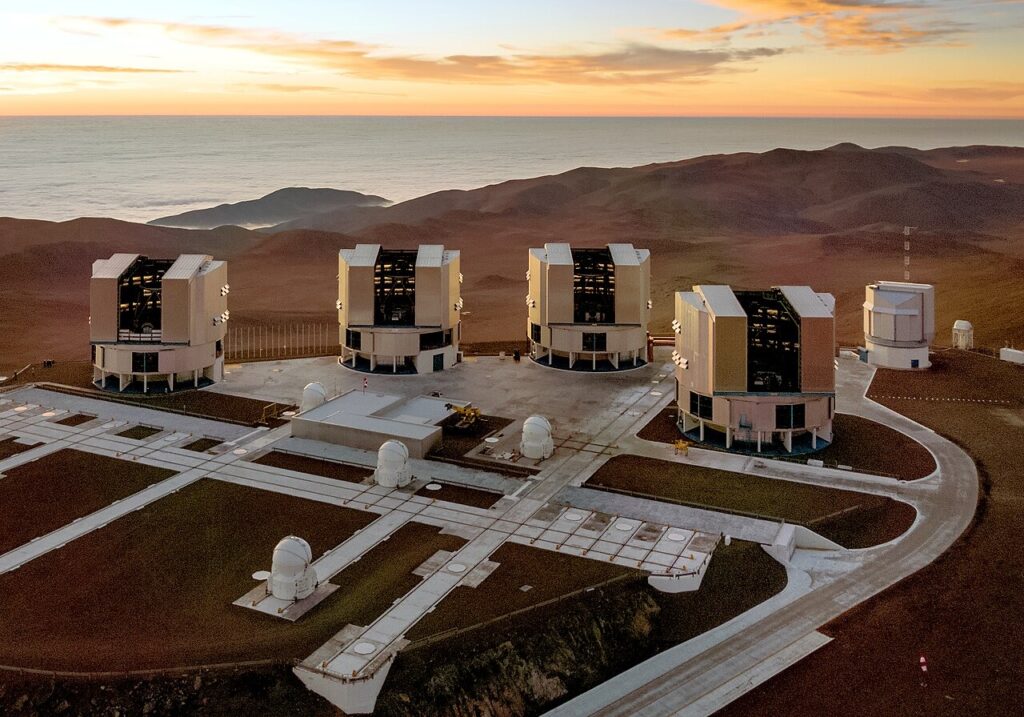
Figure 1: The Very Large Telescope consists of four 8 metre class telescopes together with 4 ~1.8 metre telescopes that make up the VLTI. These are situated on top of Cerro Paranal – a high altitude, incredibly dry region of Chile which is unlike any landscape in Australia and is ideal for optical astronomy. Image credit: ESO/G. Hüdepohll
A note from Jayde…
Last year, I joined an exclusive group of around 50 people globally (and one of only three Australian students since 2019) selected for the European Southern Observatory (ESO) Summer Studentship Programme. The programme offers a fully funded six-week experience at ESO’s headquarters in Garching, Germany, where students work on cutting-edge projects with supervisors, attend seminars, participate in onsite conferences, conduct observations, and access opportunities most researchers never encounter in a lifetime, let alone compressed into six weeks.
This experience fundamentally transformed my career. During the program, I worked on a project titled “Exploring the Growth of Dense Stellar Systems Across Cosmic History,” which focused on understanding when and where star clusters formed throughout the universe. While that’s fascinating in its own right, these environments are prime sites for forming compact objects, meaning they can offer clues about where we might expect signals from black hole mergers to originate.
Beyond the technical skills and new research perspectives gained from collaborators across nationalities and backgrounds, it taught me something equally valuable: the power of genuine international collaboration. While Australia is wonderfully multicultural, our research communities tend to operate in relative isolation. Working within a European facility exposed me to how much more we achieve when borders dissolve in pursuit of shared scientific questions. The experience directly influenced my PhD direction and reshaped how I approach research problems. For that, I’m deeply grateful to everyone involved.
Neither my nor Jayde’s life-changing experiences would be within reach if it weren’t for a strategic partnership that Australia has had with ESO over the last 10 years. This partnership expires in 2027 and Australia has decided not to stay on as a member of ESO going forward. This jeopardises our seat at the table of global astronomy and the opportunities available to Australian students – those that Jayde and I, as well as countless others, have valued so dearly.
What is the strategic partnership and why was Australia in it?
Taking sharp images of deep space objects requires a few things. The most obvious thing you need is a large telescope; as you build larger and larger telescopes, you have more light collecting area which reveals the most distant and hidden objects in the Universe. However, building these comes with an exponentially larger price tag. In addition to this, you need good ‘seeing’: the atmosphere distorts the light coming down to the ground, so ideally you want your big telescope high up on a mountain that does not need to look through a lot of humid air. As a flat, humid country with a medium-sized economy, Australia benefits enormously by being part of a Strategic Partnership with the European Southern Observatory – an organisation of over a dozen countries that pool together their capital to make use of Chile’s geographic advantages for astronomy.
In 2017 the Australian government committed $130 million to obtain member-level access to ESO’s instruments at the La Silla Paranal Observatory, namely the VLT and New Technology Telescope. There have been thousands of successful telescope proposals since the partnership started, including over 500 being led by Australians and more than 100 refereed papers developed from these data. Not only this, but Australia gained some access to other ESO perks, one of those being preferential access to the ESO Summer Programme that Jayde attended. Each year, just seven positions become available at this highly competitive internship. With roughly 400 applicants annually competing for limited spots, the selection process heavily favors ESO member states. Australia, as a strategic partner, also has priority over non-member countries.
The benefits don’t stop at telescope access and summer programmes, though, with Australian students and early career researchers (ECRs) having been able to receive funding support for collaboration and travel. Dr David Sweeney, a University of Sydney alumnus and current postdoctoral researcher at the institution, said that he ‘was fortunate to visit ESO for several months as part of their Scientific Visitor Programme, at no cost to me or my supervisor, which was a highlight of my PhD and has lead to collaborations which I still lead and others within which I am still active’. He notes that although these opportunities are still available to non-member states, they become prohibitively competitive and expensive where financial and travel support to ESO facilities is not available to non member states.
Since 2022, Australia has also been part of ESO’s Technology Development Programme. This allows Australian engineers and astronomers to be better integrated into the design decisions and manufacturing of ESO instruments – a programme which significantly boosts the local economy, national recognition, and develops the next generation of world-class engineers. This collaboration is due to expire together with the Strategic Partnership in 2027, and puts current and future instrumentation projects into a realm of uncertainty.
Where do we go from here?
With the partnership soon expiring, and the state-of-the-art ESO Extremely Large Telescope (ELT) nearing the end of its construction, the Australian government has chosen not to pursue the full membership status for which it was invited to apply. For roughly $50 million per year, becoming a full member would have allowed Australian access to the ELT – the first 30 metre class telescope – and also the Atacama Large Millimetre Array (ALMA), both of which are not part of the Strategic Partnership. The decision to not pursue full-membership was made on a financial basis, though this price tag is just a small fraction of the roughly $330 million that astronomy contributes to the Australian economy each year.
Dr Yinuo Han – a postdoctoral researcher at Caltech and former University of Sydney student – says that without the partnership “it might be harder to get data on the VLT, and in the near future without ELT access we could be missing out on quite a lot.” Like myself, one of Dr Han’s first introductions to astronomical research was working with data on the Apep system. “The Apep data I worked on was one of my earliest interactions with research in astronomy and an important part of [my] continued interest in the field afterwards.” This infrared data on the Apep system was obtained from one of the VLT Unit Telescopes, made more accessible through the Strategic Partnership.
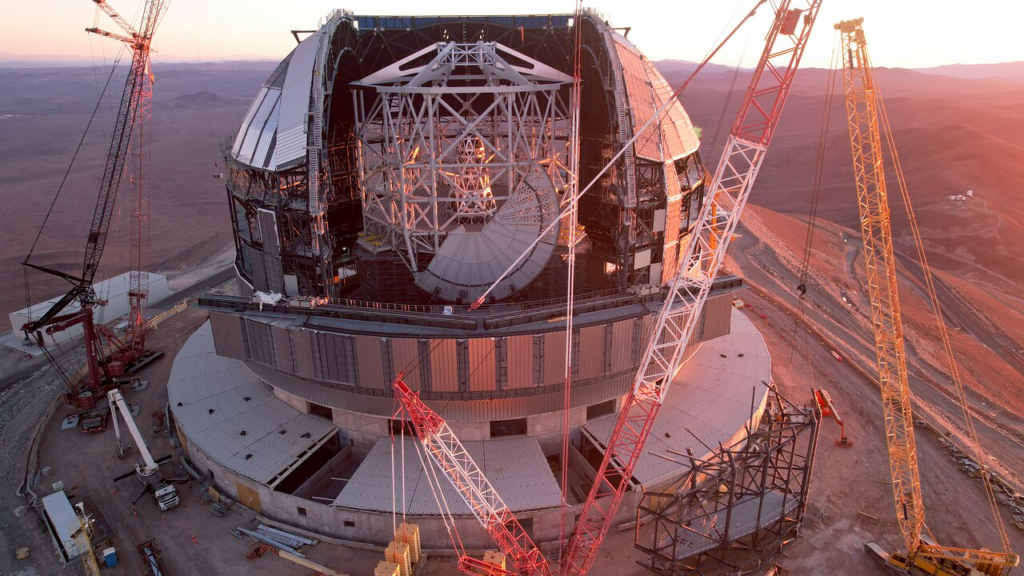
Figure 2: The ELT will be, by a large margin, the largest optical telescope in the world once construction is finished. Australia has forfeited access to the observatory by not going through with ESO full membership. Image credit: ESO/G. Vecchia
In absence of the partnership or full membership, Australian students will still be able to apply for time on many ESO instruments, just without the generous preference given to ESO member states. In addition to the loss of tangible perks, withdrawing from the ESO will further isolate Australian students from the global astronomical community. “Aside from the immediate benefits to my PhD of these experiences, the ties I developed to astronomers and students in ESO have helped me tremendously in the years since (examples include proposal writing, instrument tutorials and enduring mentorship). I would consider it a great loss to Australian astronomy if future students could not have these experiences,” said Dr Sweeney.
Australia currently has no formal nor proposed partnerships with other 8 metre class telescopes. In lieu of the ELT, Australia is a founding member of the 25.4 metre Giant Magellan Telescope though it will not be complete until some years after the ELT’s expected first light. While Australia is a powerhouse of radio astronomy with the Square Kilometre Array Observatory coming online (among other operational radio observatories), a lack of access to cutting edge optical facilities will limit the science and follow-up potential of new discoveries. In the meantime, Australian postgraduate students still broadly have access to the Siding Spring Observatory – hosting Australia’s largest optical telescope at 3.9 metres – though its future of funding is highly uncertain. For now, Australian institutions and researchers are considering a ‘Plan B’ to continue doing cutting-edge optical astronomy and instrumentation, such as that used to support the Artemis missions, discovery of dark energy, and more.
Astrobite edited by Munira Hoosain and Abbé Whitford
Featured image credit: Y. Beletsky (LCO)/ESO
Edited on 02/05/2026 to correct a statement on Australia’s partnerships with other 30m class observatories.

