
Title: At least one in a dozen stars shows evidence of planetary ingestion
Authors: Fan Liu, Yuan-Sen Ting, David Yong, Bertram Bitsch, Amanda Karakas, Michael T. Murphy, Meridith Joyce, Aaron Dotter & Fei Dai
First Author’s Institution: School of Physics and Astronomy, Monash University, Australia
Status: Published in Nature, March 2024 [closed access]
Stellar Siblings Tell Tales
Imagine you and your twin sibling were born with identical DNA, but years later, a blood test reveals subtle differences. You’d want to know why. Astronomers face a similar puzzle when studying pairs of stars born from the same molecular cloud (a giant cloud of cold gas and dust where stars form). These “co-natal” stellar twins should have identical chemical compositions unless something happened to one of them along the way. One possibility? Devouring a planet. When a star consumes planetary material, the planet’s elements get mixed into the star’s outer layers, which leaves behind a chemical fingerprint. Today’s paper presents the largest ever search for these fingerprints, finding that roughly one in twelve Sun-like stars shows evidence of having eaten a planet.
Finding the Right Stellar Pairs
To run a “blood test” on stellar twins, you first need to be sure they actually are twins. The main challenge in detecting planetary ingestion is distinguishing it from other sources of chemical variation, and most apparent stellar pairs in the sky are not real siblings at all. When two stars look close together in the sky, that just means they lie in the same direction as seen from Earth. They may actually be at very different distances, separated by huge stretches of space along our line of sight.. The authors sidestep this problem by studying co-moving pairs: stellar siblings which they know are real siblings, because they travel through the galaxy together at the same speed and in the same direction. Using data from the Gaia satellite, they identified 91 pairs of stars separated by less than 5 light-years. These pairs almost certainly formed together and should share the same birth composition.
If two siblings start with the same chemical DNA, then any difference seen later has to come from something that happened to one of them after their birth. The team obtained high-resolution spectra (light split up by wavelength, used to read off the chemistry of stars) from three world-class telescopes (VLT, Magellan, and Keck) and precisely measured abundances of 21 elements. The high precision of these measurements is important because planetary ingestion signatures are subtle, and they typically change abundances by just 10%.
The Smoking Gun: Condensation Temperature Trends
So what does eating a planet leave in the blood? Rocky planets are enriched in refractory elements (elements that condense from a hot gas at high temperatures, like iron, silicon, and aluminum). When a star swallows a planet, it becomes enriched in these elements relative to volatile elements like carbon and oxygen, which condense at lower temperatures. In other words, a planet-eater’s chemistry tilts toward the elements that make up rocky worlds. If one twin had simply absorbed extra material of any kind, you would see all 21 elements shifted up together with no particular pattern. But if it ate a rocky planet specifically, the boost should show up only in the elements that build rocks, and not in the others. That is why the authors plot abundance differences against each element’s condensation temperature (the temperature at which an element transitions from gas to solid in a cooling protoplanetary disk): a clean upward trend, with rock-builders enriched and gas-formers unchanged, is the actual fingerprint of swallowing a planet. A positive slope indicates one star has been polluted by rocky material.
But here’s the part where the diagnosis gets harder. Condensation temperature trends alone can be misleading. Random variations from slightly different birth environments, or a process called atomic diffusion (where heavier elements slowly sink deeper into a star over billions of years), can mimic the same fingerprint. A blood test that confuses one cause for another is not very useful, so the authors developed a Bayesian analysis (a statistical framework for comparing how well different models explain the data) that compares three models: planetary ingestion, a flat (null) model in which there is no real trend at all and the differences are just measurement noise, and atomic diffusion. Only the pairs where ingestion is favored over both alternatives are flagged as planet-eaters.
Seven Confirmed Planet-Eaters
After applying three criteria (condensation temperature slopes, Bayesian evidence favoring ingestion over the null model, and Bayesian evidence favoring ingestion over diffusion), the authors identified seven stellar siblings out of 91 in which one star clearly shows signs of having consumed planetary material. This corresponds to a rate of about 1 in 12. The inferred masses of ingested material averaged around 4 Earth masses, which is roughly the size of a super-Earth (a rocky planet larger than Earth but smaller than Neptune). These are not small snacks; these are substantial planetary meals.
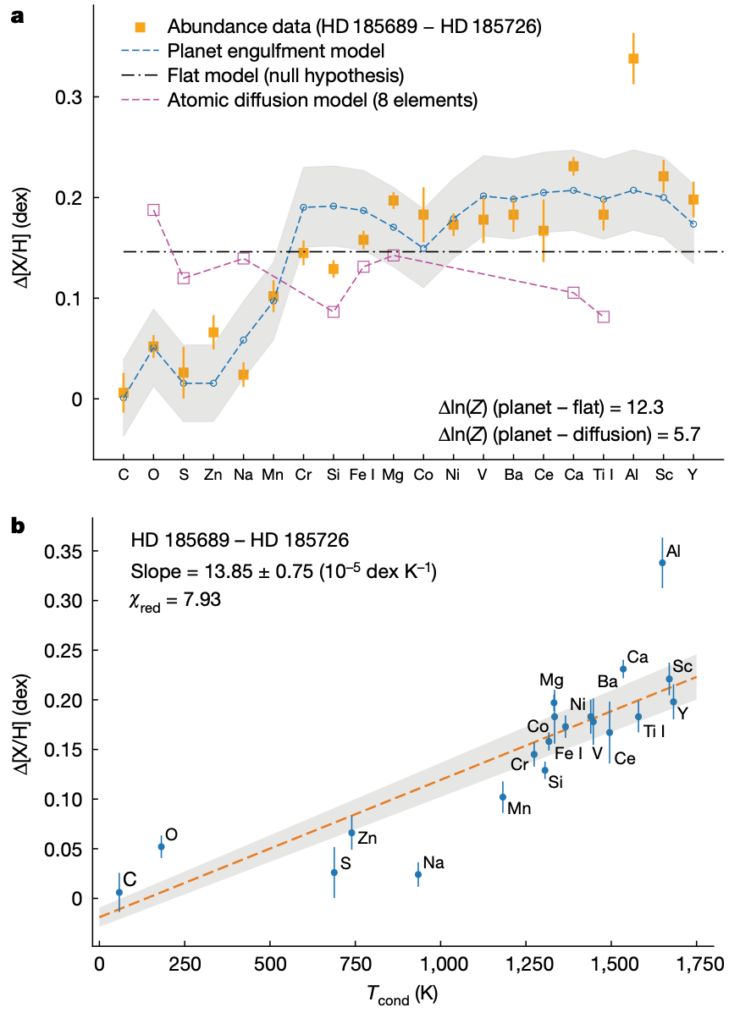
Figure 1: Chemical fingerprint of planetary ingestion in the stellar pair HD 185726/HD 185689. The top panel shows the difference in abundances between them (the y-axis) for different elements, listed from smallest to largest condensation temperature along the x-axis. The orange points are abundances calculated from observations. The blue line is the best-fit planetary ingestion model, and the magenta line shows predictions from atomic diffusion (which clearly doesn’t fit). The bottom panel shows the same data with a linear fit which reveals a positive trend, the hallmark of rocky planet consumption.
What’s Eating These Planets?
If a twin’s blood test reveals a strange diet history, the next questions are when, and why. The timing of these ingestion events is intriguing. N-body simulations (computer models that track the gravitational dance of many bodies under their mutual pull) suggest most planetary collisions and ejections happen within the first 100 million years of a system’s life. But signatures from such early events might fade over billions of years due to mixing processes in stellar interiors. The authors suggest we may be witnessing late-stage planetary system instabilities, perhaps triggered by outer giant planets gravitationally bullying their inner siblings, or by stellar flybys (close passes by another star) destabilizing otherwise stable systems. Given that only some Sun-like stars host super-Earths to begin with, the ingestion rate implies that a meaningful fraction of super-Earth systems eventually go through catastrophic instabilities that end with a planet being eaten.
The Bigger Picture
This study doubles the number of known planetary ingestion events and provides observational constraints for planet formation and evolution models. It also raises an unsettling thought: planetary systems that look stable today might not stay that way forever. Perhaps most remarkably, this work demonstrates that stars carry chemical memories of their planetary histories, memories we can now read. Those stellar twins, identical at birth, end up telling very different life stories once we look closely enough. The cosmos, it seems, keeps receipts.
Astrobites edited by Nicki Bond
Featured image credit: Nature

Interesting topic! Loved the beginning!
You err in stating :
” it becomes enriched in these elements relative to volatile elements like carbon and oxygen, which condense at lower temperatures”
Carbon condenses at a higher temperature than any of the elements you mention, in a list that omits calcium, which forms the abundant early refractory condensate mineral hibonite.
this is sooooo cool