
Title: Hunting Dark Matter with the Einstein Telescope
Authors: A.J. Iovino, M. Maggiore, N. Muttoni, A. Riotto
First Author’s Institution: New York University, Abu Dhabi, UAE
Status: Prepared for submission to JCAP
We know dark matter exists. It holds galaxies together and shapes the large-scale structure of the universe, but we have no idea what it actually is. One proposal that does not involve particles beyond the Standard Model is that dark matter is made of Primordial Black Holes (PBHs). These are black holes that formed in the very early universe, not from collapsing stars, but from dense patches of matter that collapsed under their own gravity shortly after the Big Bang. No new exotic particles required, just gravity doing what gravity does.
But there’s a problem. For PBHs to make up all of dark matter, they need to have just the right mass! This happens to be roughly in the range of asteroid-sized objects (between 10⁻¹⁶ and 10⁻¹¹ times the mass of the Sun). Go lighter than that, and the black holes evaporate.
Black Holes Can Evaporate?
Yes! Stephen Hawking showed that black holes are not truly black – they slowly radiate energy away through a quantum mechanical process now called the Hawking radiation. Think of it like a very slow leak: the lighter the black hole, the faster it loses energy and eventually disappears entirely. Very light PBHs would have evaporated in the early universe, releasing a flood of high-energy particles that would have left a measurable imprint on the Cosmic Microwave Background (CMB) – the faint glow of light left over from the Big Bang. We don’t see that imprint, which tells us that too many of these light PBHs can’t have existed. So we can rule them out, close the book, and move on. Or can we?
Enter the Einstein Telescope (ET), a next-generation gravitational wave detector currently being planned in Europe. When PBHs form, they shake spacetime itself, sending out ripples called gravitational waves. Lighter PBHs produce higher-frequency ripples, and ET is built to catch waves at precisely the frequencies that these ruled-out, ultra-light PBHs would have produced. A detector perfectly tuned to black holes we already know can’t be dark matter. How could that possibly help us?
What if the Black Holes Weren’t Isolated?
The key idea is deceptively simple: what if these ultra-light PBHs, that by themselves couldn’t be dark matter, were born in PBH clusters?
When PBHs form, they don’t necessarily appear randomly spread through space. If the density fluctuations in the early universe were not evenly distributed, then PBHs could have formed in tight groups, huddled much closer together than you would expect by chance.
In a dense enough cluster, something remarkable can happen: the black holes’ combined gravity can overwhelm the outward pressure of the surrounding radiation, and the entire cluster can collapse into a single, much heavier black hole. This process is called clusterogenesis, and the resulting black hole can be heavy enough to sit comfortably in the dark matter mass window – even though the individual PBHs that formed it were far too light to survive on their own.
Does the Math Work Out?
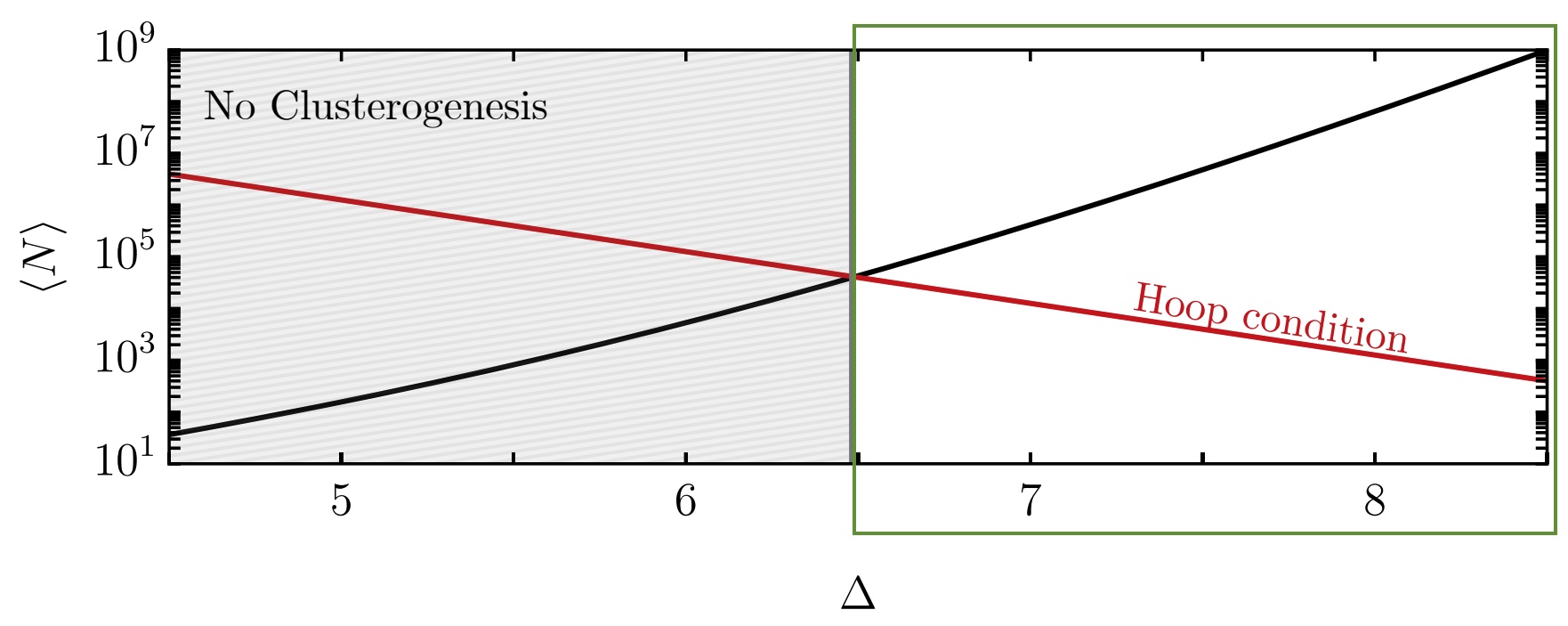
The authors carefully work out when this collapse actually happens. The cluster needs to be compact enough that it fits within the size of the black hole it would become. This condition, proposed by Prof. Kip Thorne in 1972, is called the Hoop conjecture. We see this clearly in Figure 1. We only expect to see clusterogenesis when the average number of PBHs in the cluster (black line) is above what the Hoop condition needs (red line), as highlighted by the green box. The message is simple: the more varied the fluctuations (higher Δ), the more crowded the cluster, and the more likely it is to collapse into a single heavy black hole.
There is also a race against time: the cluster must collapse before the individual light PBHs evaporate away. The authors check that this does not happen, and find that the collapse happens comfortably before evaporation becomes an issue.
So What Does ET Actually See?
Here is the beautiful part. Even though the light PBHs ultimately vanish into a heavier remnant, their formation still produces gravitational waves. This specific type of gravitational waves are called scalar-induced gravitational waves. These gravitational waves are not produced by merging black holes or neutron stars like the ones LIGO has already detected, but instead arise from the same density fluctuations that created the PBHs in the first place. Although these are an indirect effect, they carry a direct imprint of the conditions under which these PBHs were formed, making them a powerful forensic tool to understand the early Universe, and consequently of the dark matter candidates that clusterogenesis of these PBHs creates.
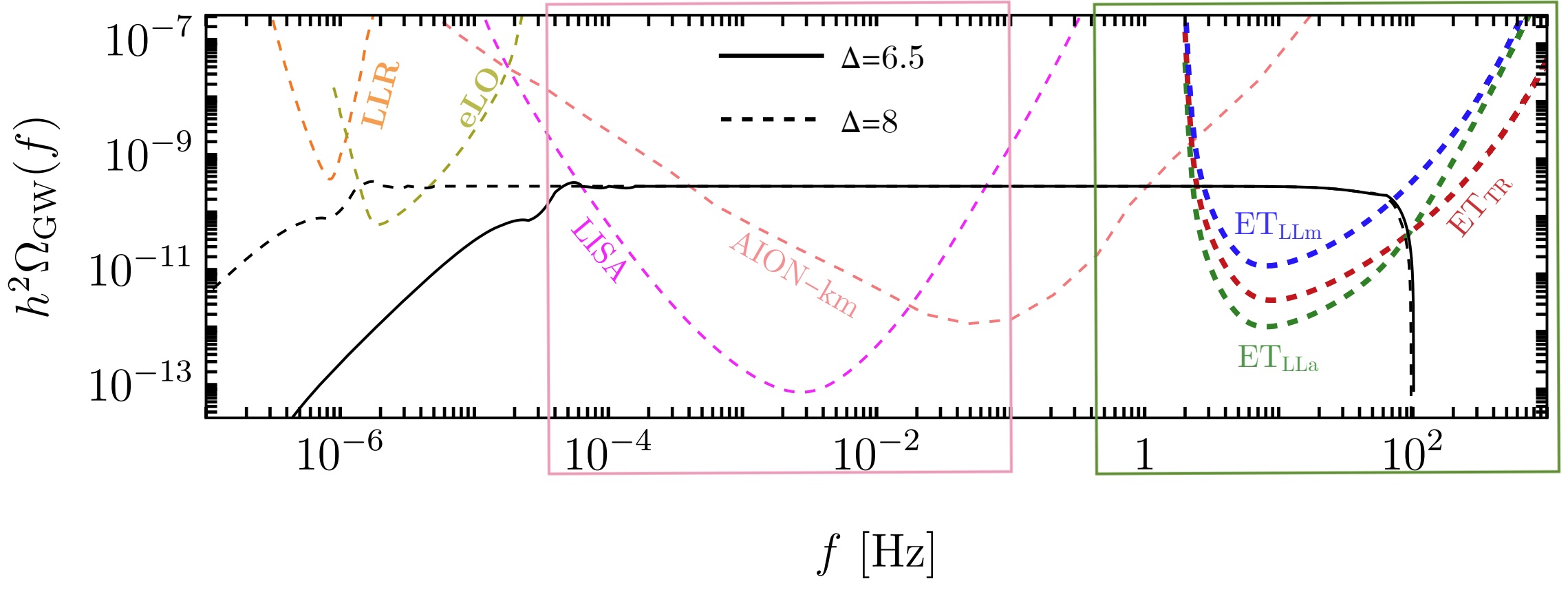
In Figure 2, we see that the signal is flat and broad, a constant hum across a wide range of frequencies, and it sits well within ET’s reach (see green box in Figure 2). In other words: ET won’t see the dark matter directly, but it could detect the gravitational wave echo left behind when that dark matter was born. The authors also find that the same signal would be visible to LISA (see pink box in Figure 2), a space-based gravitational wave detector in a completely different frequency band. For readers’ reference, LIGO would have overlap with ET’s frequency range, but LIGO is not sensitive enough for this detection.
The Big Picture
Science can be surprising. A detector built to study black hole and neutron star mergers might also give us some evidence for the nature of dark matter. Ultra-light PBHs are born, cluster together, collapse into heavier dark matter candidates, and leave a detectable gravitational wave signal in the process. If this picture is correct, dark matter wouldn’t announce itself with a bang. It would leave a quiet, steady hum in the fabric of spacetime, and the Einstein Telescope might be exactly the instrument we need to hear it.
Astrobite edited by Veronika Dornan
Featured image credit: Akshita Mittal (using Canva with elements from here and here)
