
Authors: Yuhan Yao, Ryan Chornock, Charlotte Ward, Erica Hammerstein, Itai Sfaradi, Raffaella Margutti, Luke Zoltan Kelley, Wenbin Lu, Chang Liu, Jacob Wise, Jesper Sollerman, Kate D. Alexander, Eric C. Bellm, Andrew J. Drake, Christoffer Fremling, Marat Gilfanov, Matthew J. Graham, Steven L. Groom, K. R. Hinds, S. R. Kulkarni, Adam A. Miller, James C. A. Miller-Jones, Matt Nicholl, Daniel A. Perley, Josiah Purdum, Vikram Ravi, R. Michael Rich, Nabeel Rehemtulla, Reed Riddle, Roger Smith, Robert Stein, Rashid Sunyaev, Sjoert van Velzen, and Avery Wold
First Author’s Institution: Miller Institute for Basic Research in Science, 468 Donner Lab, Berkeley, CA 94720, USA
Status: Published in The Astrophysical Journal Letters [open access]

This guest post was written by Mary Ogborn. Ogborn is a PhD candidate in Astronomy and Astrophysics at Penn State. She studies active galactic nuclei and the broad line region of theseobjects through theory and modeling, with additional interests in science policy and communication. Outside of research, she enjoys reading, knitting, and embroidery.
An Off-Center Explosion!
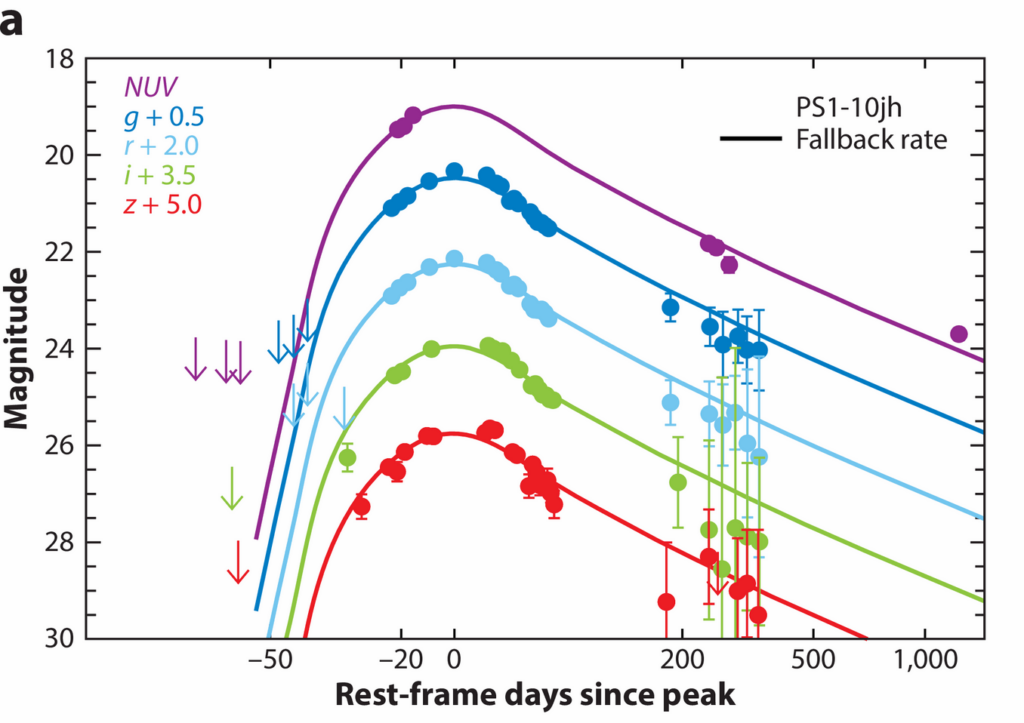
A Tidal Disruption Event (TDE) occurs when a star gets too close to a supermassive black hole (SMBH) and the tidal forces of the black hole’s gravity tear the star apart. This event is rather explosive and produces a well-known pattern in brightness over time (called a light curve) that allows us to identify when these events occur (see Figure 1 for an example light curve). We expect TDEs to occur in the nuclear – or central – region of a galaxy, where the SMBH resides. However, some TDEs have been found to be offset from this central region, which begs the question: has the SMBH moved away from its central position? In the case of today’s paper on TDE AT2024tvd, the answer is yes! The authors have found a strong candidate for a massive black hole no longer in the central region by using the signatures of a TDE, using optical wavelength surveys for the first time.
How was this TDE found?
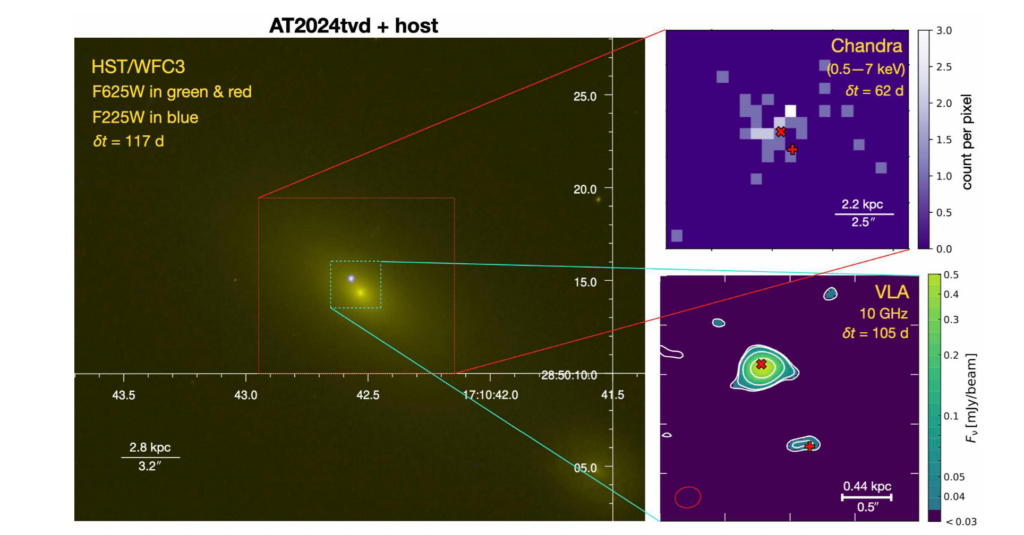
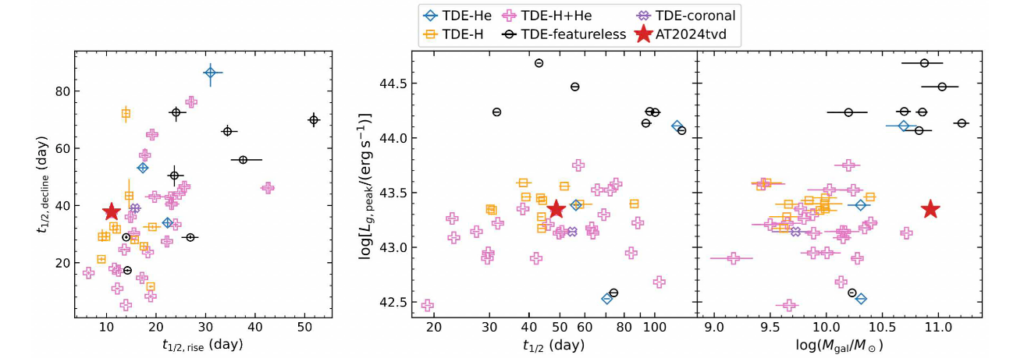
This TDE was initially identified in the Zwicky Transient Facility (ZTF) Bright Transient Survey on August 25, 2024 – the light it produced passed a certain threshold to be classified as a ‘bright’ event, and spectroscopic follow-up on this event by S. Faris et al (2024) classified it as a TDE based on the hydrogen and helium lines present. However, the authors noticed this object did not successfully pass through a pipeline that identifies events in the central region of the galaxy, which is the expected location of TDEs. The authors repeated observations of the event using ZTF and found a slight indication that the TDE was offset from the nuclear region, which led to new observations done in January of 2025 to obtain imaging and spectra of the host galaxy and this TDE using the Hubble Space Telescope (HST) (see Figure 2). Following up from the initial event, the host galaxy was also observed in the X-ray, optical, and radio regimes to get better localization of the event. The follow-up data further confirms that AT2024tvd is a TDE-this object remains hot in its UV and optical emission, and its spectrum resembles the spectra of other TDEs that have been confirmed. Additionally, the properties of its light curve compared to the host galaxy also put it within classification as a TDE (see Figure 3). This follow-up data also rules out the possibility of a supernova (SN), as this particular light curve did not cool as quickly as expected for a SN. These observations also independently prove that this TDE is indeed offset from the nuclear region of the host galaxy, and is projected to be about 0.8 kpc from the galactic nucleus, which is often defined as the central kpc of the galaxy.
How did it get there?
The authors list three potential scenarios for how this SMBH was formed and how it got to its offset location:
- In a post-minor galaxy merger, a SMBH from one of the galaxies experienced a TDE as both SMBH gradually spiral closer together to form a binary system
- An ejected SMBH from a triple system of SMBHs in the nuclear region
- A recoiling SMBH as a result of gravitational wave emission following a binary SMBH merger
The authors do not consider scenario 3 as viable, as the measured mass of the SMBH from the TDE was found to be ~107 solar masses, which is not large enough to be a result from a merged system (compared to 108-1010 solar masses), and there remains radio emission from a potential SMBH in the nucleus. Scenarios 1 and 2 are more viable – in scenario 1, the authors speculate that the SMBH came from the center of a galaxy that has been destroyed in the process of merging with the host galaxy. There are no residual traces of this merged galaxy found in the archival images, so this scenario cannot currently be confirmed. Scenario 2 also remains viable – it is possible that as the SMBH gets ejected, it carries with it a star cluster that can feed the SMBH and produce these TDEs. The current calculated rate of TDEs in this scenario is 1% the nuclear TDE rate of a typical galaxy (3×10⁻⁵ per galaxy per year), so the timescale to test this scenario will not be feasible in a human lifetime.
Though this is not the first offset TDE found, it is the only one to remain in the galactic bulge of the host galaxy, and due to its unique location and formation scenarios, can be an interesting probe of galaxies that are close to merging or may be recently post-merger. Furthermore, the signatures in its light curve and spectrum can provide markers to identify other off-set TDEs that will similarly be lost in standard pipelines that expect TDEs to be present in the nucleus of a galaxy. This will allow studies of offset SMBH, particularly SMBH that are otherwise quiescent within the galaxy.
Astrobite edited by Samantha Wong
Featured image credit: NASA
