
Title: Do little red dots really form a distinct class of astronomical objects?
Authors: Jean-Baptiste Billand, David Elbaz, Maximilien Franco, Fabrizio Gentile, Emanuele Daddi, Mauro Giavalisco, Dale D. Kocevski, Joseph S. W. Lewis, Benjamin Magnelli, Valentina Sangalli, and Maxime Tarrasse
First Author’s Institution: Université Paris-Saclay, Université Paris Cité
Status: Submitted to Astronomy and Astrophysics [open access]
Shaquille O’Neal wears a size 22 (EU size 57) shoe. An average person wears a size 10.5 (EU size 44) shoe. No podiatrist, when examining his foot, declared they had discovered a new appendage. It’s still a foot…just a really large one. A far outlier in the distribution of foot sizes. And similarly, a new paper argues that Little Red Dots—the enigmatic sources discovered by the James Webb Space Telescope (JWST)—may just be a bunch of outliers, like a bunch of Shaqs.
When JWST opened its eyes on the early Universe back in 2022, it didn’t take very long for something strange to turn up. In deep-field images, hundreds of bright, red, and extremely compact sources appeared that nobody had predicted, now referred to as Little Red Dots (LRDs). LRDs have some properties similar to a galaxy and an active galactic nucleus (AGN), a supermassive black hole actively feeding at a galaxy’s core.
LRD spectra exhibit a distinctive “V-shape” with one side containing blue UV light and the other side containing red optical light. The red optical light suggests dust reddening or a hot, dense environment, consistent with AGN. They also show broad hydrogen (specifically Hα) emission lines, usually associated with gas moving near a supermassive black hole, again pointing to AGN. On the surface, LRDs look like AGN…but the details don’t quite fit. Their broad lines imply black holes that are surprisingly massive for such an early cosmic epoch, and they lack the X-ray emission that AGN usually exhibit. Naturally, astronomers got excited: had JWST detected an entirely new class of astronomical object lurking in the early universe?
Theories multiplied fast, filling up the arXiv. Some argued LRDs were a distinct class of dusty AGN. Others proposed more exotic theories, such as Black Hole Stars (BH*), in which a black hole embedded in dense gas mimics a stellar atmosphere. Despite all the disagreement about what LRDs are, the general consensus places them in a distinct class of their own, deserving a brand-new explanation. The authors of today’s paper step back and ask: what if LRDs aren’t a new category at all?
A Spectrum of Weirdness
Most studies of LRDs make hard binary cuts: a galaxy either is or isn’t an LRD depending on whether it crosses some threshold in color, compactness, or line width. But these thresholds can be arbitrary, and objects near the boundaries may change between classifications depending on which criteria you use. To address this issue, Billand et al. introduce two continuous parameters to quantify the “LRD-ness” of galaxies and apply them to a sample of JWST galaxies. The sample includes 48,000 galaxies drawn from four of the widest JWST fields to obtain an unbiased census of the early universe galaxy population.
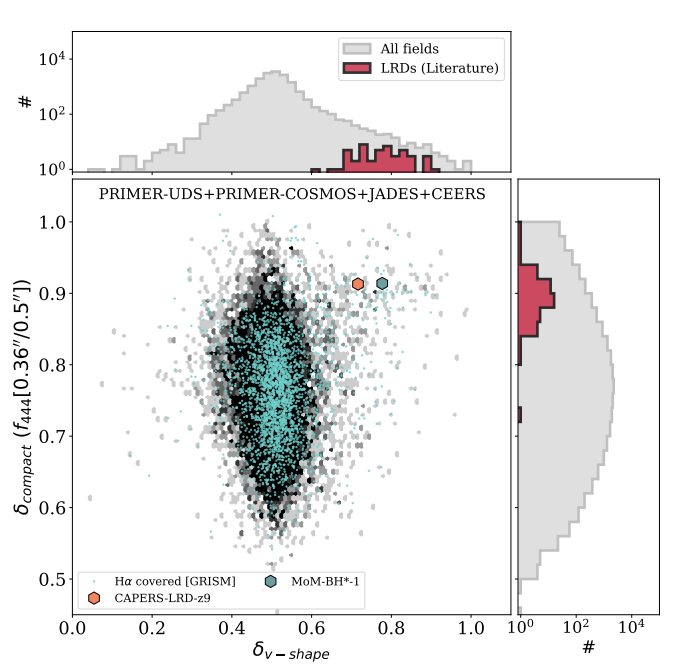
The first parameter is δV-shape, which measures how pronounced the V-shape in a galaxy’s spectrum is, with 0 indicating an ordinary spectrum and 1 indicating an extremely V-shaped spectrum. The second parameter is δcompact, which measures how concentrated a galaxy’s light is. Together, these parameters place every galaxy on a smooth landscape rather than sorted into bins: a shoe size chart, not a yes-or-no classification.
Figure 1 shows the full galaxy population spread across the space of δV-shape and δcompact, with LRDs shown as overlaid red histograms. Across the full landscape, LRDs live in the top right corner with high δV-shape and high δcompact. Importantly, there is no clear gap between the LRD population and the rest of the galaxies. The red histograms don’t sit on an island of their own; they sit at the tail of a continuous distribution that stretches all the way back to ordinary galaxies. LRDs aren’t in a different shoe shop; they’re just at the far end of the rack.
The authors also find that as δV-shape increases, the fraction of compact galaxies rises smoothly and the strength of the Hα broad line increases gradually. Neither property shows a sudden jump at the point where normal galaxies become LRDs. Even the deficit of nitrogen emission [N II], long considered a quirky LRD trademark, turns out to be a general property of compact, metal-poor galaxies everywhere in the sample. In other words, every property that seemed to set LRDs apart can be found, in less extreme form, in ordinary galaxies…a huge foot is still just a foot.
97% Feet, 3% Unknown
These trends point towards the simple physical explanation that LRDs are mostly ordinary AGN reddened by dust. However, ALMA, the go-to telescope for detecting dust in distant galaxies, has repeatedly failed to find any dust in LRDs, which seemed to rule out this idea—until today’s paper. Billand et al. show that the required dust mass for these LRDs to be reddened is so small that current ALMA observations simply are not sensitive enough to detect it, reconciling this issue.
A small number of sources, like MoM-BH*-1 and CAPERS-LRD-z9 (the hexagons in Figure 1), still genuinely stand out. These sources exhibit unusually strong Balmer breaks (another spectral feature). These sources might be something exotic and new, but they only comprise about 3% of LRDs. The vast majority of LRDs show ordinary Balmer break strengths, and the dusty AGN model holds.
Perhaps LRDs are not a new class of objects. Maybe they are galaxies at the end of continuous distributions in compactness, spectral shape, and line width: simply outliers of an established group. The Shaqs of the galaxy population, if you will.
Astrobite edited by Isha Loudon
Featured image credit: Matthee et al.
