
Paper title: GRMHD simulations of black hole accretion variabilities: implications to hard state X-ray binary transients
Authors: Rohan Raha, Banibrata Mukhopadhyay, and Koushik Chatterjee
First author institution: Indian Institute of Science
Status: Published in MNRAS (open access)
Trying to figure out the right initial conditions to reproduce the observational characteristics in your favorite X-ray binary (XRB which differs from your run-of-the mill binary star system in that one of the stars is a black hole instead, which is responsible for the eponymous X-rays) is a lot like trying to figure out the right car to buy in 2026. You actually enjoy the driving aspect of driving a car, so you need it to have a manual transmission; but you live in a snowy climate, so you really shouldn’t elect for a rear wheel drivetrain; you also need the whip to look cool (duh), so obviously it cannot be an SUV; and ideally, the price tag won’t exceed the cost of your entire undergraduate education. Unfortunately, it seems there is no way to meet all your non-negotiables.
Theorists face a similarly complex puzzle in trying to explain how material accretes (or falls) onto the black hole in XRBs, especially since these systems show such diverse observational properties. Some emit hard X-rays (the extra-energetic kind), some soft, some clearly thermal, and some clearly non-thermal. Some host persistent radio jets, and some have luminosities so high they approach the Eddington limit (or the brightest the system can possibly be and remain in hydrostatic equilibrium, which is an absolute must if you want your system to continue to exist!). Some have a constant brightness, while others still vary both over time and across observing frequencies, and on a multitude of different time and amplitude scales. One particularly extreme source, GRS 1915+105, has 12 different variability patterns! Of course, these properties are not fixed for any individual XRB either; they are observed to change on all sorts of time frames. So how can we possibly find a model to explain all of these features? Well, today’s authors have tried and found some success!
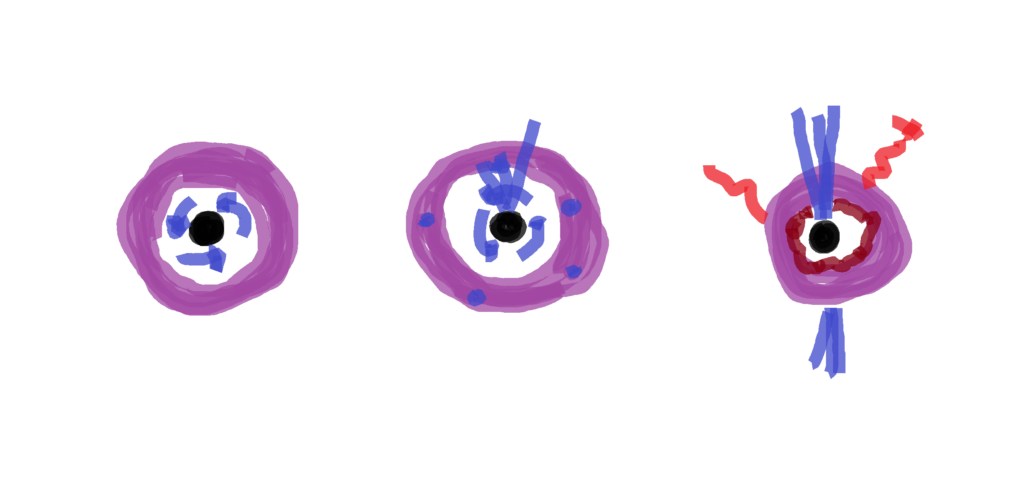
Accretion disks in an XRB
In an XRB, our black hole is generally encircled by an accretion disk full of gas, dust, and other favorite black hole snacks which are rotating far too quickly to fall into the black hole. Eventually, the debris in the disk will spiral onto the black hole, but first it has to slow down and move inward. But how?? The original idea was that turbulence (or unpredictable behavior) in the fluid motion of the disk accomplishes this, but it turns out this is not nearly enough. In the early 1990s, we realized the real star of the show is magnetorotational instability (MRI). Let’s say you find yourself in an ambient magnetic field (even a weak one) while orbiting a black hole in an accretion disk, and the closer you are to the center, the faster you move. Now let’s say you want to stir the pot, so you bump radially inward a bit. The magnetic field does not want you to do that, so it tries to bring you back by slowing you down, a little like those pesky driver assist features in new cars that shimmy you back if you try and change lanes without using your turn signal first. However, the attempt to restore order by the magnetic field has the opposite effect, causing you to fall even further inward and start the whole process over again (luckily, this is not what happens in response to the car shimmying – the ensuing scandal would turn the infamous Ford Pinto affair into a backpage news story).
Adding electromagnetism and general relativity to the situation
More recently, General Relativistic Magnetohydrodynamical (or GRMHD) simulations, which incorporate the effects of magnetic and gravitational fields on fluid motion, have further revealed that MRI is only part of the story. There seems to exist a binary of accretion disk states: one with weak magnetic fields, strong winds in the disk, and steady accretion powered by MRI, known as the Standard and Normal Evolution (SANE) accretion state; and one with strong magnetic fields, which vary in accretion rate (and consequently, brightness), launch radio jets, and occasionally spew out magnetic flux eruptions, or the Magnetically Arrested Disk (MAD) state . However, today’s authors argue accretion disk states (illustrated in Figure 1) do not fall cleanly into either category, and propose an intermediate class (INT) which has elements of both and is responsible for the more complex observational properties of XRBs.
GRMHD results reveal!
Here, our authors simulate the behavior of XRBs in each state (MAD (Figure 2), INT (Figure 3), and SANE (Figure 4)) under various initial magnetic field configurations and strengths, with the goal of reproducing the diverse observational characteristics. First, they find very different infall speeds (or how quickly the material in the disk spirals towards the black hole) for each class and, consequently, different (mass) density distributions. In the SANE disk, in which MRI is responsible for the infall, the material moves slowly, and the centrifugal (outward) force generated by the rotation of the disk is sufficient to balance out the gravitational (inward) force from the black hole (a cosmic Silly Silo). As a result, the disk is more uniform in density, and only very close to the event horizon of the black hole do we really get up to (infall) speed (and a measly 3% of the speed of light, at that). Conversely, in the MAD state, the strong magnetic field disrupts the centrifugal support system, so material falls much faster (reaching up to 10% of the speed of light) until, at the last minute1, the field provides enough magnetic force near the event horizon to prevent stuff from zooming straight into the black hole (a cosmic drop tower). We get a pile up of matter at the center of the disk, with the density dropping off steeply further out. In the INT state, we see an in-between scenario, and the responsibility of supporting the disk is shared by the centrifugal and magnetic forces.
The simulated black holes ATE (and it was really interesting to see how!)
Next, our authors compare the accretion rate among the different states. In all three, the net accretion rate is constant, and we have a stable, well-fed black hole. However, this is the least interesting part of the story; the track from the edge of the accretion disk to the center is not a one-way street, and material tends to flow both toward and away from the black hole. The MAD disk is quite efficient at shuffling mass inward, but it hinders itself by re-ejecting much of it in its jet. In the SANE disk, the MRI-driven path inward is much more meandering, but in the absence of a jet, the inflowing material tends to keep inflowing. Only very close to the center do we see notable outflow in the SANE state, caused by strong winds (the Chicago of the accretion disk, if you will). In the INT disk, jets and winds coexist, both contributing to the outflow of material.
Clear conclusion: accretion states must be a spectrum!
Our authors conclude the three-accretion state classification explains much of the diversity observed in XRBs. The MAD disk is influenced primarily by magnetic processes, which cause a non-uniform distribution of matter (and, as a result, a non-uniform accretion rate which then manifests as non-uniform brightness), well-ordered magnetic fields (ideal for keeping a radio jet alive), and hard X-ray emission. On the other hand, the SANE disk is dominated by centrifugal and gravitational forces, not magnetic, depriving it of exciting jets and variability. In the INT state, both the conventional dynamic forces and magnetic forces shape the accretion disk, creating an unstable equilibrium between SANE and MAD.
While this news is exciting, there is more to be done! These simulations do not account for the cooling of the disks as light radiates away, or the effect of radiation pressure (if enough photons bounce off you, it turns out you will notice), which are important for XRBs emitting soft X-rays. Moreover, our authors assume the accretion state is fixed forever, but it is decidedly not! We observe XRBs transitioning states often, and on all kinds of timescales, so the next challenge is to figure out why. Maybe our authors will take on this challenge; not me though – my next investigation is to figure out how, if I’m forced to accept that my new car will come with an Operating System, I can at least make sure it is Linux.
Astrobite edited by Akshita Mittal
Featured image drawn specifically for this bite!
- Well, quantifying time this close to a black hole is a treacherous affair, so let’s say, figuratively at the last minute. ↩︎
