
Title: GW231123: A Possible Primordial Black Hole Origin
Authors: Valerio De Luca, Gabriele Franciolini, and Antonio Riotto
First Author’s Institution: Center for Particle Cosmology, Department of Physics and Astronomy, University of Pennsylvania, 209 South 33rd Street, Philadelphia, Pennsylvania 19104, USA
Status: Accepted to Physical Review Letters [closed access]
Gravitational wave astronomy is revolutionising how we understand some of the biggest and densest objects in the universe. What’s cooler than looking at the biggest things you could possibly look at? Well, watching them smash together of course.
When two black holes spiral toward each other and finally collide, they release more energy in a fraction of a second than our Sun will radiate in its entire lifetime and that energy does not come out as light. It ripples outward through the fabric of spacetime itself, stretching and squeezing the universe at a frequency we can actually detect. These are gravitational waves, first predicted by Einstein in 1916 and finally caught in the act by LIGO in 2015 – using lasers so extraordinarily precise they can measure a distance one ten-thousandth the width of a proton. Since that first historic “chirp” over a decade ago, the LIGO-Virgo-KAGRA (LVK) collaboration has catalogued hundreds of these cosmic collisions and one of the most spectacularly puzzling events in that catalogue is GW231123.
So what makes GW231123 so special and so deeply unsettling for physicists? For starters, it’s the heaviest pair of black holes we have ever detected merging into one another. Ever. The primary (larger) black hole weighed in at a staggering 137 solar masses, with its companion coming in at 103 solar masses. Already remarkable. But here’s where it stops being a celebration and starts being a headache: according to our best theories of stellar physics, these black holes simply should not exist. Here’s the key problem: both black holes fall within what’s known as the “pair-instability mass gap“. This is a range between roughly 60 and 130 solar masses where black holes are theoretically forbidden from forming via stellar collapse. Stars in this mass range are expected to go out not with a quiet gravitational crunch, but with a catastrophic explosion called a pair-instability supernova, leaving no black hole behind at all. So where did these two come from? We actually covered the chaos this caused earlier this year so check out Kelsie’s bite on all the broken models here.
And if the masses weren’t puzzling enough, their spins certainly are. Physicists measure this with a dimensionless spin parameter that runs from 0 (perfectly still) to 1 (the theoretical maximum, spinning as fast as physics allows). GW231123’s primary black hole clocked in at 0.9 with the secondary close behind at 0.8. This is the highest spin ever confidently measured from a gravitational wave event!
So what is the new news? Well, today’s authors have flipped the problem on its head entirely. What if GW231123’s black holes aren’t too big — but are instead the descendants of a much more mysterious process that happened long before the first star ever switched on?
Enter primordial black holes.
Rather than forming from a collapsing star, primordial black holes (PBHs) are thought to have formed in the very early universe where regions of the infant cosmos were so dense that they collapsed directly into black holes under their own gravity. No star required. It’s one of the most exotic ideas in modern cosmology, and it comes with a big question mark: if PBHs are born tiny and slow-spinning, how do you get two of them showing up billions of years later with masses over 100 solar masses and black holes that are spinning almost as fast as possible?
The answer, the authors argue, is cosmic patience – and a lot of eating.
Over billions of years, a pair of PBHs locked in a gravitational dance would have been steadily gobbling up the surrounding gas in a process called accretion. As hydrogen and other baryonic matter spirals inward and forms a disk around each black hole, two things happen: the black holes get heavier, and they spin up. Think of it like a figure skater pulling in their arms; the infalling matter carries angular momentum that gets transferred to the black hole, winding it up over cosmic time. The authors find that you don’t even need to accrete that much to take a near-stationary black hole all the way to a spin of 0.9. There’s also a helpful boost from dark matter: halos of dark matter surrounding the PBHs act as a gravitational catalyst, enhancing the accretion rate beyond what gas alone would provide.
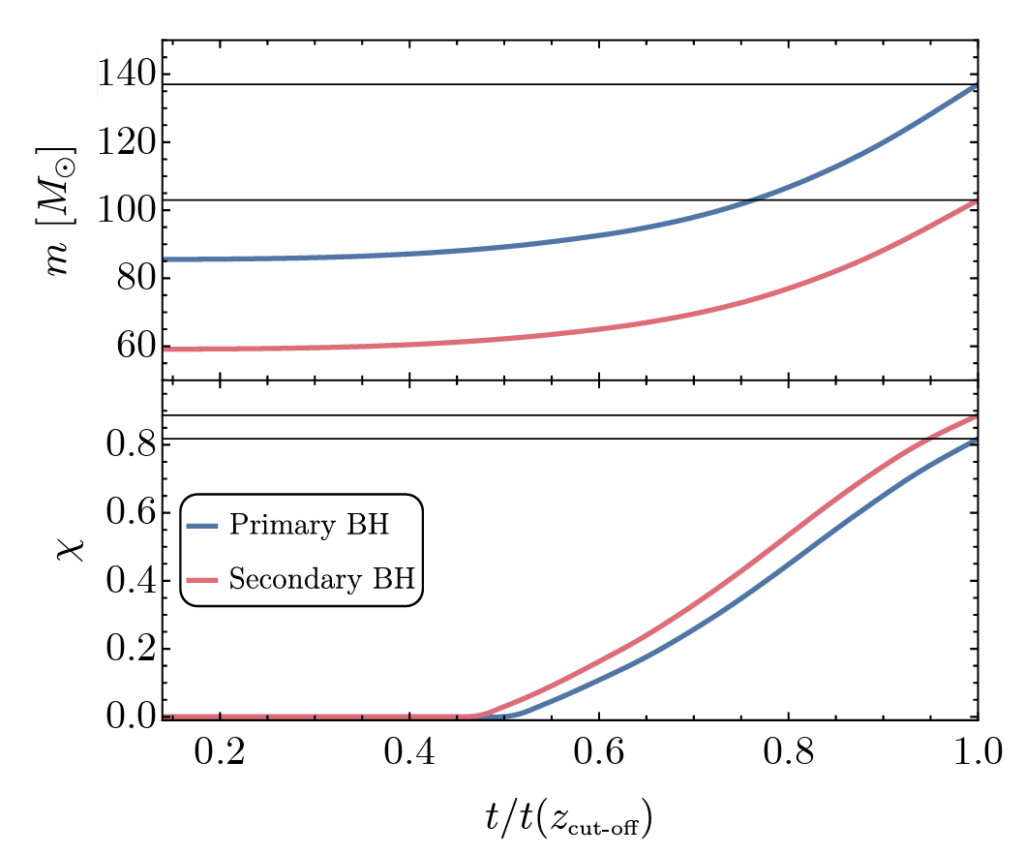
Running the full cosmological evolution through their model, the authors work backwards from the observed masses and spins to figure out what these black holes would have looked like at birth. Their answer? The two black holes started out at around 85 and 59 solar masses respectively and spent the next several billion years quietly feeding until they reached the monsters we detected in 2023. You can see how these parameters are thought to have changed over time in Figure 1.
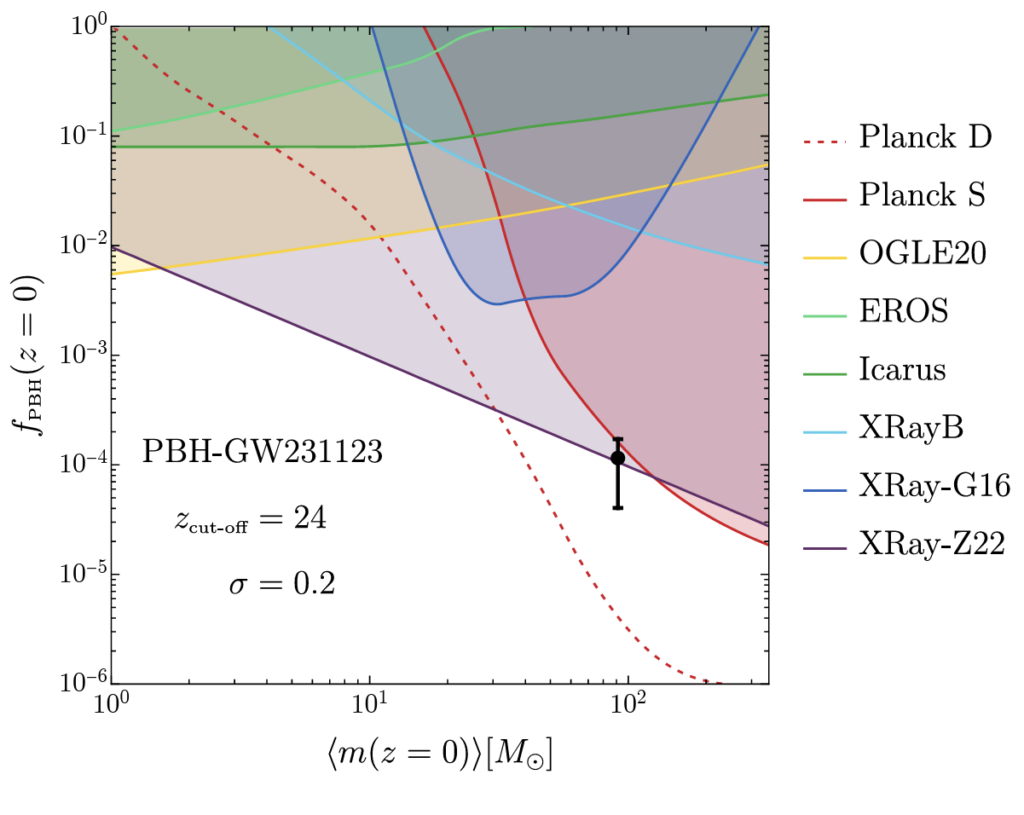
Now here’s where it gets really spicy. The model works… but only just. The parameter space needed to make this all add up, shown in Figure 2, sits right at the edge of what’s already been ruled out by X-ray and cosmic microwave background (CMB) observations. Accreting black holes in the early universe would have injected energy into the CMB, leaving subtle imprints we can look for – and the PBH interpretation of GW231123 is teetering right on that exclusion boundary. It hasn’t been ruled out, but it’s one good dataset away from potentially being killed off entirely. That’s either thrilling or terrifying depending on your relationship with being wrong.
So what happens next?
The beauty of this paper is that it doesn’t just propose an idea, it makes concrete, testable predictions that upcoming experiments can go after directly.
First up is the LVK O5 observing run, already underway. If the primordial black hole story is correct, the collaboration should detect around 20 more events similar to GW231123, and crucially, their masses and spins should follow a very specific correlation predicted by the accretion model. If future heavyweight mergers don’t line up with that predicted pattern, the hypothesis takes a serious hit.
Second, next-generation detectors like the Einstein Telescope will be able to peer much further back in time as their far greater sensitivity means signals from across the observable universe will finally be detectable, reaching back to epochs long before the first stars formed. If PBHs are real and responsible for events like GW231123, we should see similar mergers happening at very high redshifts, from when the universe was only a few hundred million years old. The authors predict around ten such detectable events above redshift z = 15. Finding merging black holes that far back in cosmic history would be almost impossible to explain with conventional stellar astrophysics.
Third, the same accretion disks responsible for spinning these black holes up should leave an electromagnetic fingerprint. As the two black holes spiral toward each other, their accretion disks would get tidally disrupted, producing bright, short-lived flares potentially visible in X-ray or gamma-ray surveys. Catching one of these flares in coincidence with a gravitational wave signal would be an extraordinary multi-messenger confirmation.
GW231123 arrived as a problem — two black holes that broke the rulebook, spinning faster than they should, heavier than stellar physics allows. De Luca, Franciolini and Riotto’s answer is audacious: don’t look to the stars. Look to the Big Bang. The next few years of gravitational wave astronomy will tell us if they’re right — and either way, the universe has our full attention.
Astrobite edited by Wasi Naqvi
Featured image credit: NASA Animator Dana Berry
