
In this series of posts, we sit down with a few of the keynote speakers of the 248th AAS meeting to learn more about them and their research. You can see a full schedule of their talks here, and read our other interviews here!
Esra Bulbul has built her career studying some of the largest structures in the Universe. A group leader at the Max Planck Institute for Extraterrestrial Physics, she uses X-ray observations of galaxy clusters to probe the nature of dark matter, dark energy, and the growth of cosmic structure. As the lead scientist for cluster science and cosmology within the eROSITA collaboration, Bulbul has helped produce the largest X-ray catalog of galaxy clusters to date. She is being awarded the 2025 AAS High Energy Astrophysics Division Mid-Career Prize.
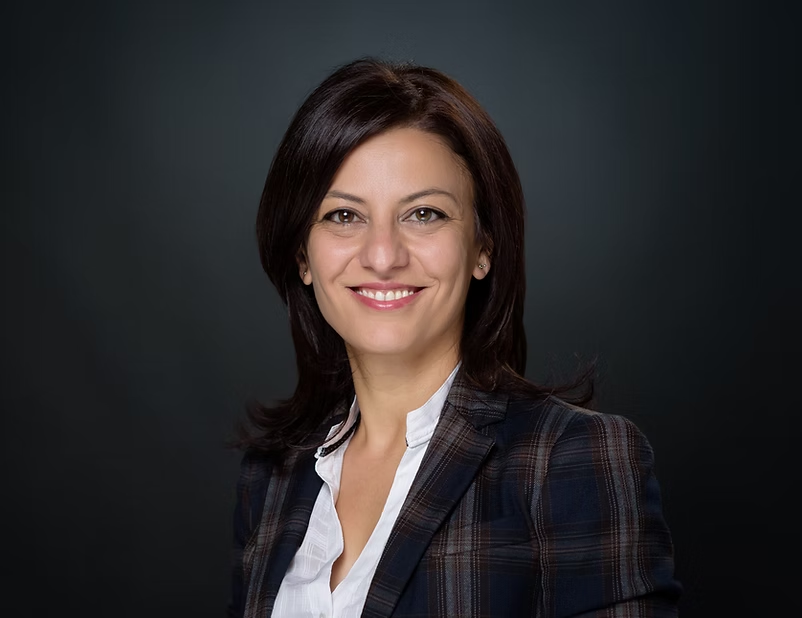
Photo Credit: ERC Dark Quest
Growing up under the Milky Way
Bulbul’s fascination with astronomy began long before she ever looked through a telescope. Growing up in a small town in Turkey, she remembers stepping outside at night and seeing the Milky Way stretch across the sky. Those dark skies inspired questions about the Universe that would stay with her for years.
That curiosity eventually carried her across continents. She completed her PhD at NASA’s Marshall Space Flight Center before holding research positions at NASA’s Goddard Space Flight Center, MIT, and the Harvard-Smithsonian Center for Astrophysics. Today, she leads the Galaxy Clusters and Cosmology Group at the Max Planck Institute for Extraterrestrial Physics in Germany, where she studies galaxy clusters in the Universe that can reveal the nature of dark matter and dark energy.
Learning to navigate a new world
Moving to the United States for graduate school brought challenges beyond the research itself. Bulbul recalled what it meant to be far from home while adapting to a new culture and working in a language that was not her own. At the same time, she faced the pressures of establishing herself in a highly competitive research environment.
Looking back, she credits much of her success to the people around her. Throughout a scientific career, she said, everyone encounters supportive mentors who make all the difference. Her experiences have also shaped the advice she gives to young scientists, especially women. Growing up, she explained, many women are encouraged to stay quiet or avoid drawing attention to themselves. In science, however, speaking up matters. She encourages students to share their ideas, ask questions, and let their enthusiasm show. “Be more proactive,” she advised. “Talk to people.”
Galaxy clusters as laboratories for cosmology
Bulbul’s research focuses on galaxy clusters, the largest gravitationally bound structures in the Universe. These enormous collections of galaxies act as cosmic laboratories, allowing astronomers to test how the Universe has evolved over billions of years. Using X-ray observations from missions such as eROSITA, her team studies the hot gas inside these clusters. By combining those observations with large optical surveys like DESI and future facilities including Rubin Observatory, 4MOST, and the Square Kilometer Array, astronomers can measure how cosmic structure grows over time and place increasingly precise constraints on cosmological models.
One question excites Bulbul more than any other: Is dark energy changing with time? As new surveys continue to improve the precision of cosmological measurements, she believes astronomers are approaching an era where they can begin testing this question with unprecedented precision.
Advice for the next generation
Bulbul encourages undergraduate students to explore broadly. “Take classes outside your immediate interests. Learn statistics.” Become familiar with artificial intelligence and modern computational methods. For cosmologists, she noted, statistics has become just as essential as physics. At the same time, technical skills alone are not enough. Building connections, finding good mentors, and developing confidence are equally important parts of becoming a scientist.
A new era for X-ray cosmology
In her AAS plenary lecture, Bulbul will highlight how the eROSITA mission has transformed X-ray astronomy. Since its launch in 2019, eROSITA has mapped the X-ray sky with unprecedented depth, producing one of the largest catalogs of galaxy clusters ever assembled. Those observations are already delivering increasingly precise measurements of the matter distribution in the Universe, and when combined with the latest multiwavelength surveys, they promise new insights into dark matter, dark energy, and the evolution of cosmic structure.
For Bulbul, this is an especially exciting moment to be a cosmologist. “We’re very close,” she said, to placing some of the strongest constraints yet on the fundamental ingredients of our Universe. She also hinted that the collaboration expects major new cosmological results by the end of this year, bringing astronomers another step closer to understanding the nature of dark energy and the evolution of cosmic structure.
To hear more about the X-Ray Universe and Cosmology, tune in to Esra Bulbul’s Plenary Lecture at 4:40 PM PT on Monday, June 15th, at #AAS248!
Edited by: Niloofar Sharei
Featured Image Credit: AAS
