
In this series of posts, we sit down with a few of the keynote speakers of the 248th AAS meeting to learn more about them and their research. You can see a full schedule of their talks here, and read our other interviews here!
For decades, astronomers have collected stunning top-down portraits of other galaxies, beautiful face-on spirals with arms and bulges and bright nuclei laid out for anyone to see. We have never had one of our own. The Milky Way has only ever been seen from the inside, from observers stuck somewhere in its disk. Dr. Cara Battersby has been working harder than almost anyone to fix that. With her group at the University of Connecticut (UConn), she has just built the first real top-down 3D map of the Central Molecular Zone (CMZ), the dense, turbulent few hundred light-years of gas that wraps around the supermassive black hole at the heart of our Galaxy. “It would be weird,” she tells me, “to know more about another galaxy center than our own.”
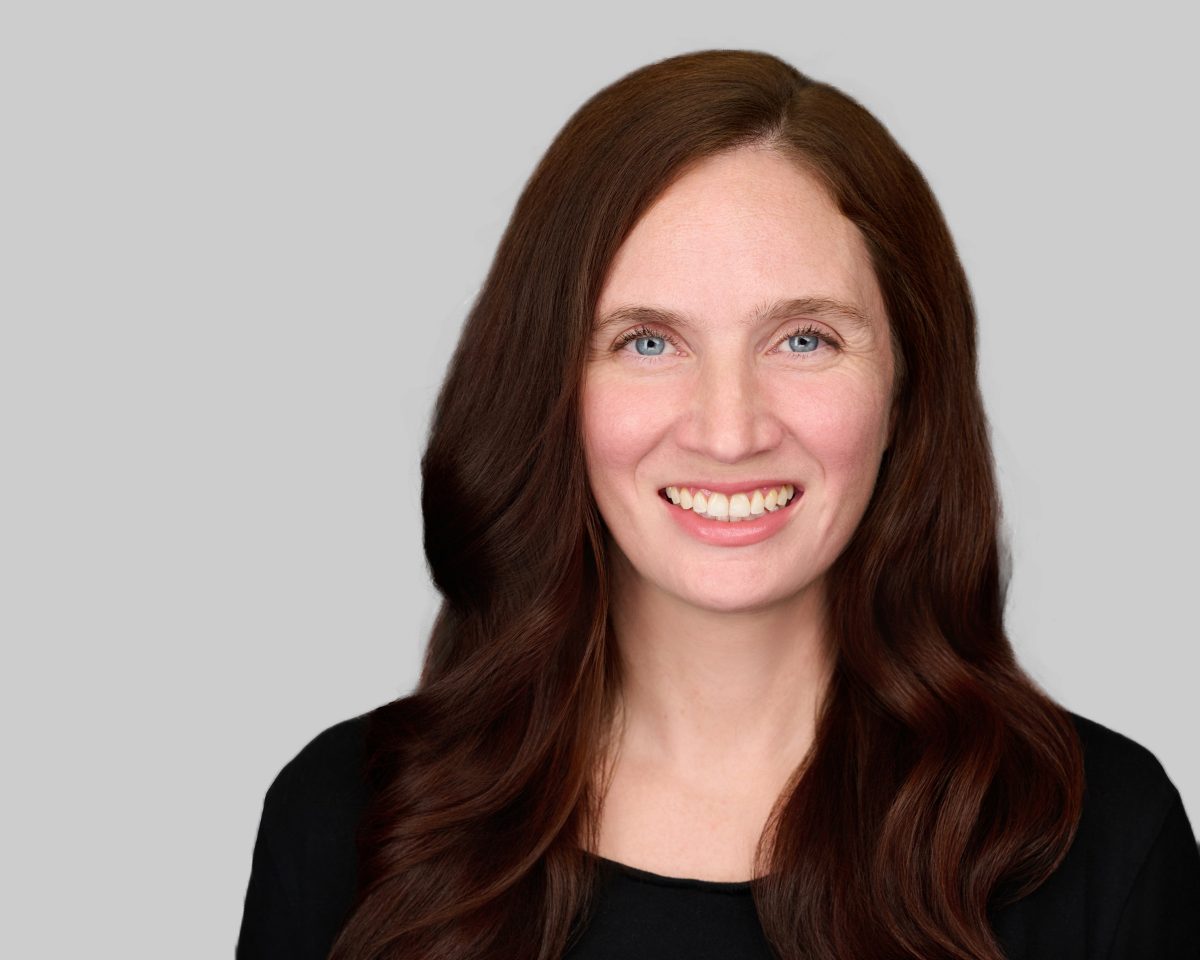
Dr. Battersby is an Associate Professor of Physics at UConn, where she founded and leads the Milky Way Laboratory. This June, she will give a plenary lecture at the 248th meeting of the American Astronomical Society on what that new top-down view of our Galactic Center is revealing. She also plans to spend part of the talk on something the field doesn’t talk about enough: how to actually build a career in this work without giving it your whole life.
The clearest pointer to who Dr. Battersby is, scientifically, may be a drawing her mother saved from early elementary school. The prompt was “What do you want to be when you grow up?” and young Cara had filled the page with three careers: a teacher, an ice skater, and a scientist. The scientist appears to be standing next to an emergency eyewash shower that, for some reason, is exploding. “I clearly did not know what a scientist was,” she laughs. What she did know, even then, was that she was curious about everything; “Science is curious” became a kind of childhood mantra. She traces the more formal start of her career to a summer REU at MIT’s Haystack Observatory, where she got to spend nights with a big radio telescope looking for methanol masers in young star-forming regions. “I never tried an astronomy project I didn’t like,” she says. She studied star formation in earnest through her PhD at CU Boulder and her postdoc at Harvard, and it was only late in those years that colleagues began pointing her toward what was a much weirder part of the sky: the very center of our own Galaxy. Once she started asking a few questions about the CMZ, she says, she “got totally absorbed by this multilayered, rich tapestry of questions.” She has been there ever since.
The reason the CMZ pulls her back, she explains, is that it is the only place in the universe where astronomers can study the center of a galaxy close enough to resolve the individual stars and gas clouds and understand the physics controlling it all. The price is that we have only one. The reward is that we can study it in extraordinary detail. The CMZ is also genuinely strange. Its gas is denser, hotter, and more turbulent than anywhere else in the Galaxy, and its magnetic fields are orders of magnitude stronger. Despite all that dense gas, it forms surprisingly few stars. She compares it, half-laughing, to “a weird little red-headed stepchild galaxy inside of our own galaxy.” This year, with her group, she has begun mapping its actual three-dimensional shape by combining data across the electromagnetic spectrum in a Bayesian framework to estimate the most-likely positions of clouds in 3D. They are also using X-ray echoes from past accretion events of Sgr A*, which act as a cosmic CT scan, to understand this 3D structure. Light that left the black hole hundreds of years ago has been illuminating clouds in the CMZ ever since, slowly revealing where they sit. Her team co-leads ACES, the largest ALMA mosaic ever made, which has just revealed that the CMZ is far more filamentary than anyone expected. “We’re the first ones to see these images,” she says, “and we’re all like: what is this?”
When I ask what advice she would give her younger self, two pieces come up. The first is to trust herself more. As an undergraduate and a graduate student, she says, she had “a lot of self-doubt and imposter syndrome and was just always looking to other people for validation,” when she had the ability all along to ask the right questions and answer them herself. The second, which she clearly thinks the field needs more honest conversations about, is that a career in science is a marathon, not a sprint. There is no single path to a single destination, and the most useful thing she ever did for her own work was to refuse to chip away at the rest of her life in order to feed it. “A really rough proposal week- sure, you can deal with that,” she says. “A semester or a year, though, you should be happy on those timescales. You should be fulfilled on those timescales.” It is the same instinct that has led her to spend hundreds of hours a year, on top of her research, founding and running outreach programs: UConn STARs, BiteScis, BRIDGE+, and CU-STARs at Boulder, that bring physics to students from historically underserved communities. Her UConn STARs undergraduates take over the physics classes at Hartford Public High School for a week each spring, and the bilingual students among them teach the demos in Spanish. The point of the program, she explains, is exposure: for many of the kids at Hartford, a UConn STARs undergraduate is the first physicist they have met who looks like them, sounds like them, or comes from anywhere like where they come from. Astronomy, in her view, is one of the things humans do that don’t directly save lives but make life worth living, like art. If we are going to do it, she thinks, the way in has to be open to anyone who finds the universe interesting.
That widening of the lens, from “what does the center of our Galaxy look like?” to “who actually gets to ask?” is what makes Dr. Battersby’s plenary at AAS 248 something undergraduates and grad students, in particular, should not miss. She’ll be presenting the new top-down picture of the Galactic Center, what it means for the supermassive black hole at the heart of the Milky Way and the gas feeding it, and a quieter conversation about what it actually takes to build a career in this field as a whole person. It is the kind of talk that does double duty: a piece of amazing science, and a small reminder to the readers of Astrobites that the people doing it are people first.
To hear more about the 3D structure of the Galactic Center and the cycles of gas and energy at the heart of the Milky Way, tune into Dr. Cara Battersby’s Plenary Lecture at 4:40 P.M on Wednesday, June 17th, at #AAS248!
Edited by: Sowkhya Shanbhog
Featured Image Credit: AAS
