
In this series of posts, we sit down with a few of the keynote speakers of the 248th AAS meeting to learn more about them and their research. You can see a full schedule of their talks here, and read our other interviews here!
For more than four decades, George Helou has helped shape modern infrared astronomy. A native of Lebanon, Helou studied physics at the American University of Beirut before earning his PhD in astrophysics and radio science at Cornell University. Since arriving at Caltech in the early 1980s to work on the Infrared Astronomical Satellite (IRAS), he has contributed to nearly every major generation of infrared space astronomy, from IRAS and the Infrared Space Observatory (ISO) to Spitzer and beyond. His scientific work has advanced our understanding of galaxy evolution and star formation.
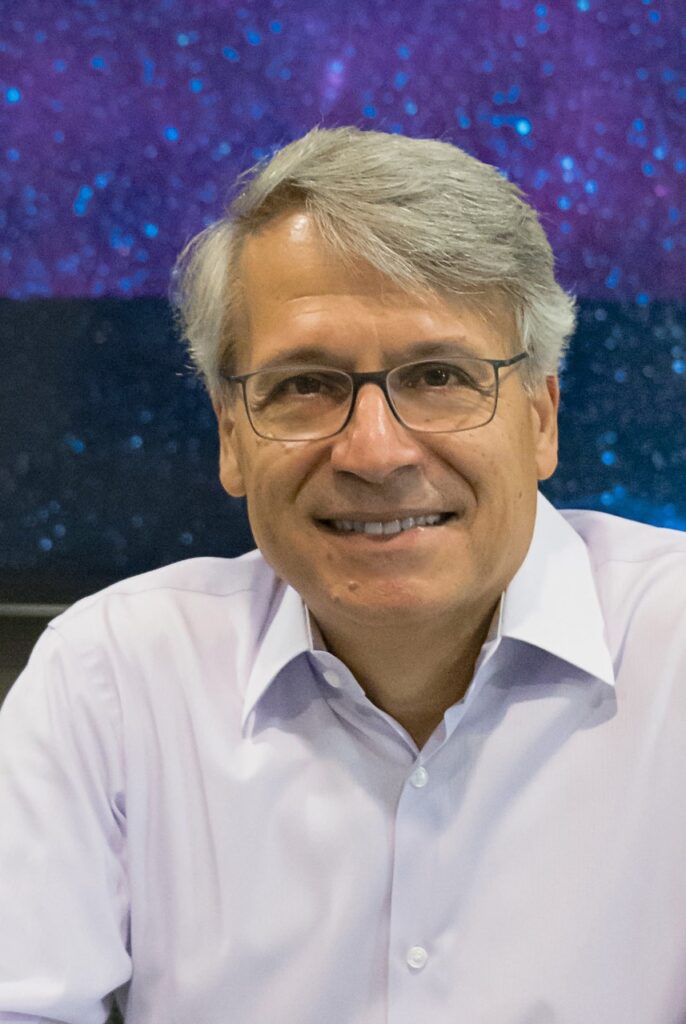
Photo Credits: George Helou
A passion before a plan
Like many astronomers, Helou’s fascination with the Universe began early. “I decided in high school that astronomy was what I wanted to study,” he recalled. At the time, the choice felt unconventional; people around him often treated it as more of an eccentric dream than a serious career path. When he entered university, however, Helou chose physics rather than astronomy. Physics, he explained, offered flexibility: it could lead to astrophysics, fundamental physics, or even engineering if circumstances required.
Receiving a scholarship to study astrophysics at Cornell opened the next door, but Helou emphasized that even during graduate school, he never assumed an academic career was guaranteed. “It was a series of opportunities, encounters, discoveries, and decisions that landed me here,” he said.
Following opportunities into the infrared
Helou’s eventual move into infrared astronomy emerged from what he calls “scientific opportunity.” “The passion for understanding the Universe is a constant,” he said. “But the channels through which you pursue that, your tools, your research areas, should remain flexible.” That opportunity arrived in the form of IRAS.
Launched in 1983, IRAS produced the first all-sky survey in the far infrared, revealing the Universe at wavelengths where astronomers had never before obtained such complete and detailed views. The mission’s impact extended far beyond Helou’s own work; IRAS ultimately transformed infrared astronomy into a major observational frontier and became foundational to the creation of the Infrared Processing and Analysis Center (IPAC). “There were so many discoveries waiting to be made.” That moment marked the beginning of a long relationship with infrared astronomy. IRAS was followed by ISO, then Spitzer, and a succession of increasingly capable facilities such as WISE, Herschel, Planck, and now Euclid and SPHEREx.
The questions that still keep him curious
After decades in infrared astronomy, Helou remains motivated by unanswered questions. One puzzle stands out above the rest: the appearance of massive galaxies and supermassive black holes surprisingly early in cosmic history. This challenge emerged from studies combining Hubble and Spitzer data and has become one of the defining questions now being pursued by the JWST. “How did these massive systems assemble so early?” he asked. “That is a puzzle we don’t know how to put together.”
At the same time, another long-standing theme continues to drive his work: star formation. Helou has spent much of his career studying how galaxies convert gas into stars, and why some undergo dramatic bursts of star formation. In contrast, others remain quiescent, and it is unclear what physical processes regulate those cycles. Although astronomers now have many pieces of the answer, he noted, there is still no complete predictive model of how galaxies evolve from initial conditions into the systems we observe today.
People build science
Beyond research, Helou has spent decades in leadership roles supporting major missions and scientific infrastructure. When asked what skills matter beyond doing good science, his answer focused less on management techniques and more on people. He described leadership as operating along two parallel tracks.
The first is technical and organizational: defining scientific goals, designing the systems that support them, and creating pathways that allow a community to turn ideas into discoveries. The second is human. “Humans do science,” he said. No matter how elegant the plans or infrastructure may be, success depends on understanding how teams function and how individuals contribute.
Advice to students: preserve the reason you started
Keep your options open. Try more things. Learn broadly, even subjects that seem unrelated. “You never know what nuclear physics concept may become important for astrophysics one day.”
But above all, Helou emphasized the importance of preserving something less tangible. “The most valuable thing I had at the time, and I encourage people to think about it this way, was the passion for understanding the Universe.” Skills matter, he said, but curiosity drives the development of those skills. He encouraged students not to become consumed by anxiety about whether they will ultimately secure an academic career. “What matters is the relationship we develop with the Universe and the excellence we pursue in our work.”
A plenary about the richness of the infrared Universe
For his AAS plenary lecture, Helou hopes to communicate not only infrared astronomy’s scientific achievements but also its sense of wonder. His talk will explore the extraordinary diversity of phenomena revealed at infrared wavelengths and trace the connections among four decades of infrared missions. He described infrared surveys as offering a startlingly different perspective on the sky, one that feels visually richer and reveals structures hidden at visible wavelengths.
Helou also plans to emphasize that breakthroughs do not happen in isolation. While JWST currently represents the frontier of infrared capability, he sees it as part of a broader ecosystem built through generations of missions born of individual creativity, community effort, and funding agency support. Those connections, he believes, are just as important as any single telescope.
To hear more about the Infrared Universe, tune in to George Helou’s Plenary Lecture at 11:40 AM PT on Wednesday, June 17th, at #AAS248!
Edited by: Niloofar Sharei
Featured Image Credit: AAS
