
This interview is part of Astrobites coverage of #BlackSpaceWeek presented by Black in Astro. Black in Astro is a grassroots organization that offers support and networking for Black people working in or studying astronomy and space-related fields across the globe. Black Space Week is a virtual conference that features panels, talks, art, giveaways, and various other virtual events to celebrate Blackness in astronomy and space science. For more information on Black Space Week and Black in Astro, please visit their website: https://www.blackinastro.com/.
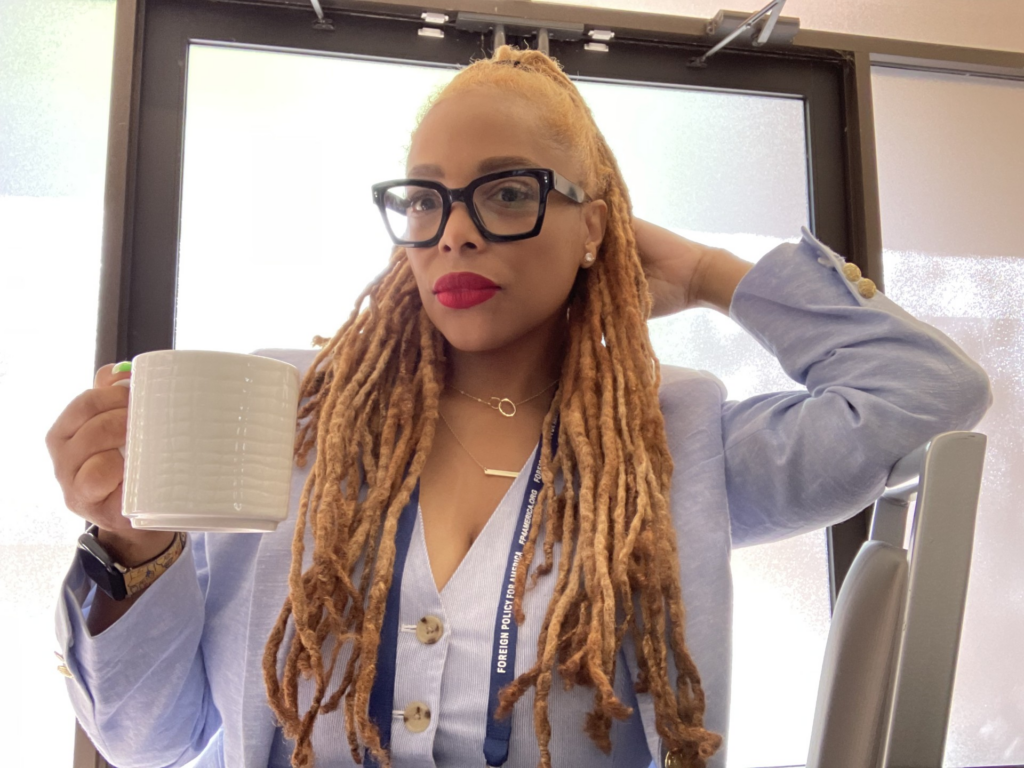
Today’s interviewee is Dr. Eboni (Nola) Haynes, an adjunct professor at Georgetown University is a political scientist, academic, policy-writer, and advocate. Her interests revolve around emerging threats and weapons in space, policy and intersectionality. Her journey started in New Orleans, Louisiana (NOLA, hence the nickname), and involves many pivots, which she emphasizes played a crucial role in shaping her path and career. Right from the beginning, she says that “I think that’s important for people to hear that pivots will come, life moments will come” and what is important is how do you respond to them.
Growing up in the South, space had always been a huge part of her life. She says, “one of the things that you get access to is a beautiful, clear, starry sky.” She also recalls her early exposure to STEM through various programs that her father enrolled her in on a college campus. Describing herself as a hardcore trekkie, she also mentions that she often sees the world through a Star Trek lens.
After her parents separated, she moved to Los Angeles with her mother, and started working in beauty pageants and acting to support and contribute to the household. However, her life really started to take a different shape once she decided to go back to school at Los Angeles Valley College. Starting out with a love for geology, she even presented her work at a conference. However, another pivotal moment in her life was when she took a political science class. Reminiscing that moment, she says, “I just kind of left geology behind. I still love rocks. If I ever get the chance to go to Mars, I’m sure that will come in handy, but political science just captivated me.”
Finishing her undergrad at UCLA, she moved to Boston for her Masters at the Harvard Divinity School. She initially started out with interests in race, politics, class and religion in the context of New Orleans, since that’s the world that she grew up in. She was also studying Arabic at that time, and recalls an incident that led to changing her perspective. After the Boston marathon bombings in 2013, and amidst conversations surrounding terrorism and identity at the divinity school, she recalls, “I’m standing at the bus stop one day with a big Arabic textbook in my hand, and this man comes up to me and spits on me.” Although she knew what it was like for her as a black woman, that experience, among others, helped shift her perspective to a more international level and brought her attention to how identity shows up in global structures. While at the divinity school, she started pivoting towards international relations and security studies, and remarked that her work will always have an ethical component to it, especially based on her past experiences.
Eventually, she started her PhD in political science and international relations at the University of Southern California. Her work in terrorism and identity naturally moved her towards the topic of arms controls, which became the bulk of her PhD research, and what eventually landed her into discourse around space. She highlights the critical role of her mentors in that journey. “I have incredible women mentors,” referring to Bonnie Jenkins, the first Black Undersecretary of Arms Control and International Security, and Michelle Flournoy, who helped her find her path in policy around space.
Much of Dr. Haynes work revolves around the crucial topic of arms control in space. Although there are existing treaties and agreements that loosely govern the use of weapons in space, they are often ineffective. She highlights, “We’re seeing so much chaos, and arms control might be important, especially in space, an environment that is naturally anarchic.” She emphasizes that “Space is for all of us.” Together with her colleague Amber McIntyre, she came up with “Beyond STEM”, which advocates for an entire workforce to be trained to go to space. “This is an all-hands-on-deck type of situation. Yes, we need physicists, we need all the tech and STEM people, but we also need policy people, we need lawyers. We’re talking about people living in space, you need all the things! So we need to start building that infrastructure for that.”
Dr. Haynes also highlights the contradictions in space currently, and how multiple things can be true at once. Speaking of the success of the Artemis mission, she mentions its diverse crew, with the first woman, first black pilot, and the first Canadian to orbit the moon. Despite all the successes of the mission, she also mentions how it is particularly concerning that NASA’s budget was being slashed at the same time as everyone celebrated the many successes of the Artemis mission.
Finding Community and Advice
When I asked Dr Haynes for advice and about the importance of community in her life, she mentions that there will be challenges down any road that one may take, especially as a woman and person of a colour. It is in these hard moments where community comes in, and can play a significant role. She emphasizes that the academic journey can sometimes be isolating, and said “You need a community, and it doesn’t necessarily have to be your academic community. You need a community where you can go and refuel. You need a community where you can go and you won’t be judged. You need a community that will nourish you throughout the journey, because you will feel depleted.”
Her advice for the younger generation is to “Be you” and not to try and fit into a particular mold. She emphasizes that it is important to show up as yourself, as your perspective will help you stand out. Speaking about her experiences, she mentions being chastised for being too glamorous and intellectual. She says, “I will never satisfy anyone. That is why you need to show up as your authentic self. It’s that interest, that childlike interest that has you in space in the first place. Hold on to that.”
Dr Nola Haynes says that through her work and advocacy, both in academic and media circles, she wants to build a platform through which she can talk to young girls that looked like her growing up, who may not even consider space to be an area of opportunity. She wants them to see her, with her nails, lipstick, and energy, and get to inspire them, while showing that they do not need to sacrifice parts of themselves for whatever they may want to pursue.
Edited by Nathalie Korhonen Cuestas
Featured image credit Dr. Nola Haynes
